

Its people represent more than a sixth of the world’s population, but in key science and technology areas and even in factories that employ unskilled workers, it faces a labor shortage.
Its current economic strength relies in part on factors and strategies that it will need to remake—if not scuttle entirely—to achieve its future performance targets. And while the government’s policies still play to the interests of state-owned enterprises, private industry and entrepreneurs are increasingly taking the lead in meeting the objectives outlined in successive five-year plans.
As innovation moves to take precedence over the more traditional value of stability, China’s science and technology community finds itself living in interesting times.
Pursuing energy imperatives
Within the materials science sector, research and development responds to a mix of demands to promote growth and adhere to government policy. To achieve a more technology-driven economy, China’s policymakers identified seven strategic emerging industries. The list includes energy efficient and environmental technologies; next-generation information technology; biotechnology; high-end equipment manufacturing; new energy; new materials; and new-energy vehicles.
“Therefore, energy materials, environmental material, advanced structural materials, and functional materials are of the first priority in China’s next development in materials science engineering,” says professor Fei Chen of Wuhan University of Technology in an interview.
For Chen and his colleagues, those needs translate to an expectation that their work will promote innovation that conforms to government policy and national priorities. “Our research focus is on new energy, such as composite solid electrolyte and all-solid-state lithium-ion batteries; grid-scale energy storage systems, such as liquid metal batteries; and additive manufacturing,” he says.

Fei Chen and his students at Wuhan University of Technology study new energy technologies to promote innovation that agrees with government policy and national priorities. Credit Fei Chen
China’s government established ambitious performance standards in these areas. For example, “By the year 2030, 40 percent of automobiles in China will be new energy automobiles,” Chen says. And that, in tandem with the government roadmap for energy saving, foreshadows rapid growth in the lithium-ion battery market in the coming decades.
Chen is concerned with resolving the safety concerns and energy density constraints that prevent current battery technology from meeting these demands. He is collaborating with local industry to create next-generation safe, high-energy, high-density solid-state battery applications for new energy vehicles.
“One of our areas of research in new energy focuses on composite solid electrolyte and all-solid-state lithium-ion batteries. Currently, the research group is implementing pilot production of solid electrolytes in all-solid-state batteries, collaborating with Smoothway Inc. in Shuhai City, Guangdong Province,” he says. “That is my work, and I think it is in agreement with China’s development policy.”
Economy and environment
Changes in global expectations and standards are also having an impact on industrial fortunes in China. The abrasives sector is a case in point.
Rex Hadley, sales director for the Americas at Abrasives.com, notes that as North American and European countries impose limits on production and enact new environmental regulations, those controls “make it either not possible or simply very expensive to extract, process, and produce these abrasives.”
“Companies end up not doing it or have to sell at a high price. Whereas in China, let’s say some of these restrictions are a bit more lax,” he adds.
However, Hadley sees China’s abrasives producers’ market advantage diminishing. “The Chinese government has been increasing their regulations on environmental impact,” he says. “Prices have been going up directly as a result of that.”
The company’s CEO, Dever Yang, envisioned the website as a kind of Alibaba that serves the abrasives industry exclusively. A trader whose focus has always been export markets, he parlayed his relationships with producers in China to create the site, which charges suppliers a membership fee.
“A lot of producers in China don’t have access to the foreign markets and customers,” Hadley says. And because margins are fairly low and the industry relies on volume business, they see advantages to having a presence on a sector-specific site. Amid growing global consciousness of environmental concerns, this approach may be part of a strategy for maintaining China’s competitive edge and price-to-quality ratio in abrasives.
Old school vs. new markets
Other industries are also navigating a balancing act between markets with competing or conflicting priorities regarding energy savings and environmental concerns.
Weifang Renhe Special Ceramics Co., Ltd. makes silicon carbide products for customers in Asia, Africa, the Middle East, Europe, and North America. Xu Han, manager of the foreign trade department, estimates that “95 percent of the kilns in the world are using reaction bonded silicon carbide. There are some higher-temperature ones for special ceramics, using nitro bonded. Some are with crystallized SiC, some are sintered SiC. Some countries, such as India or Pakistan, are still using the regular SiC or the older material, which is much cheaper. But those countries really don’t care about energy saving.”
The company must maintain its work with those materials because it commands an estimated 70% of the existing market in India. As in China, that market is set for substantial expansion. “New factories are building nonstop, and the technologies in China and India are behind,” Han says. “So, more technologies need to be developed and new materials need to be developed in order to save energy, save labor, cut costs. We’re trying to catch up with the factories in the U.S., Germany, Italy, Poland, to see what they’re doing so we can bring it back to China or bring it to India.”
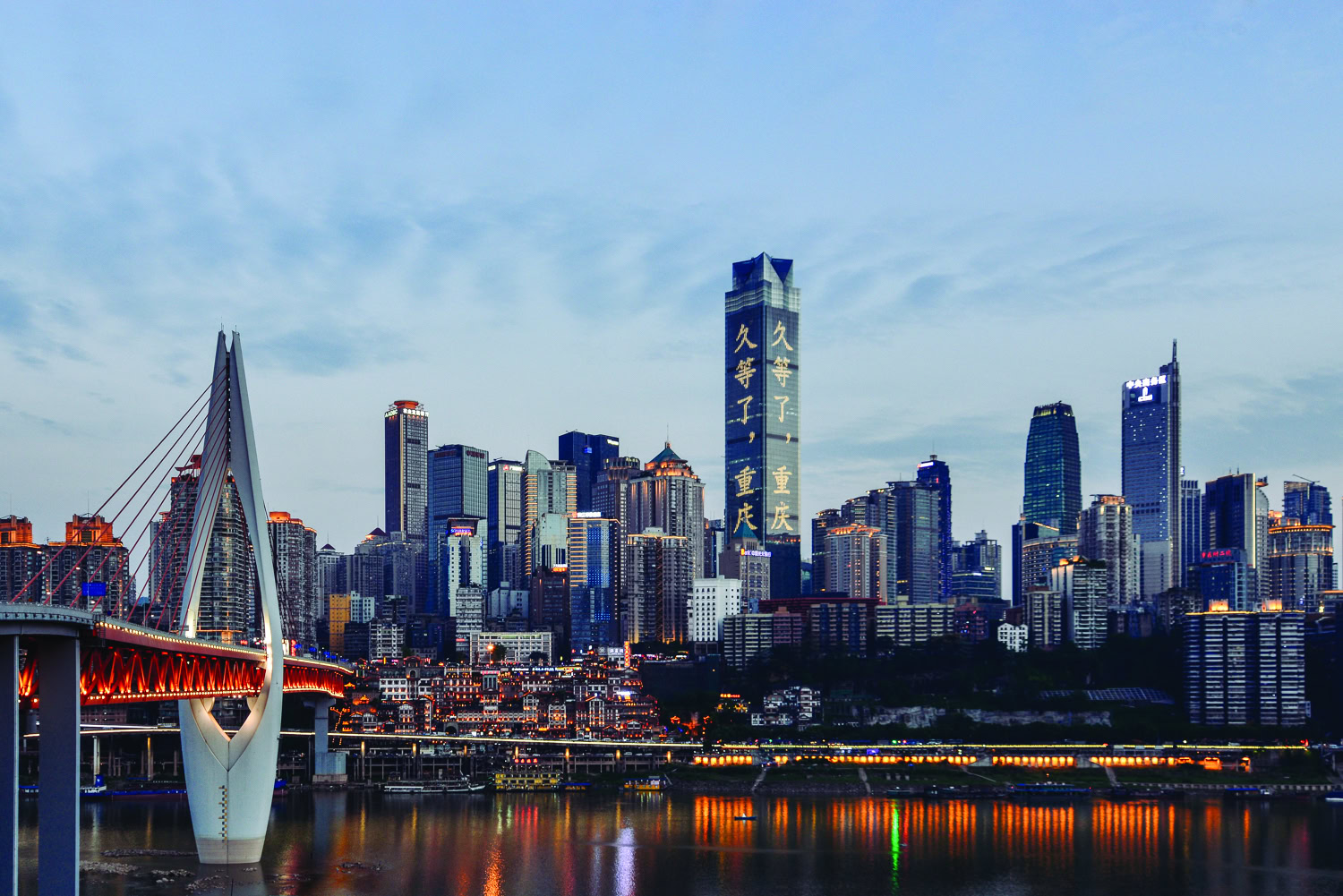
A view of Chongqing Central Business District from across Jialing River. Chongqing is the fastest-growing city in the world, in part because the Chongqing government was among the first local governments to encourage entrepreneurship. Credit Juukeihc, Wikimedia (CC BY-SA 3.0)
Weifang Renhe Special Ceramics has seen demand increase “significantly” in the past five to 10 years, but “even where you have strong demand, you don’t depend on that to continue indefinitely,” Han notes. “For silicon carbide, after five years the price will drop, because more factories for silicon carbide are coming right now in China. One material or technology can be used for maybe 10 years, but after 10 years, if you don’t come up with a new thing, other people may find something else to replace you.”
Among the recent developments in China are form ceramic wall panels—light, environmentally-friendly alternatives to traditional building materials like bricks. “It’s old technology, but it’s been super popular in China for the past one or two years, because the Chinese government is paying factories a lot of money to develop this technology,” Han says.
Those factories’ kilns use silicon carbide, and the company is working with two of the three biggest factories in the sector. “Everything is new,” he says. “The kiln is new. The technology is new. The shape of the silicon carbide product we also had to develop, we had to do R&D with the customer. We had to work together to find out the size of the material, the lens, the thickness, the shape—everything is brand new. So, there’s lot of new technology and lots of new developments.”
Weifang Renhe Special Ceramics participates in Ceramics Expo and exhibitions in Germany and Italy each year to stay abreast of emerging trends and technologies. Among its current interests is sintered silicon carbide. “For our company, this is definitely a new technology that we need to experience more with other companies, lab services, to develop the thickness, the shape, for our customer,” Han says. “Another technology we want to develop for our company is nitro bonded silicon carbide. That’s the next technology we need to go into.”

Locations of Chinese Academy of Sciences Institutes throughout China. Credit Chinese Academy of Sciences
The labor conundrum
Ambitions at this scale require an extensive workforce of skilled and unskilled labor, and China faces unusual challenges in that regard.
Because it is sometimes playing technological catch-up, the country has relied on visiting scholars and “strategic scientists” to work at its universities and institutes to train the next generation of STEM professionals. Based on his experiences at his university, Chen regards having foreign researchers teach students a positive move. He believes scientific research “should have no border” and that regardless of political tensions between countries, “in scientific research, we need to do more collaborative work” on behalf of “a community of shared future for mankind, not only the community of China.”
His team has collaborated on additive manufacturing projects with professor Enrique J. Lavernia of the University of California, Irvine, who is a member of the U.S. National Academy of Engineering. Another collaboration partner is professor Takashi Goto of Tohoku University in Japan, who has worked with Chen’s team on projects related to advanced thin films and coating technology using chemical vapor deposition (CVD) or physical vapor deposition (PVD) methods.
This cross-border teamwork may encourage not only innovation but also a more capitalist mindset. Chen is conscious of his work’s being “in agreement with China’s development policy,” and Han sees opportunity in kilns used in government-subsidized factories. But a new generation of students is finding motivation in the pursuit of personal wealth. The push to pursue entrepreneurialism is a decided shift from old university standards that regarded their volumes of published paper output as the greatest measure of performance.
Today, “most of our students have greater interest in research that is viable commercially,” Chen says. But he does not see the current science and engineering curriculum, education, and training fulfilling the development needs that will evolve in the coming decades, either domestically or globally. He advocates educational reform to resolve that challenge.
Individualism is also rising among students who want to “do something they are interested in,” Chen says. “They would like to maybe start up their own business after they graduate. The number is still very small, but it grows. And the Chinese government encourages them to do more startup companies and try to use their knowledge to open their own business. I think the number will increase gradually.” But if those startups flourish and more graduates are drawn to commercial ventures, the country will remain reliant on foreign STEM professors to train succeeding generations of students.
Meanwhile, factories face their own challenges in attracting and retaining employees. Han estimates that his company’s workforce averages about 45 years in age. Younger people, including new graduates, want to live and work in cities, and factories for the most part are located just outside those urban areas. And that is driving salaries upward for “basic labor” as well as engineers and other skilled professionals—a class of employees who are paid “a lot more to keep them in the factory so they don’t go to other companies with our technology.”
Strength in numbers
And so it goes in China as the country seeks its equilibrium between stability and startup potential. In that, size may be its greatest asset. Unlike smaller countries that are forced to jettison fading industries or technologies as they are replaced with newer advances, China can afford to pursue technology advances without abandoning customers who still require less-developed solutions.
Those solutions may not represent the country’s future, but they still generate a respectable contribution to its export volume and GDP. And they do not stand in the way of innovation—witness the hundreds of entrepreneurial ventures that have emerged from research at the Chinese Academy of Sciences (see sidebar). Since last year, that organization and its affiliated institutes have announced such breakthroughs as:
- Fabrication of fine-grained pure Y2O3 transparent ceramic with improved mechanical and thermal performance, by a research team led by professor Zhang Long of the Key Laboratory of Materials for High Power Lasers at Shanghai Institute of Optics and Fine Mechanics. Long also led a research team that successfully fabricated a high transmittance yttrium aluminum garnet (YAG) planar waveguide (PWG) composite structure without pores on the bonding interface by two-step sintering process.
- A new composite material that is highly effective in cleaning water contaminated by organics, developed by a team led by Huang Fuqiang, chief researcher at the Shanghai Institute.
- A new ceramic aerogel that can be used in thermal insulation developed by a team of researchers from China and the U.S., that has strong mechanical and thermal stability, and scores well in transformation and toughness.
- Fabrication of a Cu2Se/Yb0.3Co4Sb12 thermoelectric module with eight n-type Ni/Ti/Yb0.3Co4Sb12 legs and eight p-type Ni/Mo/Cu2Se legs that achieved a high energy conversion efficiency of 9.1% and excellent service stability. Scientists from the Shanghai Institute of Ceramics and Northwestern University based the advance on high-performance liquid-like materials.
- Completion of the world’s first ceramic manufacturing experiment under microgravity by scientists at the Technology and Engineering Center for Space Utilization. The team used digital light processing technology, an additive manufacturing technique that is already in widespread use but was not thought to work in microgravity. The experiment was conducted aboard a European parabolic flight aircraft in Switzerland, and the team also tested a metal casting technique using 3D printed ceramic molds.
China continues to court exchanges with scientists and researchers from other countries as well as partners in commercial ventures and foreign trade. Its sheer size promises opportunity in a market that is still a long way from realizing its full expansion potential.
Read more: “The Chinese Academy of Sciences“
Read more: “Market Snapshot: Globalization giant“
Read more: “Directory of Chinese companies, institutes, universities, and publications“
Capsule summary
New values
To achieve a more technology-driven economy, China’s policymakers identified seven strategic emerging industries that place innovation over stability. This expectation shapes both industry and academic research pursuits.
Balancing expectations
Global markets with competing or conflicting priorities regarding energy savings and environmental concerns challenge China’s competitive edge. Cross-border teamwork may encourage innovation, but it also stimulates a more capitalist mindset.
The greatest asset
As China seeks equilibrium between stability and startup potential, size may be its greatest asset. China can afford to pursue technology advances without abandoning customers who still require less-developed solutions.

Related Articles

Market Insights
Engineered ceramics support the past, present, and future of aerospace ambitions
Engineered ceramics play key roles in aerospace applications, from structural components to protective coatings that can withstand the high-temperature, reactive environments. Perhaps the earliest success of ceramics in aerospace applications was the use of yttria-stabilized zirconia (YSZ) as thermal barrier coatings (TBCs) on nickel-based superalloys for turbine engine applications. These…

Market Insights
Aerospace ceramics: Global markets to 2029
The global market for aerospace ceramics was valued at $5.3 billion in 2023 and is expected to grow at a compound annual growth rate (CAGR) of 8.0% to reach $8.2 billion by the end of 2029. According to the International Energy Agency, the aviation industry was responsible for 2.5% of…

Market Insights
Innovations in access and technology secure clean water around the world
Food, water, and shelter—the basic necessities of life—are scarce for millions of people around the world. Yet even when these resources are technically obtainable, they may not be available in a format that supports healthy living. Approximately 115 million people worldwide depend on untreated surface water for their daily needs,…