
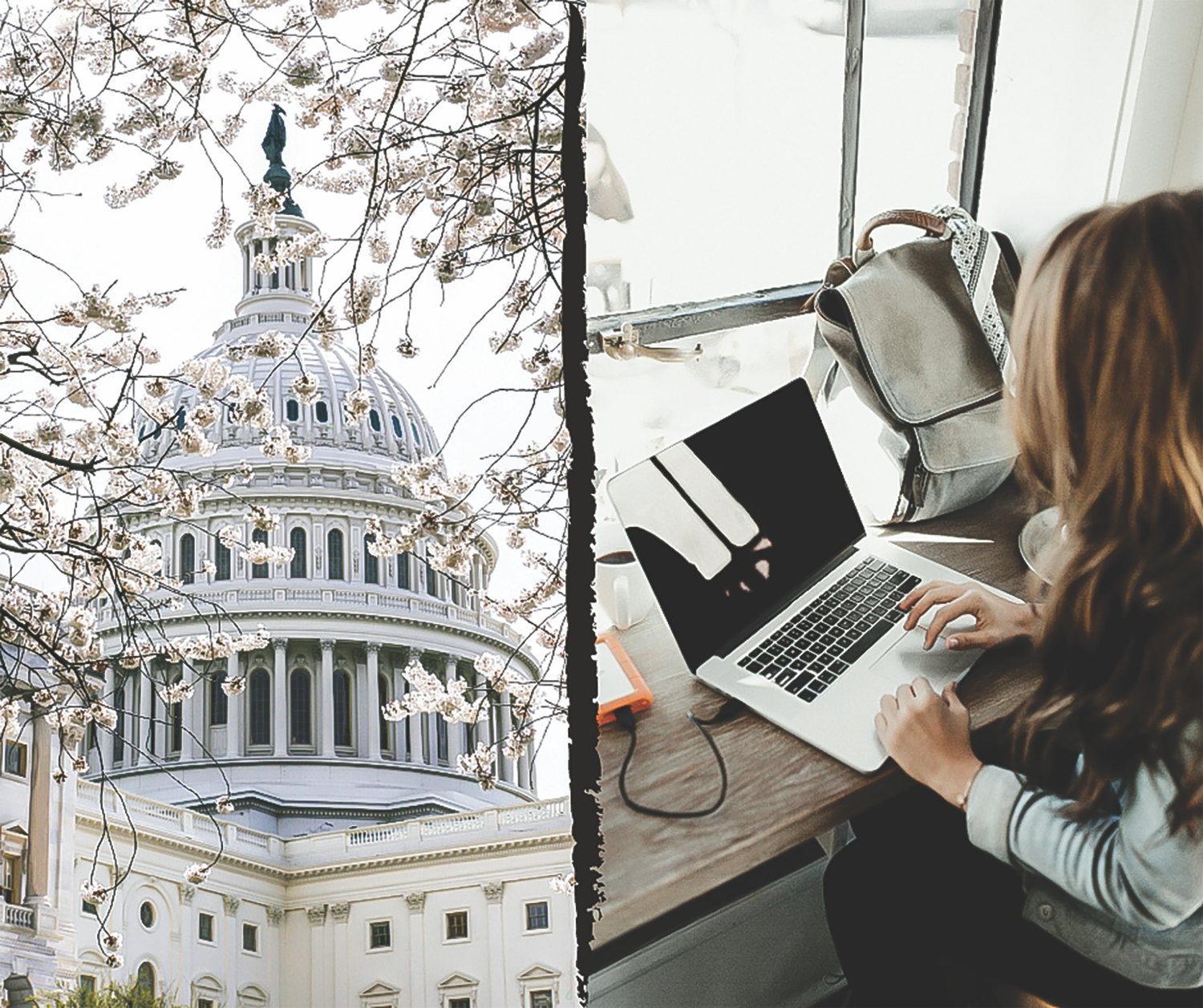
The Material Advantage Student Program’s Virtual Congressional Visits Day (CVD) was held this year from April 20–22, 2021. The CVD is an annual event that gives students an opportunity to visit Washington, D.C., to educate congressional decision makers about the importance of funding for basic science, engineering, and technology. While we were not able to physically be in D.C. this year, we did offer a virtual CVD program for Material Advantage students. The CVD experience began with a virtual welcome event on April 20, featuring talks by
- Alex Martin, 2019–2020 TMS/MRS Congressional Science & Engineering Fellow
- Matthew Hourihan, American Association for the Advancement of Science
- Megan Malara, 2020–2021 TMS/MRS Congressional Science & Engineering Fellow
After the talks concluded, the students were provided with a chance to go into break-out rooms to further organize their teams and to do some role-play in advance of their appointments in the following days.
This year’s student attendees worked hard to schedule congressional visits with legislators and staffers for April 21 and 22. Despite their hard work, it proved to be a difficult task to schedule congressional visits due to a variety of factors outside of attendees’ control.
On the evening of April 22, the Washington, D.C. Chapter of ASM International and the Washington, D.C./Maryland/Northern Virginia Section of The American Ceramic Society cohosted an event, which gave the students an opportunity to network with local professionals in the D.C. area.
Additionally, the Washington, D.C. Chapter of ASM arranged for a speaker from the Defense Advanced Research Projects Agency, who presented a talk on Advances in Personal Protection (PPE) Strategies and Technologies. The Material Advantage CVD event was attended virtually this year with a total of 27 students and faculty from the following universities:
- Boise State University
- California State Polytechnic University, Pomona
- Iowa State University
- Michigan Technological University
- Missouri University of Science and Technology
- Purdue University
- San Jose State University
- University of Tennessee, Knoxville
- University of Maryland
- College Park University of Michigan
- University of Minnesota, Twin Cities
Continued thanks to David Bahr, head and professor of materials engineering at Purdue University, and Iver Anderson, senior metallurgist at Ames Laboratory and adjunct professor in the materials science and engineering department at Iowa State University, for conducting the training on how to visit with legislators and for their assistance over the years in helping to coordinate CVD. Bahr and Anderson both serve on the Material Advantage Committee, the advisory committee that provides recommendations and feedback about the program to the four partnering organization’s leadership.
An additional thank you to Stephen Kampe, chair and professor of materials science and engineering at Michigan Technological University, for helping to cohost the virtual CVD welcome event this year.
We hope to be back in-person in D.C. again for the 2022 CVD event. If you are a student and did not get a chance to participate this year, make sure that you plan to register EARLY for the 2022 CVD event. Or if you are a professor/faculty advisor, make sure to plan on gathering a group together from your university.
For future updates, visit the Material Advantage website at www.materialadvantage.org. It is an opportunity that you will not want to miss!
Return to main article: “Student perspectives 2021“


Related Articles

Market Insights
Engineered ceramics support the past, present, and future of aerospace ambitions
Engineered ceramics play key roles in aerospace applications, from structural components to protective coatings that can withstand the high-temperature, reactive environments. Perhaps the earliest success of ceramics in aerospace applications was the use of yttria-stabilized zirconia (YSZ) as thermal barrier coatings (TBCs) on nickel-based superalloys for turbine engine applications. These…

Market Insights
Aerospace ceramics: Global markets to 2029
The global market for aerospace ceramics was valued at $5.3 billion in 2023 and is expected to grow at a compound annual growth rate (CAGR) of 8.0% to reach $8.2 billion by the end of 2029. According to the International Energy Agency, the aviation industry was responsible for 2.5% of…

Market Insights
Innovations in access and technology secure clean water around the world
Food, water, and shelter—the basic necessities of life—are scarce for millions of people around the world. Yet even when these resources are technically obtainable, they may not be available in a format that supports healthy living. Approximately 115 million people worldwide depend on untreated surface water for their daily needs,…