
The National Science Foundation’s Faculty Early Career Development (CAREER) program supports junior faculty who exemplify the role of teachers–scholars by performing and integrating excellent research and education. I started writing this series of articles about the NSF CAREER awardees in 2009.1–7 Why? To give these young professors and their work greater visibility in the broad ceramics and glass community and to encourage academic careers of ceramic researchers and educators. We need to advance fundamental research in ceramics and glass while educating the next generation. Therefore, I am honored to introduce you to the five 2016 CAREER awardees from the Ceramics Program of the Division of Materials Research at NSF.
Award 155409—Mechanism for controlling ionic valences in transition-metal-doped laser materials
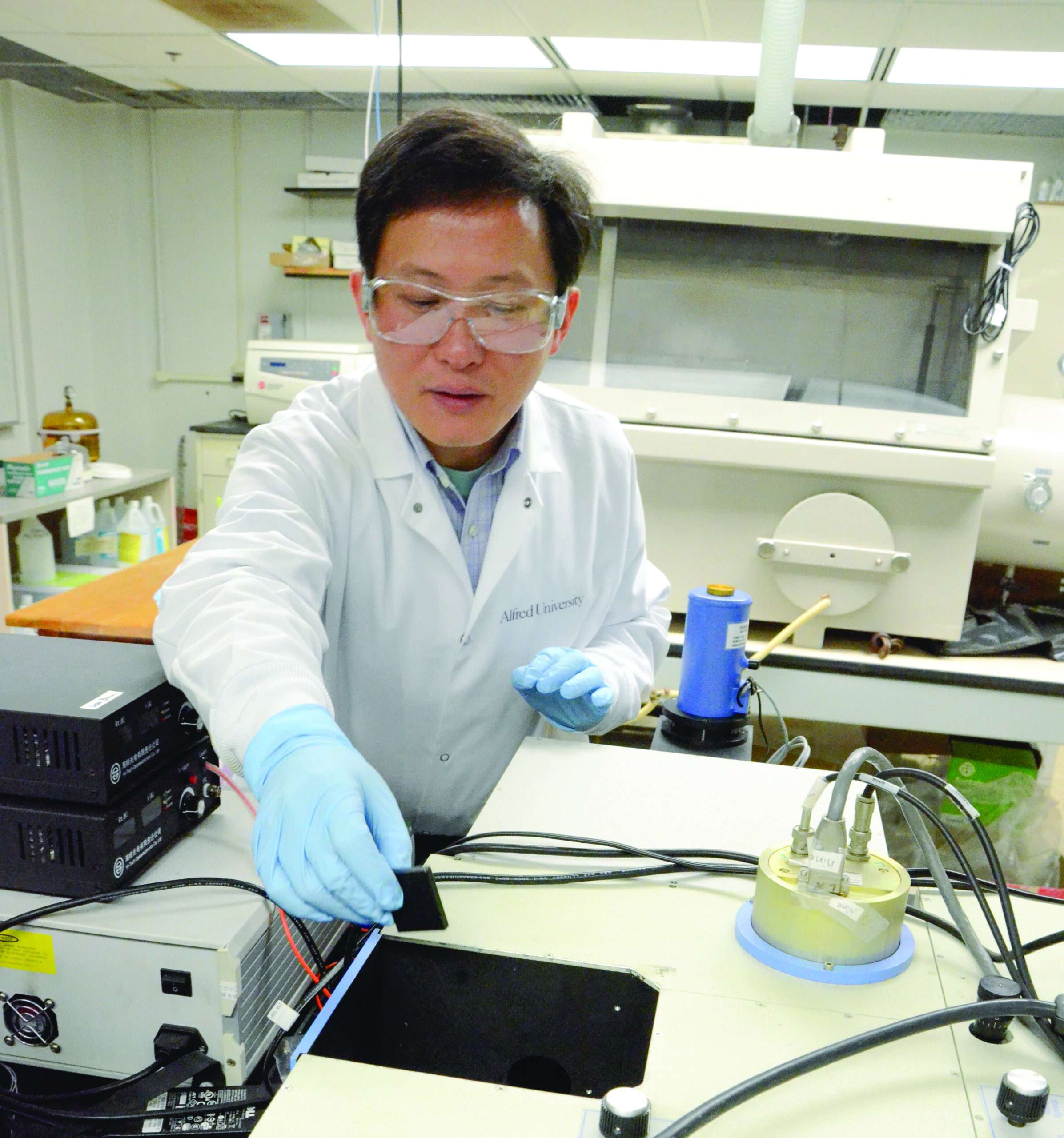
Yiquan Wu in his laboratory at Alfred University. Credit: Alfred University
SCIENCE: Yiquan Wu at Alfred University (Alfred, N.Y.) is working to understand formation, stability, and manipulation of defects in optoelectronic materials. His research may open new avenues for utilizing dopants to design and synthesize optical and photonic materials with new functionalities. Wu will address the fundamental materials science questions associated with using off-valence ion substitution to control the valency of dopant ions in laser and optoelectronic materials by developing a thorough understanding of the formation, stability, and manipulation of cation defects and ionic valencies in select materials. His research will examine mechanisms for tuning valencies of dopant ions by controlling local oxidizing or reducing environments, which can generate various electronic and coordination structures and control behavior of optically active ion centers in materials. Wu will apply simulation methods to model dopants and dopant combinations to predict possible spectroscopic properties.
TECHNOLOGY: The research has potential impacts on a wide range of important applications, including laser machining and manufacturing, laser-sparked fusion energy, laser communications, high-energy particle and radiation detection, and medical imaging. This line of research is extremely important to effectively synthesize high-quality laser materials with tailored properties. The work brings about unique opportunities to design new optical materials for applications in next-generation devices, such as ceramic lasers and scintillation detectors.
ENGAGEMENT: Wu’s group has developed an educational exchange program called “Collaborative Exchange Research and Materials in Ceramic Sciences” (CERAMICS) to help students gain research experience abroad, primarily in Asian countries. This experience provides a more global view of research approaches and activities and is jointly funded by NSF’s Office of International Science and Engineering.
Award 1553607—Controlling carbonation degradation in sustainable cements by stabilizing amorphous calcium carbonate
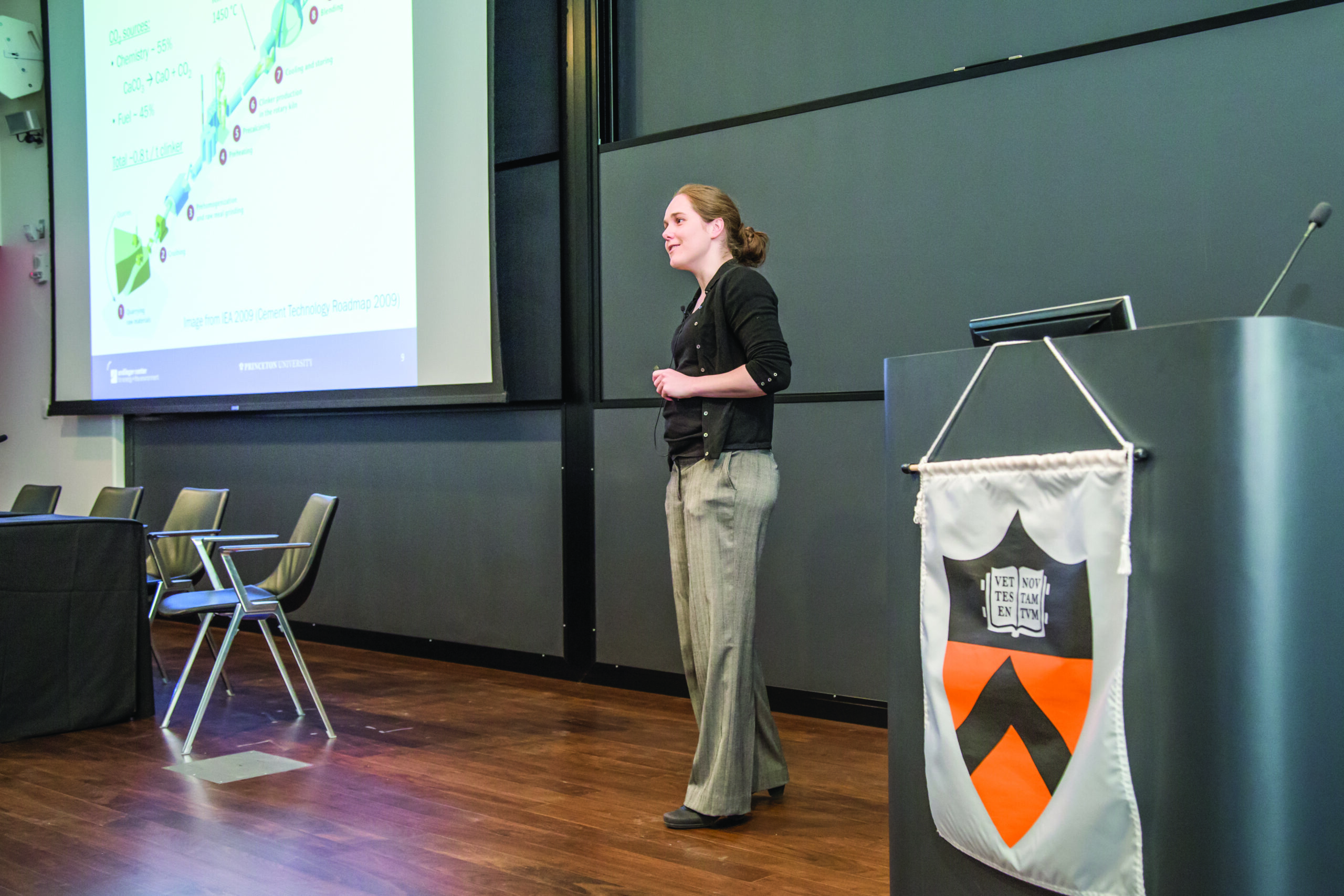
Claire White presents her research on low-CO2 cements at the Andlinger Center for Energy and the Environment Building Opening Celebration and Symposium, Princeton University in May 2016. Credit: David Kelly Crow; Office of Engineering Communications, Princeton University
SCIENCE: Claire White at Princeton University (Princeton, N.J.) is investigating chemical reactions occurring during degradation of alkali-activated materials (AAMs) under exposure to atmospheric carbon dioxide, which plagues Portland cement and new cementitious materials. White is exploring the ability to arrest degradation reactions by exploiting the stabilizing effect of magnesium on carbonate-based reaction products (amorphous calcium carbonate). This project will provide a deep understanding of complex phase formation processes that occur during carbonation-induced degradation of slag-based AAM pastes. Key objectives include obtaining a fundamental understanding of the role of magnesium in stabilizing precipitated amorphous carbonate and determining the short- and long-term stability of disordered phases, including calcium (sodium) aluminosilicate hydrate gel and amorphous carbonates. White’s studies will use a suite of state-of-the-art experimental techniques, including micrometer-resolved atomic structural information obtained using X-ray pair distribution function analysis combined with microtomography, nanoscale elemental mapping using nanofluorescence, X-ray diffractometry, infrared spectroscopy, thermal analysis, and synchrotron X-ray absorption fine structure.
SUSTAINABILITY: Portland cement manufacturing accounts for 5%–8% of global anthropogenic carbon dioxide emissions. With concrete use set to double during the next few decades, there is a pressing need for sustainable concrete alternatives. AAMs, a class of cement whose manufacture emits less carbon dioxide than Portland cement, comprise one such alternative. However, long-term durability of AAMs must be understood and optimized prior to their use in the construction industry. This research will develop highly carbonation-resistant slag-based AAMs with potential to supplant existing cement technologies. These materials can lead to new sustainable products for the construction industry with significantly reduced associated carbon dioxide emissions.
EDUCATION: This project will help train the next generation of scientists in cutting-edge research. Also, White will promote and encourage underrepresented minorities and women in science, technology, engineering, and mathematics (STEM) through outreach components centered on the new applied science and engineering curriculum that is being instituted in high schools in New Jersey.
Award 1554315—Structure–property relationships in bifunctional battery materials
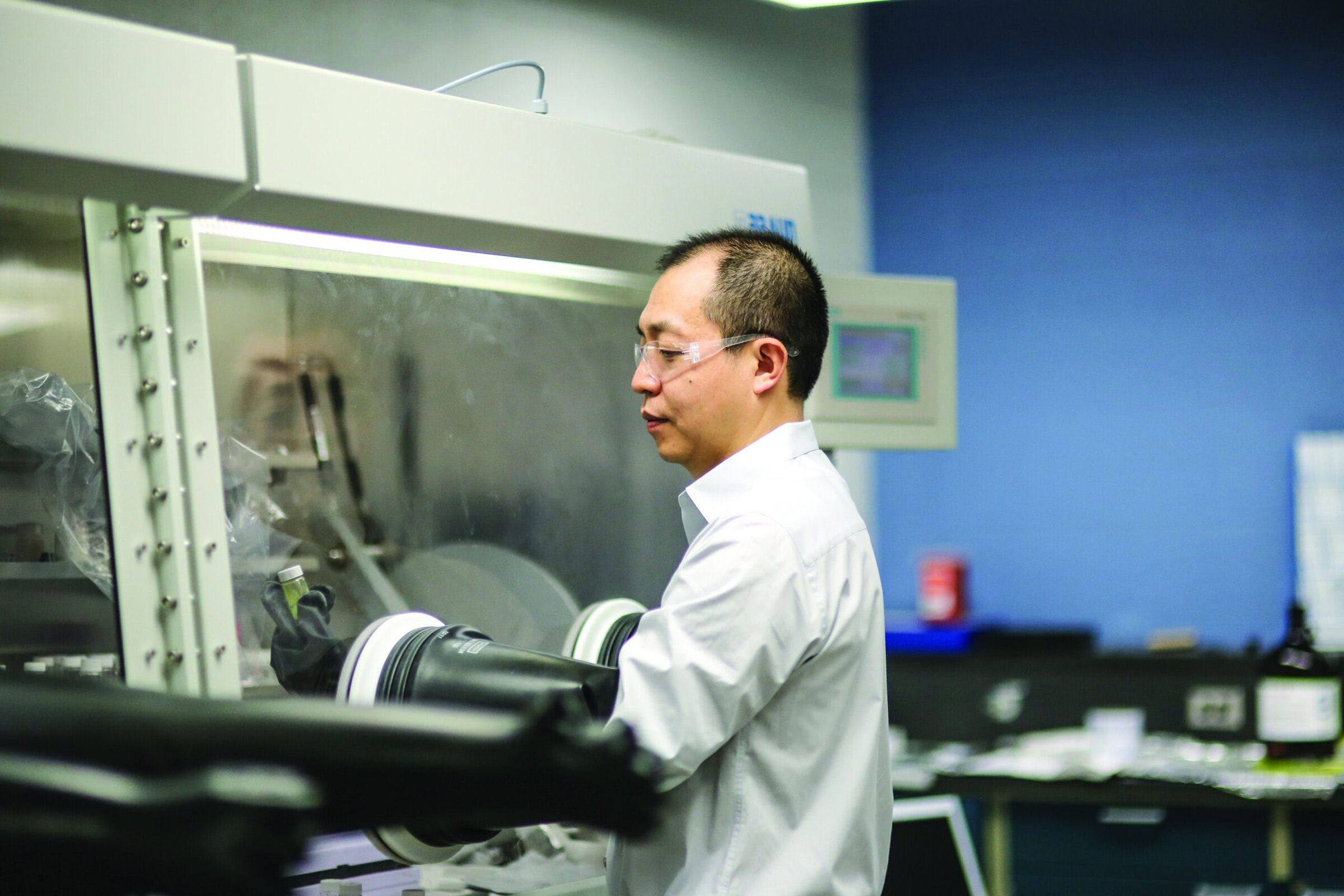
Wei Lai handles bi-functional sodium electrode materials in a glovebox at his laboratory at Michigan State University. Credit: Cara Lian
SCIENCE: Wei Lai at Michigan State University (Lansing, Mich.) studies structure–property relationships of a unique family of bifunctional sodium electrode materials to shed light on fundamental mechanisms that could enhance materials performance and inspire rational design and discovery of new materials. Sodium nickel titanates are a unique family of materials that can function either as anode or cathode because of coexistence of high- and low-redox-potential transition metals. However, the structure–property relationship of these materials remains elusive. Lai’s research seeks to understand atomic and electronic structures and their effects on ionic and electronic conductivity of model materials in the sodium nickel titanate family. Through an integrated experimental and computational approach—combining neutron/X-ray scattering probes, atomistic simulation, and electrical property measurement—Lai’s studies will examine local distribution, migration pathways, and ionic conductivity of sodium atoms as well as local electron distribution and its effect on electronic conductivity. This work has an immediate impact on this family of technologically important and scientifically intriguing materials and contributes to understanding structure–property relationships in general mixed ionic-electronic conductors, thus leading to rational design and discovery of new materials with superior performance.
SUSTAINABILITY: Although lithium-ion batteries are predominant power sources for portable electronics, their large-scale applications in the transportation and stationary markets may be hindered by lithium availability. Sodium is 1,000 times more abundant than lithium and is available domestically and internationally. Therefore, development of sodium-based battery chemistry may be essential to ensure a sustainable energy future.
ENGAGEMENT: Part of this grant supports a museum exhibition—“Batteries: Powering the past, present, and future”—to raise awareness and inspire public interest in the science and engineering principles of battery devices used today.
Award 1553519—Engineering structure and ionic conductivity in Li7La3Zr2O12 nanowire-based solid electrolytes
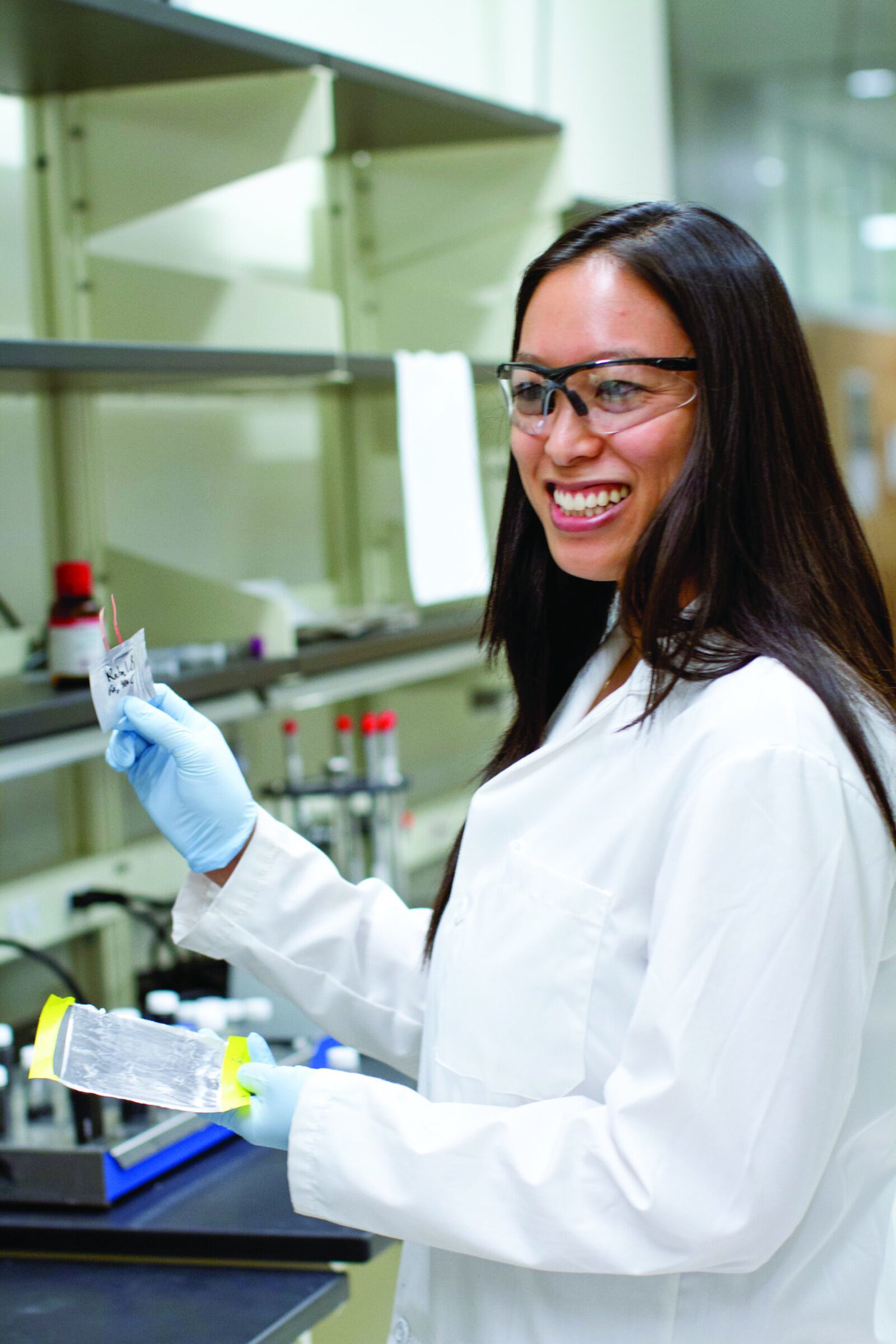
Candace Chan holds lithium-ion battery pouch cells containing advanced nanostructured materials developed in her research group at Arizona State University. Credit: Jessica Hochreiter
SCIENCE: Candace Chan at Arizona State University (Tempe, Ariz.) explores a promising safe electrolyte candidate, lithium lanthanum zirconate (LLZO). This material has good thermal and chemical stability and ionic transport properties. Therefore, novel LLZO nanowire structures and composites with unique nanoscale properties have potential to improve conductivity of lithium ions and integrate them into safer, all-solid-state batteries. Chan uses nanowires to understand LLZO phase stability, crystallization, and sintering processes, using core–shell nanowire structures to investigate interfacial properties and transport in composites and understand how to maximize highly conducting pathways for lithium ions and uniformly modify grain boundaries. Chan is using in situ and aberration-corrected transmission electron microscopy characterization to correlate ionic conductivity and electrochemical cycling tests on nanowire solid electrolyte materials and compare them with bulk materials. Insights gained from this work will enable better control of composition, stabilization of metastable phases, sintering processes, and lithium-ion transport, which can ultimately lead to ceramic electrolytes with higher ionic conductivity.
TECHNOLOGY: Lithium-ion batteries are ubiquitous in laptops and cell phones and may gain more use in transportation applications. However, these batteries suffer from safety issues originating from flammable liquid electrolytes that transport lithium ions within the batteries. Nanowire solid electrolytes may offer advantages over bulk materials—namely milder calcination conditions for crystallization, stabilization of metastable phases, and unique structures, such as core–shell composites. These characteristics can lead to improved ionic conductivity, sintering ability, and integration into all-solid-state batteries.
EDUCATION: This grant supports activities to improve the pipeline and retention of female students in science and engineering through hands-on experiences. Chan exchanges teaching methodologies with faculty in South Korea to understand strategies promoting female student achievement and how to best engage students from diverse backgrounds in student-centered learning environments.
ENGAGEMENT: Chan’s project also includes a battery-related challenge that engages local middle school girls and provides context on issues related to electric cars and research opportunities.
Award 1555015—Dynamic defect interactions in ferroelectrics
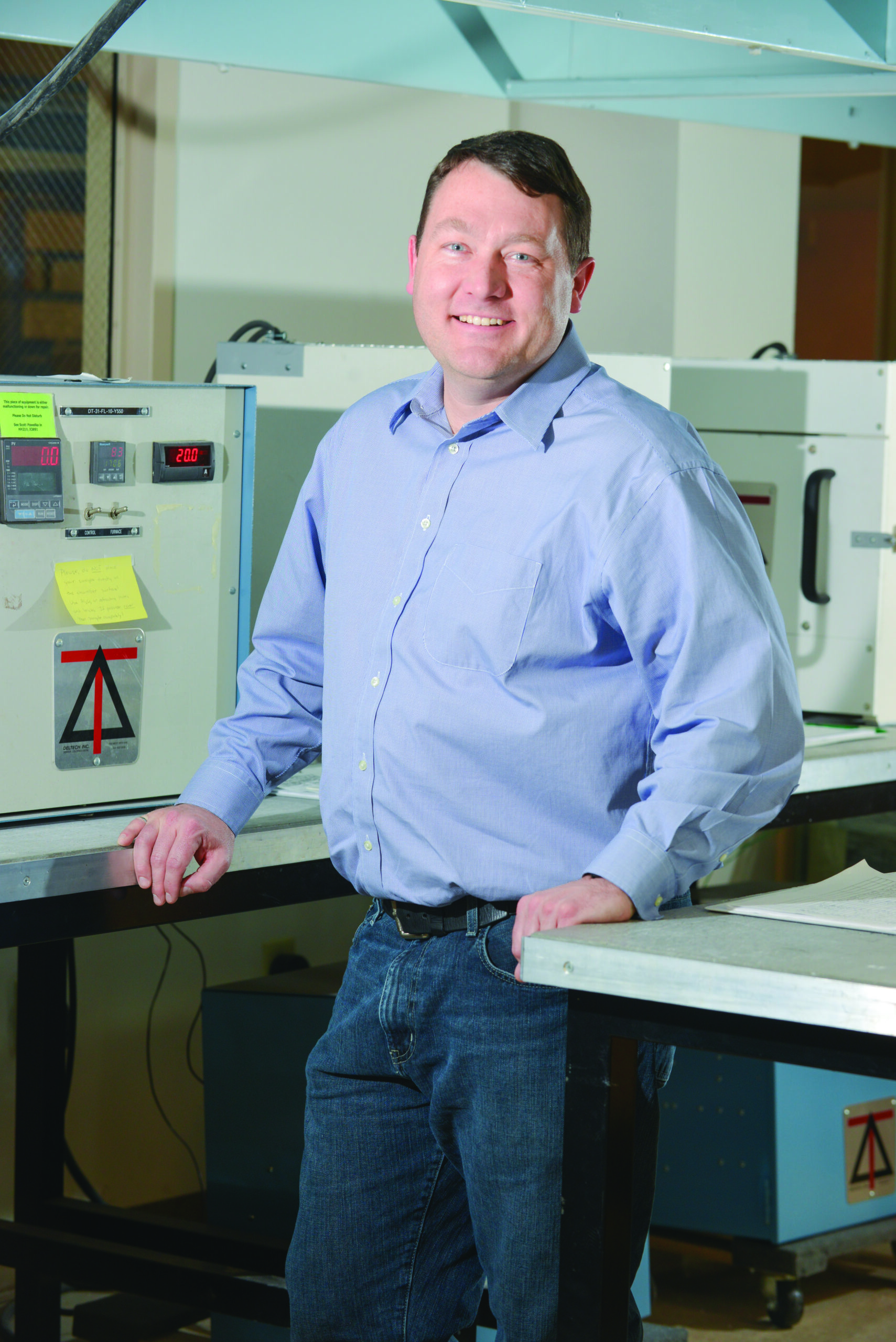
Geoff Brennecka in the furnace lab of the Colorado Center for Advanced Ceramics at the Colorado School of Mines. Credit: Colorado School of Mines
SCIENCE: Geoff Brennecka at the Colorado School of Mines (Golden, Colo.) remarks that all ceramics contain defects, impurities, and interfaces—it is simply unavoidable. Significant research has attempted to understand the effects of defects on properties, with the vast majority of work focused on static or steady-state conditions. However, ferroelectrics and piezoelectrics—which are important for applications ranging from memory devices and capacitors to actuators—commonly are used under dynamic conditions in which moving domain walls dominate property responses. Brennecka brings new experimental techniques and unique sample sets to improve quantitative descriptions of interactions of moving domain walls with ubiquitous point defects and interfaces, such as vacancies and grain boundaries. His work links the abstract energy barriers used to describe domain nucleation and pinning processes to actual chemical and structural features to identify and generalize conditions under which various features serve as nucleation and pinning sites. Through sample sets and experiments, Brennecka will endeavor to isolate variables (e.g., separate domain wall interactions with cation vacancies and with grain boundaries) and apply new tools (e.g., atom probe and X-ray tomographies, time domain thermal reflectance, and custom low-impedance drive circuitry) to develop fundamental mechanistic descriptions of domain nucleation and pinning that can be applied broadly across many materials families.
SUSTAINABILITY: Brennecka expects that better understanding of domain wall interactions with defects and interfaces will result in improved performance from lead-free piezoelectrics and active control of high-value catalysts that are free of toxic or precious metals. In turn, his discoveries will enable use of more sustainable materials to produce devices that contribute to increased energy efficiency and manufacturing sustainability across a variety of industries.
ENGAGEMENT: Brennecka is expanding student engagement through an annual “Discover STEM!” camp, curriculum development, and introduction of a campus hot glass shop. In addition, a student swap agreement allows graduate students to work with collaborators in Virginia and Australia, taking advantage of the tools and expertise available in those groups and benefitting from the experience of working in a different environment.
Closing remarks
The CAREER award is a defining step for these principal investigators. The single-investigator award identifies them as emerging world leaders in their respective fields. The junior faculty supported through these NSF awards hope to
- Attain transformative research results;
- Serve as mentors to undergraduate and graduate students and postdoctoral associates;
- Integrate new research results into teaching curriculums;
- Establish research reputations through presentations and publications;
- Grow a network through professional society connections and collaborations with industry, government laboratories, international researchers, and other U.S.-based academics;
- Build a more impactful, and often larger, research group;
- Leverage their CAREER awards to expand funding sources and extend their reach;
- Provide broad education to the general public and attract students to science and engineering fields;
- Address ceramic and glass grand challenges; and
- Contribute to sustainable technologies.
Ceramic and glass research is in an exciting era. To realize the full potential of these unique materials, we celebrate rising professors undertaking fundamental research and educating the next generation.

Related Articles

Market Insights
Engineered ceramics support the past, present, and future of aerospace ambitions
Engineered ceramics play key roles in aerospace applications, from structural components to protective coatings that can withstand the high-temperature, reactive environments. Perhaps the earliest success of ceramics in aerospace applications was the use of yttria-stabilized zirconia (YSZ) as thermal barrier coatings (TBCs) on nickel-based superalloys for turbine engine applications. These…

Market Insights
Aerospace ceramics: Global markets to 2029
The global market for aerospace ceramics was valued at $5.3 billion in 2023 and is expected to grow at a compound annual growth rate (CAGR) of 8.0% to reach $8.2 billion by the end of 2029. According to the International Energy Agency, the aviation industry was responsible for 2.5% of…

Market Insights
Innovations in access and technology secure clean water around the world
Food, water, and shelter—the basic necessities of life—are scarce for millions of people around the world. Yet even when these resources are technically obtainable, they may not be available in a format that supports healthy living. Approximately 115 million people worldwide depend on untreated surface water for their daily needs,…