

Porosity is an inherent feature of ceramic materials that can be difficult to eliminate completely. However, there are many applications that capitalize on the relative stability of porous structures at elevated temperatures, ranging from catalysis to filtration to bone scaffolding to thermal barrier coatings.1 Can nuclear ceramics become another example?
To date, porosity and void evolution within nuclear ceramics—fuels, cladding, or waste containment schemes—have been difficult to characterize and control, making it one of many consequences of extreme thermal, mechanical, and irradiative conditions. However, as mechanisms for radiation damage and recovery within ceramics continue to be clarified,2 engineered porosity may allow for additional radiation tolerance.
Numerous strategies aimed at reducing radiation damage involve the incorporation of a high density of defect sinks, typically grain boundaries within single-phase or multiphase systems.3 A pore surface is an infinite defect sink, provided that the defects have sufficient mobility to reach the pore and that the pore itself does not migrate, shrink, coarsen, or otherwise drastically change its morphology.
The rate of pore evolution in conventional ceramics is a strong function of surface energy and local diffusion phenomena. Yet, in an irradiative environment, diffusion behavior is significantly altered by heterogeneous radiation-induced defects and strong thermal gradients. Our ability to capitalize upon radiation tolerance provided by engineered microstructures, therefore, first requires a greater appreciation of these synergistic relationships.

Jessica A. Krogstad
Ceramics in the nuclear industry
Materials research for nuclear power generation has overwhelmingly focused on the behavior of metals and metallic alloys under irradiation. Continued emphasis on metallic systems is necessary for needed improvements and advancements in safety and efficiency. However, there are many areas wherein an improved understanding of irradiation damage in ceramic materials could lead to further developments. For example, silicon (or other metal) carbides have been proposed as cladding material for accident-tolerant concepts, oxide fuels (e.g., UO2) are promising for high burn-up applications, numerous waste storage concepts rely upon inert ceramic matrices (e.g., pyrochlores, spinels, ZrO2, or MgO), and ceramics have been proposed for use as first-wall materials in fusion reactors.4
In many of these applications, thermal and environmental stability relative to metallic counterparts make ceramics attractive options. However, they continue to be plagued by complications from low mechanical toughness and, in many cases, low (or otherwise incompatible) thermal conductivity. Both of these shortcomings can be at least partially attributed to porosity within the ceramic body.
Given that some porosity is unavoidable, improving the understanding of microstructural evolution assisted by radiation-enhanced diffusion and thermal or mechanical gradients may allow a paradigm shift away from tolerating porosity toward exploiting it—expanding the suitability and applications for ceramics within the nuclear industry and other radiation-sensitive fields.
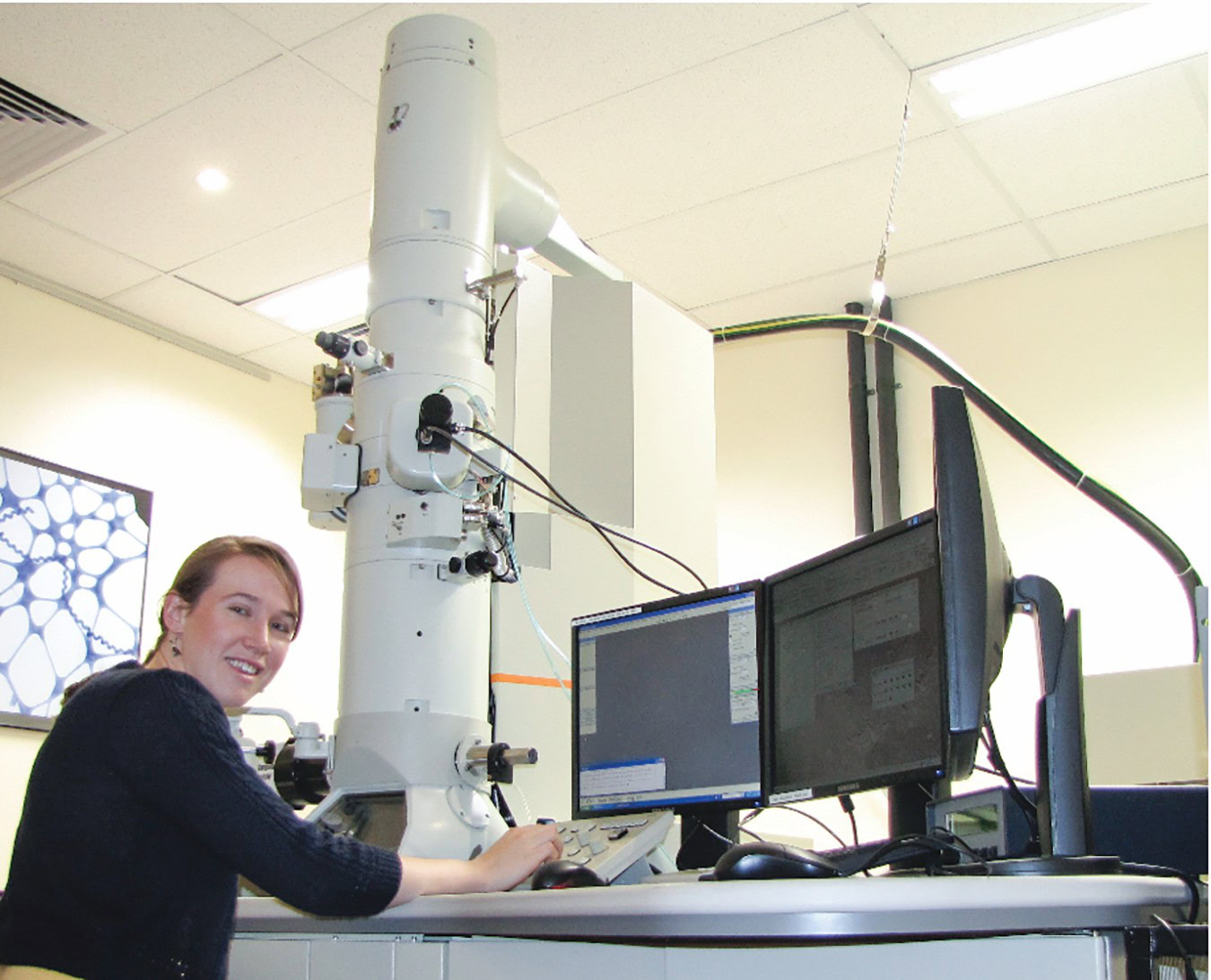
Jessica Krogstad operates an electron microscope in the laboratory. Credit: Jessica Krogstad
Irradiation damage within ceramics
The key microstructural features incorporated into metallic systems to mitigate radiation damage are susceptible to destabilization. Ceramics offer a promising, thermally stable alternative. However, differences in defect generation, mobility, and ultimate recovery within ceramic systems must first be appreciated before this enhanced thermal stability can be fully utilized.
Radiation damage in ceramics has been studied intensely in the interest of understanding UO2 fuel lifecycles and opportunities for geological waste containment. Based on increased complexity of composition, structure, and bonding, ceramics exhibit more varied damage responses. Because of the directionality of bonding and Coulombic interactions, probability of displacement is different for each atom.
The consequent aversion to antisite defects also means that the probability of Frenkel defect recombination is higher—affecting primary defect formation and secondary defect mobility.
Defect motion is possible at very low homologous temperatures, because Coulomb and strain potentials are primary driving forces for diffusion at these temperatures.5 Given this added complexity, ionizing radiation may result in significant or very little damage accumulation depending on the specific material, type of radiation and energy, and temperature.6 For example, Sickafus et al.2 and later Debelle et al.7 showed that damage accumulation in fluorite-structured yttria-stabilized zirconia (YSZ or FSZ) progressed in three stages: formation of isolated defects; rapid damage accumulation as the defects link or coalesce; and a final saturation stage where defects may even begin to disappear.
Saturation recovery behavior observed in YSZ (as well as other ceramics systems6) is largely attributed to radiation-enhanced diffusion (RED), a phenomenon that has received considerable attention within metals8 and ceramics.9,10 Figure 1 schematically depicts the conventional understanding of RED.
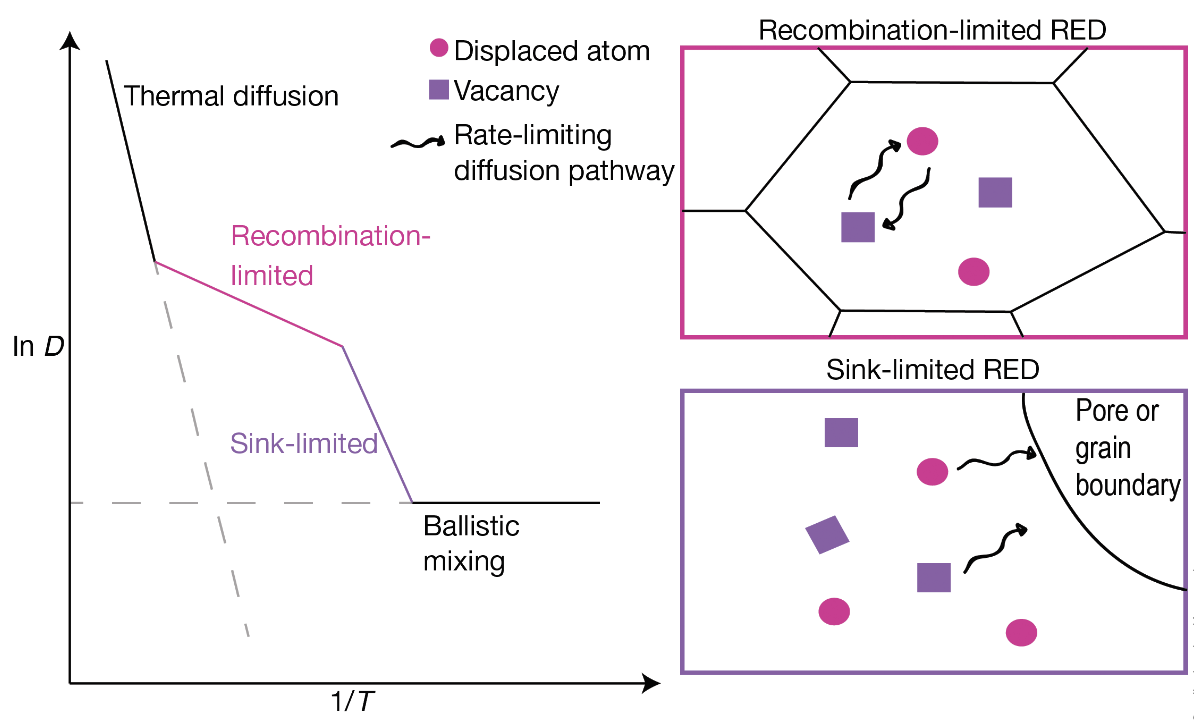
Figure 1. Schematic illustration of radiation-enhanced diffusion in ceramics, highlighting the intermediate temperature regime. Credit: Jessica Krogstad
The intermediate temperature regime—below thermally activated diffusion but above pure ballistic mixing—includes sink- and recombination-limited kinetic regimes. In ceramics, the progression from sink- to recombination-limited behavior is opposite of that observed in metallic systems, with sink-limited kinetics observed at lower temperatures and recombination-limited kinetics dominating at higher temperatures.4
Van Sambeek et al.9 argued that reordering of kinetic regimes is the result of inhomogeneous defect production or distribution and disparate defect mobilities in the vicinity of collision cascades—interstitials are excluded to the periphery, while vacancies form a loose cluster in the cascade center. This understanding makes it likely that the radiation tolerance for specific temperature ranges could be improved by chemistry or microstructural changes aimed at further suppressing the mobility of one defect type relative to the other.
Compatible routes for microstructural stabilization
Despite that the temperature regimes for sink- and recombination-limited kinetics in ceramics are opposite of those observed in metallic systems, similar radiation damage mitigation strategies, such as nanocrystallinity (increasing the density of grain-boundary sinks), have been used for ceramics. For example, Dey et al.11 recently demonstrated that coarse-grain, fully-stabilized zirconia (specifically yttria-stablized) has a higher concentration of defect clusters when compared with nanograin specimens subject to the same level of irradiation. However, abnormal grain growth also is observed in nanograin specimens, suggesting that the stability of such a microstructure is insufficient to preserve radiation tolerance over extended periods.
Further, the interface between irradiated and unirradiated grains cannot accommodate local residual stresses from accelerated grain growth, resulting in intergranular fracture at the interface. Clearly, application of the conventional interfacial sink strategy commonly used in metallic systems must be modified to accommodate the unique characteristics of ceramic systems, specifically reduced toughness, and the role of charge balance in RED. The fundamental mechanism behind the microstructural destabilization is not immediately clear.
We hypothesize that increased boundary mobility results from radiation-induced disruption of localized space charge potentials. An example of this local desegregation is provided in Figure 2. Solute segregation to grain boundaries is commonly observed in ionic ceramics and has been attributed to reduced boundary mobility via a solute drag mechanism. However, under irradiation in specific temperature regimes, concentration of point defects is not homogeneous in the bulk and is a strong function of recombination rates.
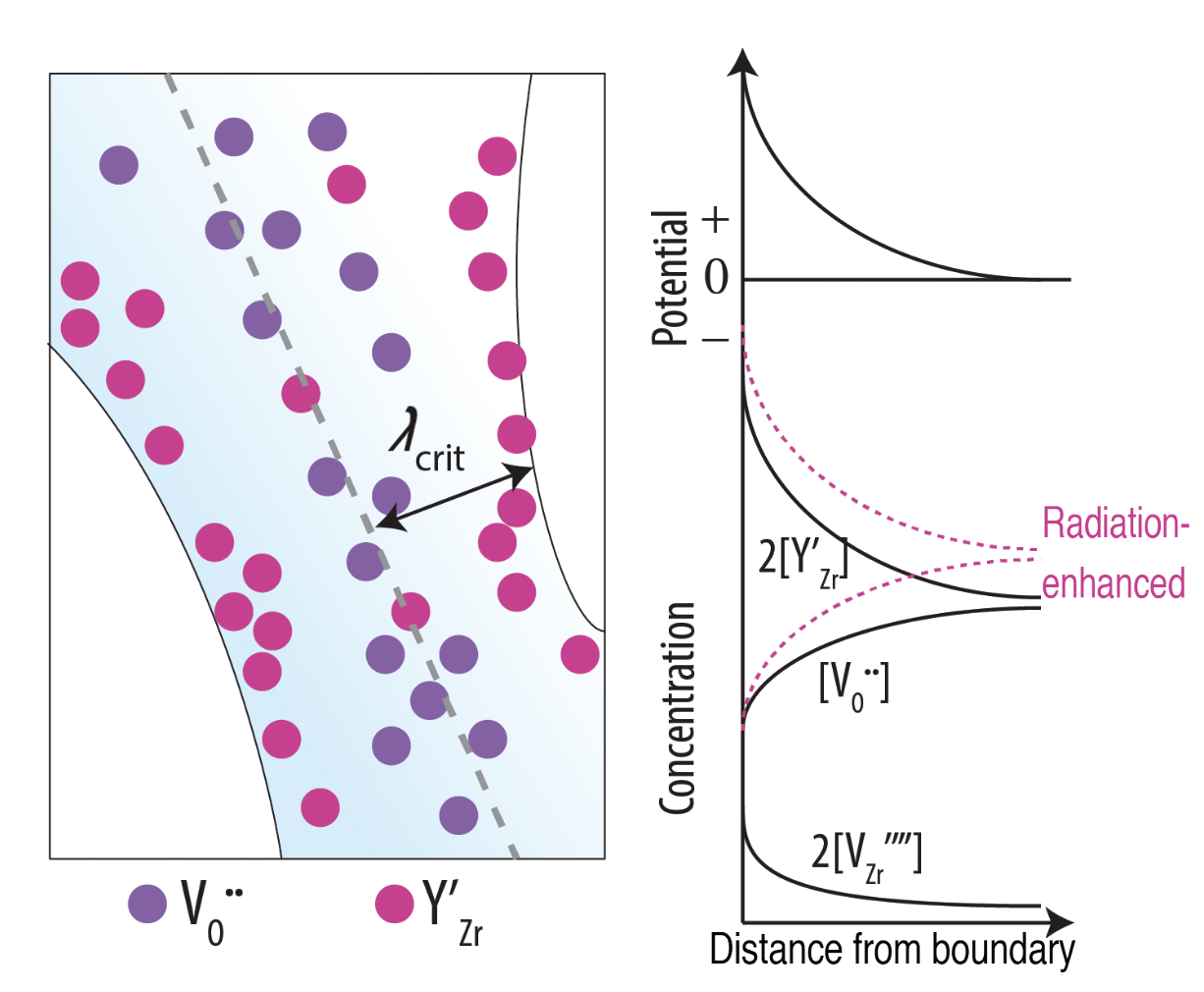
Figure 2. Schematic illustration of dopant segregation toward pore surfaces in response to the naturally depleted vacancy concentrations of these surfaces. Point defects are described using Kröger-Vink notation: VO••, oxygen vacancy with a 2+ charge; Y’Zr, yttrium cation on a zirconium cation site with a 1+ charge; VZr””, zirconium cation vacancy with a 4– charge. Critical diffusion distance (half the width of the strut) is labeled as λcrit. A potential gradient is established because vacancy population in the grain interior differs from the surface, thus driving aliovalent dopants to segregate and satisfy a local space charge imbalance. Dopant segregation may reduce boundary mobility via a solute drag mechanism, thus stabilizing the microstructure. Credit: Jessica Krogstad
If the kinetics are sink limited, recombination rates are high, and an oxygen vacancy gradient cannot be stabilized to enhance diffusion of boundary pinning solutes, resulting in rapid grain growth under irradiation. Following this logic and the currently accepted description of RED within ceramics, there should be an intermediate temperature range in which abnormal grain growth is limited.
Solute segregation and resulting microstructural changes are not temperature independent. Yet, even in the absence of an external gradient, low thermal conductivity of most insulating ceramics could easily result in an internal thermal gradient, as is commonly observed for UO2 fuel pellets. The extent and scale over which a thermal gradient is experienced (hundreds of micrometers to millimeters) can be orders of magnitude greater than the scale of defect damage accumulation and recovery previously described.
This has two consequences: the defect type and potential recovery mechanisms may vary significantly across a specimen based on different kinetic regimes accessible for a given temperature; and the thermal gradient also contributes to a gradient in chemical potential, thereby driving mass transport across large distances—an effect known as thermally induced mass transport (TIMT, but also referred to as the Soret effect or thermophoresis).
In the case of the former, presence of the thermal gradient is not anticipated to influence defect formation and migration around a singular cascade event, because local temperature over the scale of defect mobility will be effectively homogeneous. However, in the latter case, mobility of voids and pores toward the hot side has potential to expand the recombination-limited kinetic regime by increasing density and strength of local defect sinks over time, thereby stabilizing and improving radiation tolerance of the material with increasing exposure (Figure 3).
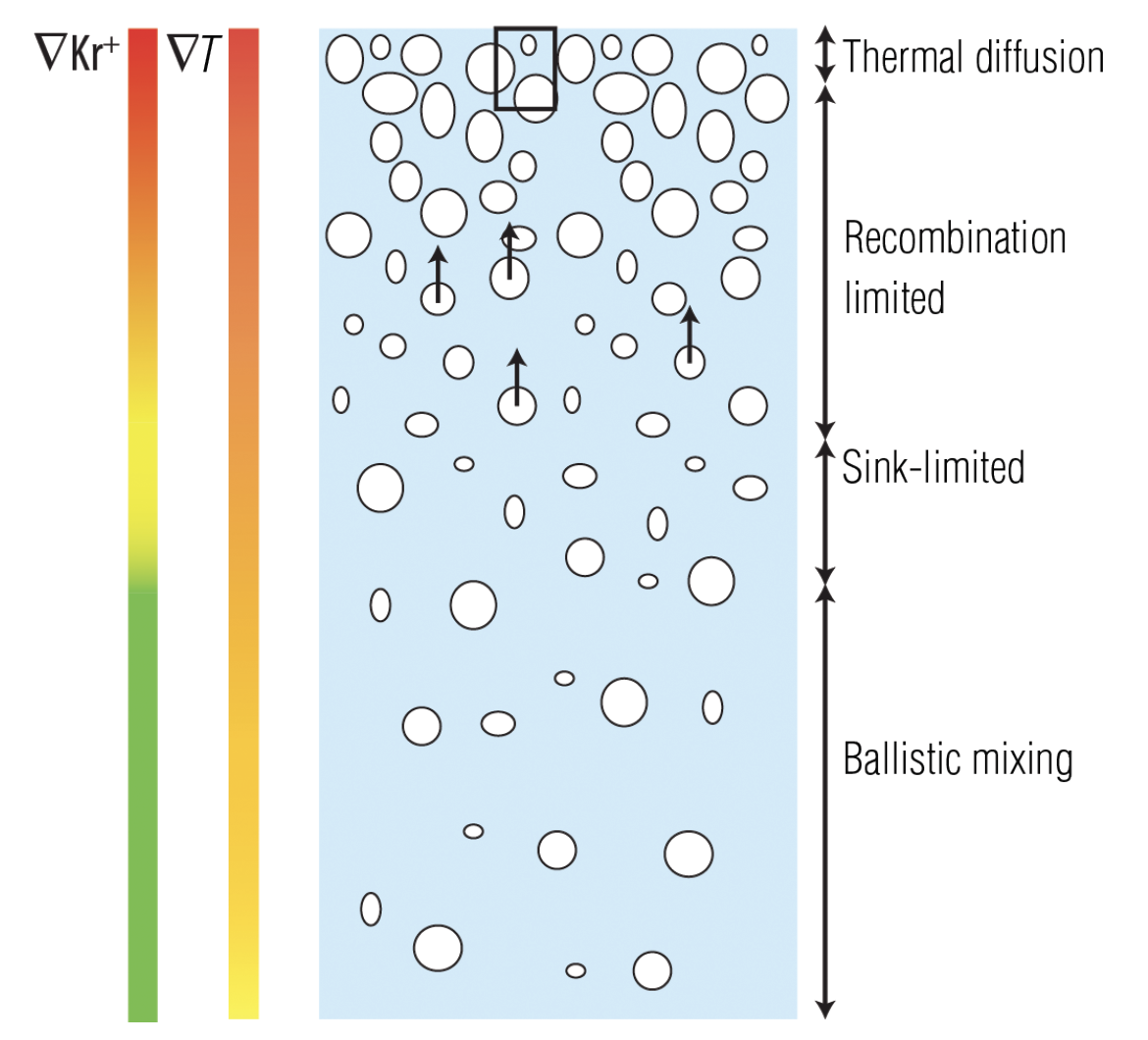
Figure 3. Both thermal and radiation gradient from a representative Kr+ ion are superimposed on a schematic porous microstructure. Such a strong thermal gradient across an irradiated ceramic body will have two consequences: different RED mechanisms will be active in different parts of the component, which may alter microstructural evolution; and the thermal gradient (∇T) may result in a chemical potential gradient driving mass transport over relatively large distances. Thermally induced mass transport typically forces porosity toward the hotter side of the gradient and will contribute to microstructural dynamics.
Looking forward
The thermal and structural stability of ceramics are ideal for extreme conditions associated with nuclear power generation, waste handling, or even deep space thermal protection schemes. Radiation tolerance within ceramics often rely on similar mechanistic approaches applied to metallic systems. However, the complexity of diffusion mechanisms caused by the covalent–ionic nature of bonding as well as other physical properties, including thermal conductivity, may significantly alter routes by which radiation tolerance of ceramics can be enhanced or tailored for specific applications.
This is an extremely challenging problem that the community has conventionally approached by isolating specific aspects of the extreme environment, such as studying the impact of thermal gradients in isolation from radiation damage. This approach has established a wide body of literature characterizing the ceramic-specific nature of radiation damage and radiation-enhanced diffusion, but these individual components may overlook important synergistic contributions to microstructural evolution in irradiative environments.
The modeling community has begun to tackle integration of these contributions, but it has been limited by the paucity of scale/temperature/dosage-appropriate experimental data necessary to establish physics-based models that are properly benchmarked. Experimental approaches that are thoughtfully designed for eventual integration with state-of-the-art modeling efforts are necessary to answer outstanding fundamental questions.
Given the complexity of these experiments, our forward-looking approach hinges upon several strategic collaborations. Specifically, our efforts to carefully tailor the microstructure of fully-stabilized zirconia (grain size, pore size, and distribution) will enable in situ observation of damage creation and recovery as a function of temperature and critical microstructural dimensions (e.g., diffusion distances to free surfaces or grain boundaries) through collaborations with the Center for Integrated Nanotechnologies and the Ion Radiation Laboratory at Sandia National Laboratory (Albuquerque, N.M.).
Contributions to microstructural evolution from thermal gradients can be evaluated by unique, in-house diffusion couple experiments within laser-established thermal gradients and in situ synchrotron X-ray tomography (at the Advanced Photon Source at Argonne National Laboratories (Lemont, Ill.)) with postmortem spatially resolved chemical analysis. With the support of a DOE Early Career Award (Office of Science, Basic Energy Science Award No. DE-SC0015894), we will integrate these experimental approaches over the next five years to truly explore the synergistic effects of radiation-enhanced diffusion and thermal gradients—hopefully enabling the introduction or expansion of ceramics within a wide range of nuclear applications.


Related Articles

Market Insights
Engineered ceramics support the past, present, and future of aerospace ambitions
Engineered ceramics play key roles in aerospace applications, from structural components to protective coatings that can withstand the high-temperature, reactive environments. Perhaps the earliest success of ceramics in aerospace applications was the use of yttria-stabilized zirconia (YSZ) as thermal barrier coatings (TBCs) on nickel-based superalloys for turbine engine applications. These…

Market Insights
Aerospace ceramics: Global markets to 2029
The global market for aerospace ceramics was valued at $5.3 billion in 2023 and is expected to grow at a compound annual growth rate (CAGR) of 8.0% to reach $8.2 billion by the end of 2029. According to the International Energy Agency, the aviation industry was responsible for 2.5% of…

Market Insights
Innovations in access and technology secure clean water around the world
Food, water, and shelter—the basic necessities of life—are scarce for millions of people around the world. Yet even when these resources are technically obtainable, they may not be available in a format that supports healthy living. Approximately 115 million people worldwide depend on untreated surface water for their daily needs,…