

The National Science Foundation is an independent federal agency that serves as a funding source for basic research conducted at America’s colleges and universities. NSF is divided into seven science and engineering research and education directorates. The Mathematical and Physical Sciences Directorate is home to the Division of Materials Research, which includes the Ceramics Program.
The Ceramics Program supports fundamental scientific research in ceramics (e.g., oxides, carbides, nitrides, and borides), glass-ceramics, inorganic glasses, ceramic-based composites, and inorganic carbon-based materials. The objective of the program is to increase fundamental understanding and to develop predictive capabilities for relating synthesis, processing, and microstructure of these materials to their properties and ultimate performance in various environments and applications. Research to enhance or enable the discovery or creation of new ceramic materials is welcome. Development of new experimental techniques or novel approaches to conduct projects is encouraged.
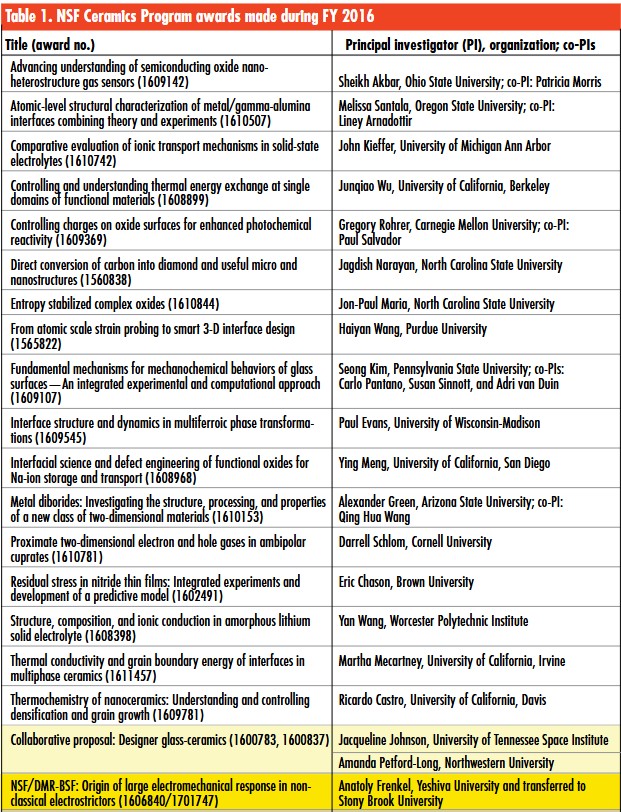
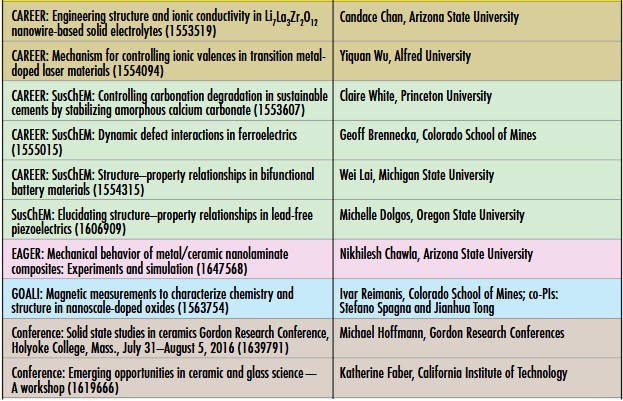
During fiscal year (FY) 2016, the Ceramics Program provided support for 30 awards, 12 supplemental awards, and cofunding of an Optics and Photonics grant managed in the Chemistry Division. The 30 awards are listed in Table 1, but more information on any NSF award is available by adding the 7-digit award number to the end of www.nsf.gov/awardsearch/showAward?AWD_ID= or by searching the NSF awards database.
Additional ceramics research is supported through centers; group grants, such as Designing Materials to Revolutionize and Engineer our Future (DMREF); instrumentation awards (procurement and development); and other programs focused on individual investigators (e.g., in the Chemistry Division, Office of International Science and Engineering, and Engineering Directorate).
NSF also provided supplemental funding to support new international collaborations; small instrumentation repairs, upgrades, and purchases; and the addition of veteran and underrepresented minority graduate students to projects (through MPS-GRSV: NSF 15-024 and AGEP-GRS: NSF 16-125). Although the Ceramics Program also has funded Career–Life Balance supplements (for leaves of absence for dependent care responsibilities) in the past, no requests were received during FY 2016.
The Ceramics Program announced at the end of August 2016 that it was undertaking a pilot alongside the Condensed Matter and Materials Theory Program to remove the proposal submission window, deadline, or target date—proposals are now accepted anytime, with a few restrictions (NSF 16-597). This approach is not unique—it is used in the Geosciences Directorate at NSF and also is used by other agencies in Germany and the United Kingdom. NSF anticipates this change will better accommodate the schedules of principal investigators and encourage submission of emerging ideas. In addition, NSF hopes the change will increase proposal quality and spread workflow (for reviewers and NSF program directors) more evenly throughout the year.
Although FY 2017 began on October 1, 2016, often the first awards appear in late winter or early spring. At any given time, one can generate a map or list of active awards near the bottom of the Ceramics Program homepage at www.nsf.gov/funding/pgm_summ.jsp?pims_id=5352.
Collaborative Research
When there is more than one investigator at the same institution, one researcher is designated as PI and others are co-PIs. If more than one institution is involved, there can be one proposal with a subaward to the other institution(s), or multiple coordinated proposals can be submitted as a joint project. The latter is labeled as “Collaborative Research” in the title, and each institution has an award number and budget. See NSF’s Proposal & Award Policies & Procedures Guide (PAPPG) for further details, including responsibilities.
Israel Binational Science Foundation (BSF)
A Dear Colleague Letter (DCL) (NSF 15-097) provides guidance for submitting collaborative materials research proposals to foster cooperation between U.S. academics and their Israeli counterparts.
Faculty Early Career Development Program (CAREER)
The CAREER solicitation (NSF 15-555) is restricted to single investigators who are assistant professors. The five awards made in FY 2016 are described in this article.
Sustainable Chemistry, Engineering, and Materials (SusChEM)
The SusChEM initiative addresses interrelated challenges of sustainable supply, engineering, production, and use of chemicals and materials. The latest DCL, NSF 16-093, provides additional details and there is a description in the budget request to Congress.
EArly-concept Grants for Exploratory Research (EAGER)
“The EAGER funding mechanism may be used to support exploratory work in its early stages on untested, but potentially transformative, research ideas or approaches. This work may be considered especially ‘high risk–high payoff’ in the sense that it, for example, involves radically different approaches, applies new expertise, or engages novel disciplinary or interdisciplinary perspectives.” Full details are provided in the PAPPG.
Grant Opportunities for Academic Liaison with Industry (GOALI)
GOALI (DCL NSF 16-099) promotes university–industry partnerships by making project funds or fellowships and traineeships available to support universities working with industry. Projects must meet certain conditions, including having at least one co-PI from industry. For the 2016 award, the GOALI industry partner is Quantum Design.
Conferences
Submissions should follow Special Guidelines found in the PAPPG for Conference Proposals.


Related Articles

Market Insights
Engineered ceramics support the past, present, and future of aerospace ambitions
Engineered ceramics play key roles in aerospace applications, from structural components to protective coatings that can withstand the high-temperature, reactive environments. Perhaps the earliest success of ceramics in aerospace applications was the use of yttria-stabilized zirconia (YSZ) as thermal barrier coatings (TBCs) on nickel-based superalloys for turbine engine applications. These…

Market Insights
Aerospace ceramics: Global markets to 2029
The global market for aerospace ceramics was valued at $5.3 billion in 2023 and is expected to grow at a compound annual growth rate (CAGR) of 8.0% to reach $8.2 billion by the end of 2029. According to the International Energy Agency, the aviation industry was responsible for 2.5% of…

Market Insights
Innovations in access and technology secure clean water around the world
Food, water, and shelter—the basic necessities of life—are scarce for millions of people around the world. Yet even when these resources are technically obtainable, they may not be available in a format that supports healthy living. Approximately 115 million people worldwide depend on untreated surface water for their daily needs,…