
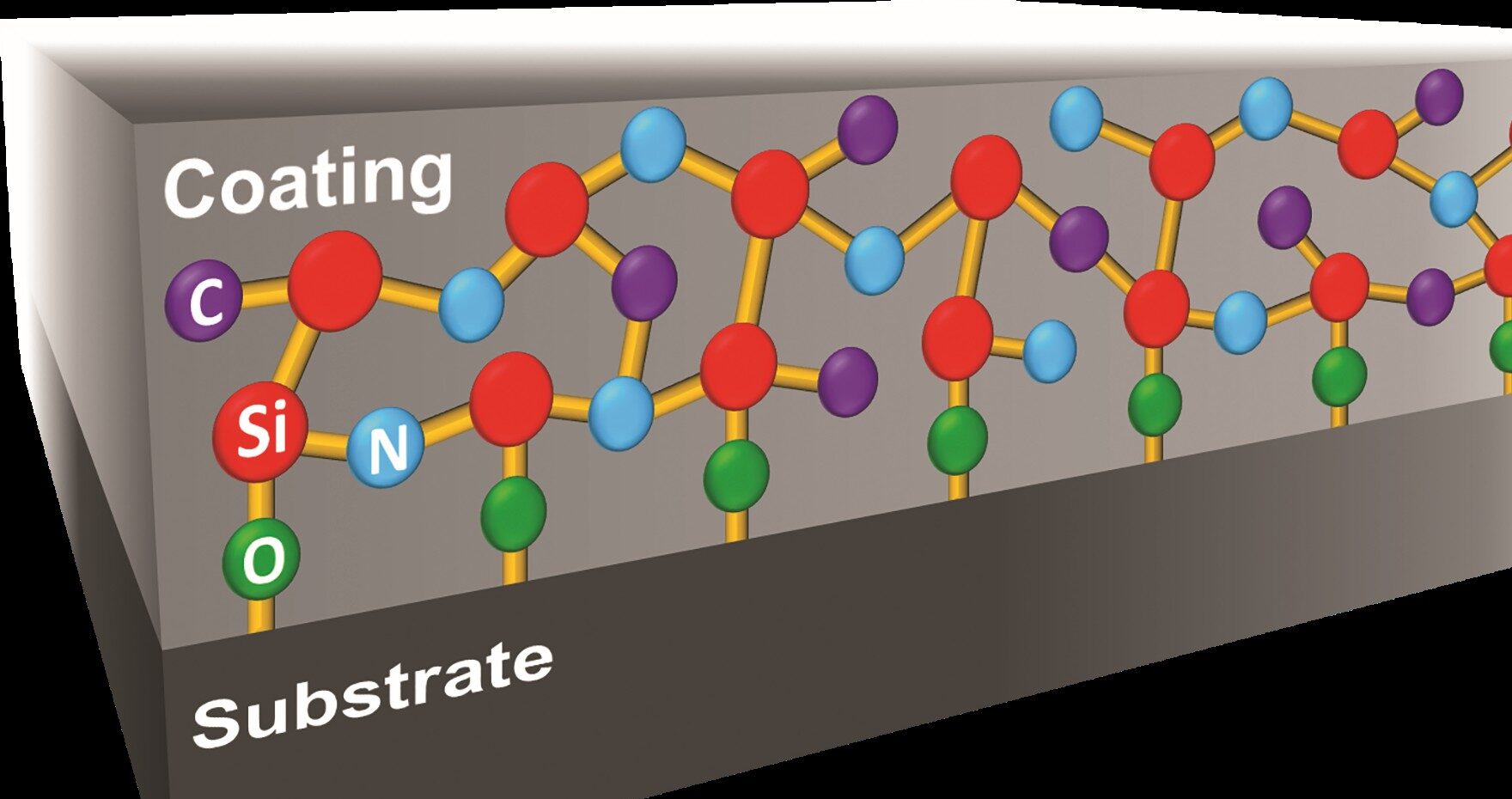
Polymer-derived ceramic and ceramic-like coatings: Innovative solutions for real problems
Polymer-derived ceramic (PDC) technology focuses on the conversion of metalorganic compounds, also known as preceramic polymers, to ceramic materials.1 Preceramic polymers, which are either liquids or meltable/soluble solids, are subjected—after or during shaping processes—to chemical and thermal treatments, which induce cross-linking of the polymers into thermoset materials. Further thermal treatment converts the thermoset polymer to an amorphous ceramic and, at higher temperatures, to a crystalline ceramic.
In comparison with traditional powder technology to prepare ceramic materials, the PDC route has advantages of homogeneity of chemical composition at the molecular level and lower processing temperatures.1 Moreover, shaping in the polymeric state before conversion to ceramic reduces processing cost and time and extends the lifespan of shaping machines.
Because of the availability of a broad spectrum of polymer and ceramic shaping technologies, such as casting, tape casting, fiber drawing, molding, and pressing, the PDC route enables realization of a variety of ceramics, including bulk parts, cellular materials, fibers, and coatings.1 PDC is especially attractive for coating applications, because it enables use of wet deposition techniques, typical of organic coatings, to prepare layers with properties of ceramic materials, such as high-temperature resistance and hardness.