
Role of atomistic simulations in understanding fission product accommodation in ceramic nuclear fuel
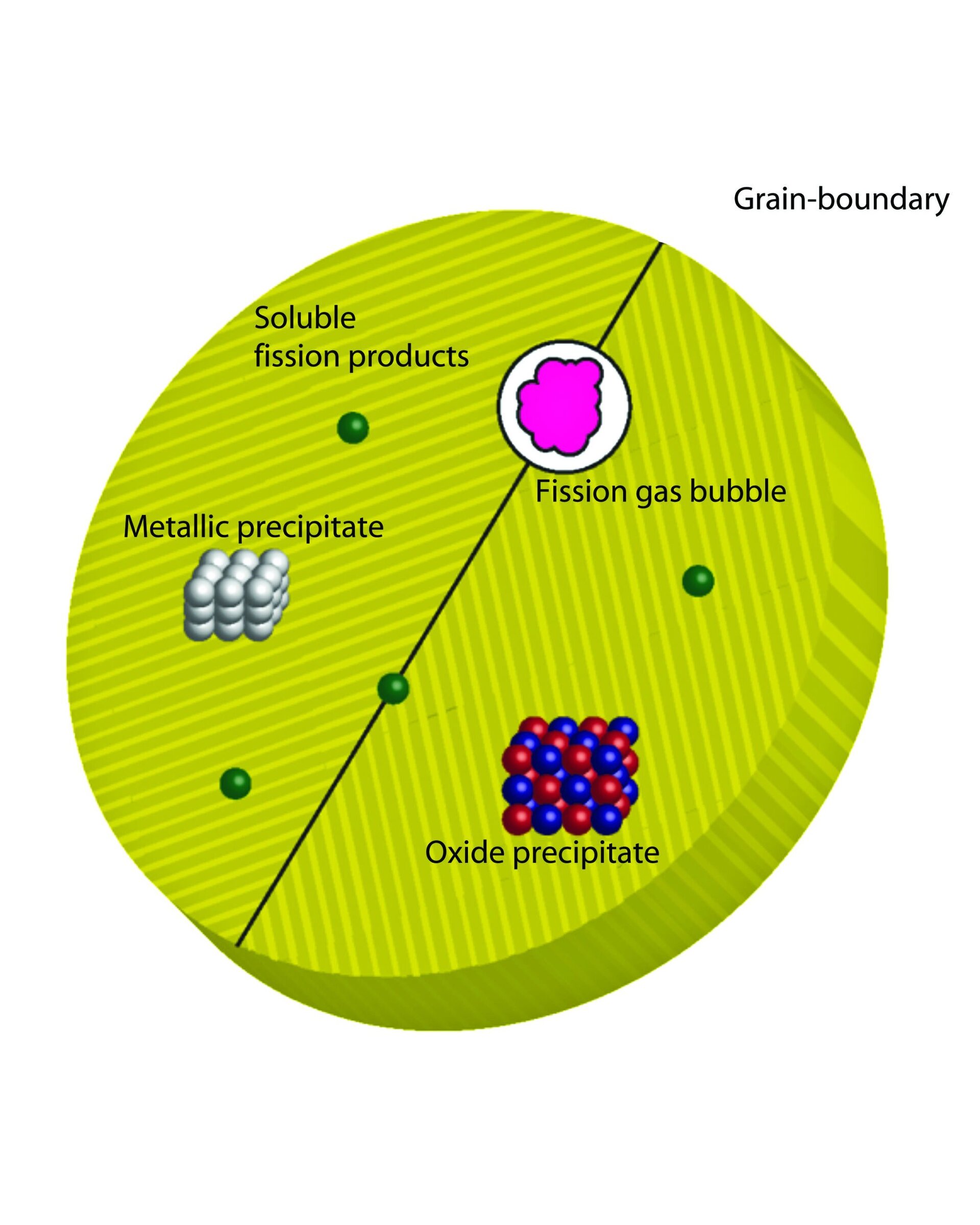
Power from nuclear reactors is an important contributor to the energy portfolios of many countries, including the United States, because of its high efficiency and lack of greenhouse gas emissions. Most nuclear fuels are in the form of ceramic pellets, with a majority of these composed of uranium dioxide (UO2), its oxygen-poor (hypostoichiometric) or oxygen-rich (hyperstoichiometric) phases, or its alloys. Under normal operating conditions, the uranium transmutes to produce a wide range of chemically distinct fission products, some of which have short lifetimes and some of which have long lifetimes. Fission products range from insoluble noble gases that form gas-filled cavities to other elements that are either soluble in the nuclear fuel matrix or that separate into new oxide phases or metallic precipitates (Figure 1). Over time, the production and accumulation of these products causes the nuclear pellets to degrade and ultimately requires that they be replaced, with some inevitable accompanying loss of efficiency. Understanding the fission generation process and the various mechanisms by which these products are accommodated by the nuclear fuel microstructure is critical to design longer-lived pellets.
The fission process occurs when an actinide atom, such as uranium, captures a neutron and splits—or fissions—resulting in many chemically distinct daughter products of lighter elements that somehow must be accommodated within the fuel, hundreds of megaelectron-volts (MeV) of energy that ultimately generate power, and neutrons that go on to continue the process. The specific types and amounts of fission products produced depend on the type of reactor, the composition of the fuel, and other details of the operating conditions. Additionally, the fission products, which chemically span much of the periodic table, vary in their ultimate fate within the fuel. Nonetheless, some general trends have been observed.