
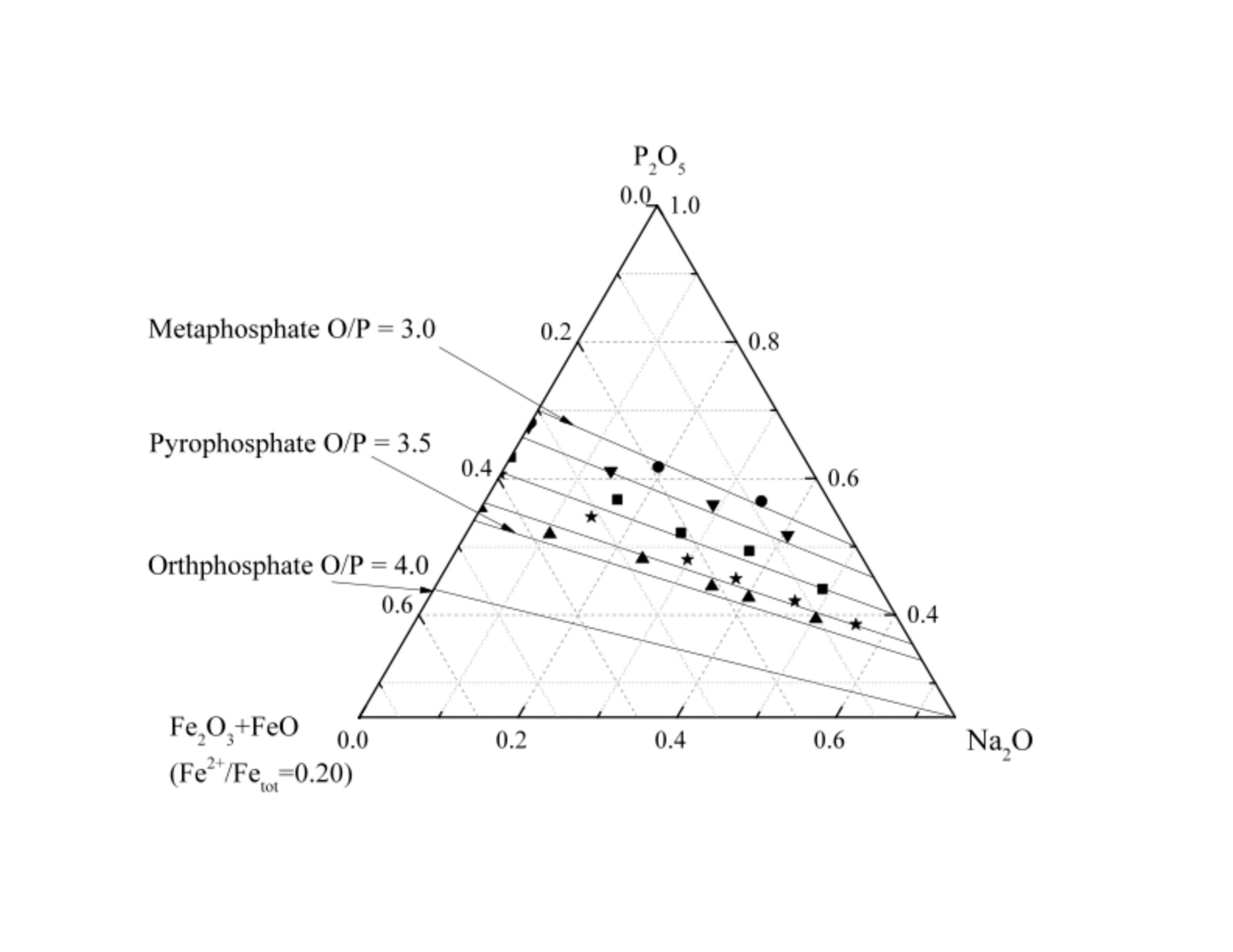
Structural study of Na2O–FeO–Fe2O3–P2O5 glasses by high-pressure liquid chromatography and Raman spectroscopy
The excellent chemical durability of iron phosphate glasses makes them potential hosts to vitrify high-level nuclear waste (HLW).1–3 The properties of iron phosphate glasses depend on glass structure, which is determined by the type and concentration of metal cations and the resulting phosphate chain length distributions.4–8
The structural complexity of iron phosphate glasses is increased by the variation in the Fe-redox conditions and by disproportionation reactions of phosphate anions in the melts.4 The relative fraction of Fe2+/Fetot is typically about 20% for the glasses obtained by conventional melting (in air) and quenching techniques.2,9,10 Disproportionation reactions produce the wider distributions of phosphate chains, which are related to the glass formation energy.11,12 The Flory distribution model describes the distribution of chains in phosphate melts:13