

Africa is home to 1.38 billion people, more than one-seventh of the world’s population. From a foreign trade perspective, it is an enormous market—one whose potential large global economies are beginning to fully appreciate.
For example, in the United States, the U.S. Chamber of Commerce urged the Biden Administration to “make Africa engagement a presidential priority…[and] enhance the competitiveness of U.S. business in Africa.” The organization endorses free trade agreement negotiations with Kenya and “capacity building to support a trade agenda in the African Continental Free Trade Area.”1
Africa has long been mined for its raw materials.2 The African continent, for example, is the preeminent source of critical materials such as nickel, cobalt, and rare-earth mineral ores and gold. Other valuable ores found in Africa include bauxite, iron ore, and uranium ore. But as international research and development collaborations demonstrate, Africa can be more than a node on the supply chain or a target for increased export activity.
R&D, with emphasis on development
France’s National Centre for Scientific Research (CNRS) is collaborating with researchers in South Africa on INFINITE-CELL,3 a project focused on developing next-generation solar cells. According to its website, the project “proposes extending the very high efficiency tandem device concepts to emerging thin film PV technologies with high potential for reduction of costs and avoiding the use of critical raw materials.” The goal is to bring to market “cost-efficient photovoltaic tandem devices based in the combination of wide band-gap kesterite absorbers as top cell, and low-cost c-Si [crystalline silicon] thin film as bottom cell”—and its performance targets include “using only fully sustainable materials and processes.”
Throughout Africa, researchers are working on strategies for converting agricultural waste from an ecological problem to a sustainable materials solution. In Madagascar, the French National Research Institute for Sustainable Development hopes to use a “large supply of organic materials and waste, coming mainly from the fruit industry.” Its initiative for identifying and recycling agro-industrial waste and biomolecules seeks to address the challenge that “Madagascar does not have a developed chemical industry and it imports most of its drugs but also a large number of compounds and active ingredients in special chemicals (surfactants, cosmetics, paints, pesticides, dyes, polymers, etc.).”4
CNRS issues rolling calls for proposals5 to support “development of long-term scientific partnerships with African institutions” and has worked with academic institutions worldwide (including the University of Chicago and the University of Arizona) on Ph.D. joint programs.
China is also prominent among international actors seeking to tap Africa’s research potential. In September 2019, the Chinese Academy of Sciences signed a memorandum of understanding with the African Academy of Sciences in Nairobi to promote “collaborative research, skills development, and technology transfer.”6
The Academy’s Sino-Africa Joint Research Center is collaborating in Kenya on an effort to address the increasing use of treated and untreated wastewater for irrigation in farming as freshwater resources dwindle.7 The wastewater is often polluted with heavy metals that build up over time in soil and plants and may reach toxic levels.
U.S. interest in the region is not exclusively economic. The U.S. Geological Survey’s international programs in Africa include mitigating carbon dioxide buildup in Cameroon’s Lake Nyos; conducting geochemical mapping in Morocco; and, in partnership with the Department of State and the Geothermal Energy Association, developing Africa’s geothermal energy resources.8
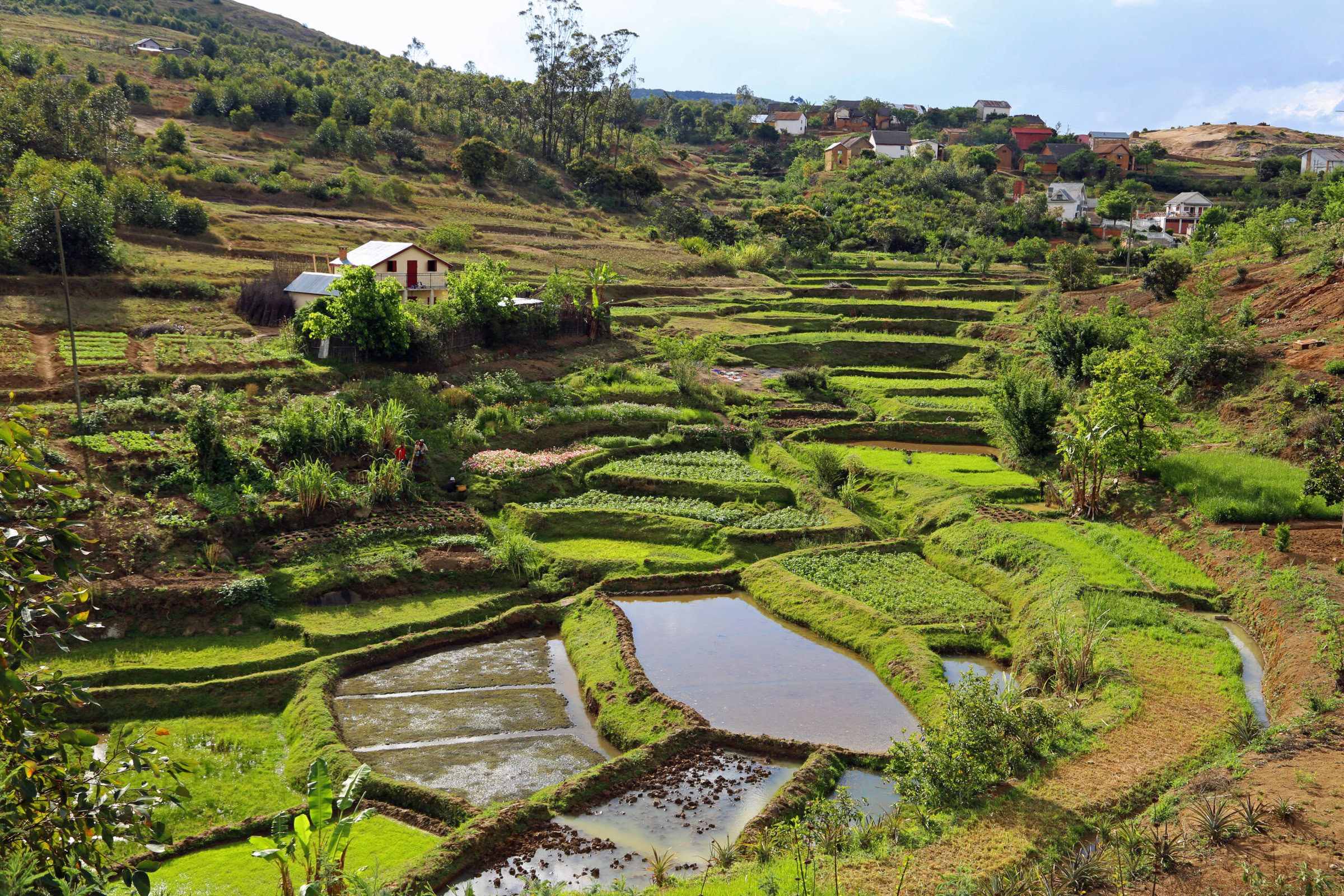
Example of terraced agricultural land in Madagascar. Credit: vil.sandi, Flickr (CC BY-ND 2.0)
Developing foreign trade and homegrown talent
Kenya, which is in the early stages of negotiating a Free Trade Agreement with the U.S., launched Vision 2030 “to transform Kenya into a newly industrializing, middle-income country.”9 Integral to this initiative is its Nano-Sciences, Material Science and New Production Technologies Programme,10 which calls for the establishment of the Kenya Institute of Technology and the National Physical Science Research Laboratory for Engineering and New Production Technologies.
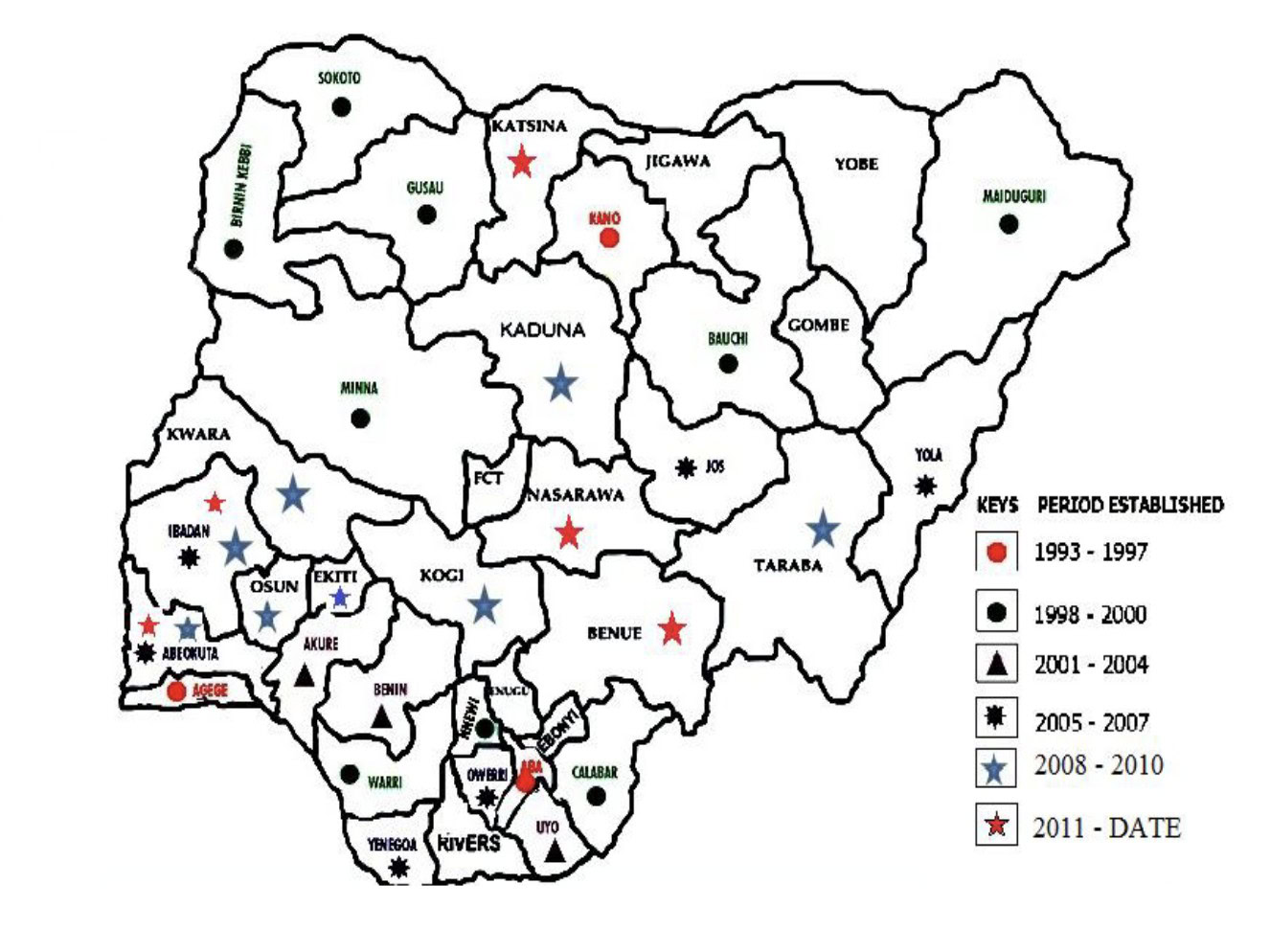
A 2013 map of incubation centers operated by the National Board for Technology Incubation. At that time, the Board operated 29 incubation centers; they currently operate 27. Credit: Jibrin, Makoyo, and Amonye, International Journal of Engineering Research & Technology (CC BY 4.0)
Similarly, Nigeria’s Federal Ministry of Science and Technology seeks to integrate science, technology and innovation within the country’s socioeconomic development efforts through advocacy, capacity building and commercialization of R&D outcomes.11 Its National Board for Technology Incubation operates 27 incubation centers located throughout Nigeria,12 while the Nigerian Institute for Science Laboratory Technology seeks to provide researchers with a “bridge between the laboratory and the economy.”
Most of these are early-stage initiatives that will need bilateral cooperation in know-how, market access, and basics such as equipment and supplies to come to fruition. We spoke with ceramic innovators to get their insights on where the sector stands in Africa today—and how they see its future on this continent. Their interviews appear on the following pages.
Acknowledgements
We thank Sossina Haile, Walter P. Murphy Professor of Materials Science and Engineering at Northwestern University, for her help in connecting us to knowledgeable sources for this article.
Learn more about Haile in the September episode of Ceramic Tech Chat at https://ceramictechchat.ceramics.org.
Read more: “Phylis Makurunje, researcher inspired by South Africa space program“
Read more: “Aron Shonhiwa, business development manager, Cermalab Materials Testing Laboratory“
Read more: “Oluwagbenga Johnson, mechanical and metallurgical engineering professor, School of Engineering and the Built Environment, The University of Namibia“
Read more: “A wealth of contradictions: in Africa, resource-rich countries seek an end to their economic struggles“

Related Articles

Market Insights
Next-gen superconducting ceramics could change how we travel and much more
Forty years ago, two physicists from IBM’s research laboratory in Zürich, Switzerland, reported a groundbreaking discovery: Superconductivity, or the quantum mechanical phenomenon in which certain materials exhibit zero electrical resistance when cooled, could be achieved at higher temperatures using ceramics. Superconductivity had been discovered decades before, but its applications had…

Market Insights
Why most AI manufacturing projects fail and how to fix it
Artificial intelligence is reshaping advanced manufacturing, especially processes involving ceramics, glasses, and other hard or brittle materials. But adopting AI is far more difficult than simply buying software and connecting machines. Manufacturers must understand the advantages and limitations of different models, so they can determine where AI fits best within…

Bulletin Features
Radiation effects on rare earth chemistry in molten salts for nuclear applications
Across the nuclear energy sector, molten salts are shaping the next generation of nuclear technologies, from advanced power reactors to used nuclear fuel recycling. In molten salt reactors (MSRs), molten salts uniquely serve as both the primary coolant and fuel medium, a dual role that sets MSRs apart from conventional…