
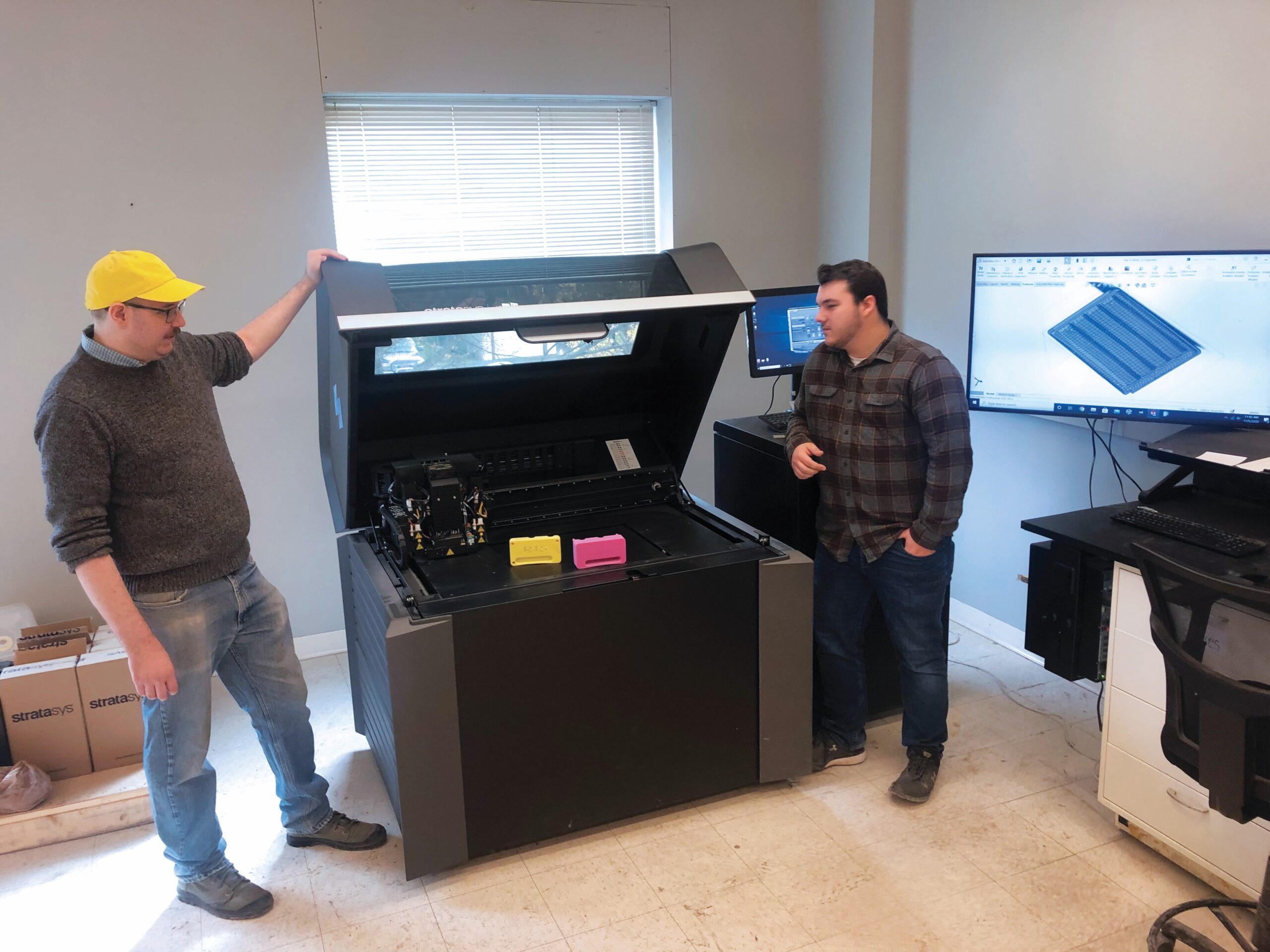
ALFRED, NY—Alfred University and its Center for Advanced Ceramic Technology (CACT) are supporting the launch of a new business that will commercialize a new additive manufacturing-based system for the terra cotta industry.
William Carty, professor of ceramic engineering and the J.F. McMahon Chair in Ceramics at the Inamori School of Engineering at Alfred University, launched the new firm Replacement Tiles Solutions, which is located at the IncubatorWorks facility in Alfred. IncubatorWorks—established in 1992 and previously operated as the Ceramics Corridor Innovation Center—is a state-of-the-art incubator offering services and facilities to foster growth of entrepreneurial businesses in ceramics, glass, advanced materials, and related technology-based industries.
Replacement Tiles Solutions is developing innovative solutions to 3D scan terra cotta roof tiles and other terra cotta elements in order to produce high-resolution molds used to make precise duplicates of the material needing replacement. Because this unique process allows for near-perfect color matching, replacement terra cotta can be installed without negatively impacting a roof’s aesthetics.
Replacement Tiles Solutions is working closely with Orchard Park, N.Y.-based Boston Valley Terra Cotta, a global manufacturer of architectural ceramics that will serve as a subcontractor to the new company. Alfred University alumnus John Krouse ’85 (B.S., ceramic engineering) is president of Boston Valley Terra Cotta, a company with over 40 years’ experience as a grade 1 terra cotta roof tile replacement company, which will assist Replacement Tiles Solutions in bringing their new process to market.
“Thanks to significant advances in additive manufacturing, and leveraging our decades-long experience in working with terra cotta materials, we are transforming the way terra cotta roofs are repaired,” Carty says. When terra cotta roofs are damaged, it is not uncommon for the entire roof to be removed and replaced, which can be an extremely expensive proposition. “Using our process, a homeowner can not only save thousands of dollars in materials and contactor costs by replacing only the damaged tiles, but also significantly reduce the amount of time needed to conduct the repairs,” Carty adds.
Replacement Tiles Solutions also partnered with CACT, one of 15 NYSTAR Centers for Advanced Technology. The CACT is providing support for internships, access to analytical services, and partnership opportunities. One such partnership includes restoration of the historic Celadon Terra Cotta building located on Alfred Village’s Main Street. Built in 1892 by the Celadon Terra Cotta Company, the building was designed as a sales office and display center for the company, and was considered a “catalog” of their work. Due in large part to the Celadon Terra Cotta Company’s location in Alfred, this prompted then Governor Theodore Roosevelt in 1900 to establish the New York State School of Clay-Working and Ceramics (now the New York State College of Ceramics) in Alfred.
“Thanks to funding being made available through Governor Cuomo’s Smart Growth Community Grant program that was awarded to the Village of Alfred, we’re able to utilize state-of-the-art technology to scan and duplicate certain terra cotta elements on that building that could otherwise never be reproduced,” says John Simmins, CACT executive director.
A committee of faculty, staff, and students from Alfred University have begun the process of identifying the repairs needed to both preserve its historic elements and ensure the building is structurally secure for another hundred years.
Adds Simmins, “The CACT was launched to support the growth of New York State’s ceramic industry, including the creation of start-up companies like Replacement Tiles Solutions. This is an exciting opportunity to support the growth of a new business in Alfred, leading to significant capital investment and sustainable job creation in our region.”
To date, Replacement Tiles Solutions has invested approximately $500,000 in specialized equipment used in its process, and the firm employs a handful of part-time and student workers. The firm hopes to graduate from the IncubatorWorks facility within the next two years and relocate to a larger facility to allow for expanded manufacturing while remaining in the Alfred community.

Related Articles

Market Insights
Next-gen superconducting ceramics could change how we travel and much more
Forty years ago, two physicists from IBM’s research laboratory in Zürich, Switzerland, reported a groundbreaking discovery: Superconductivity, or the quantum mechanical phenomenon in which certain materials exhibit zero electrical resistance when cooled, could be achieved at higher temperatures using ceramics. Superconductivity had been discovered decades before, but its applications had…

Market Insights
Why most AI manufacturing projects fail and how to fix it
Artificial intelligence is reshaping advanced manufacturing, especially processes involving ceramics, glasses, and other hard or brittle materials. But adopting AI is far more difficult than simply buying software and connecting machines. Manufacturers must understand the advantages and limitations of different models, so they can determine where AI fits best within…

Bulletin Features
Radiation effects on rare earth chemistry in molten salts for nuclear applications
Across the nuclear energy sector, molten salts are shaping the next generation of nuclear technologies, from advanced power reactors to used nuclear fuel recycling. In molten salt reactors (MSRs), molten salts uniquely serve as both the primary coolant and fuel medium, a dual role that sets MSRs apart from conventional…