

Raw materials are the starting point of it all. Without them, we would not be able to manufacture all the advanced functional materials that make our high-tech world of today possible.
That is why every year, we take a moment to focus on the state of raw materials with a review of the United States Geological Survey’s annual Mineral Commodity Summary.
The Mineral Commodity Summary 2016 details 2015 statistics on the production, supply, and overall market for more than 90 minerals and raw materials—from alumina all the way to zirconium. The report details events, trends, and issues for each material, and paints a quick two-page overview of the climate surrounding each commodity.
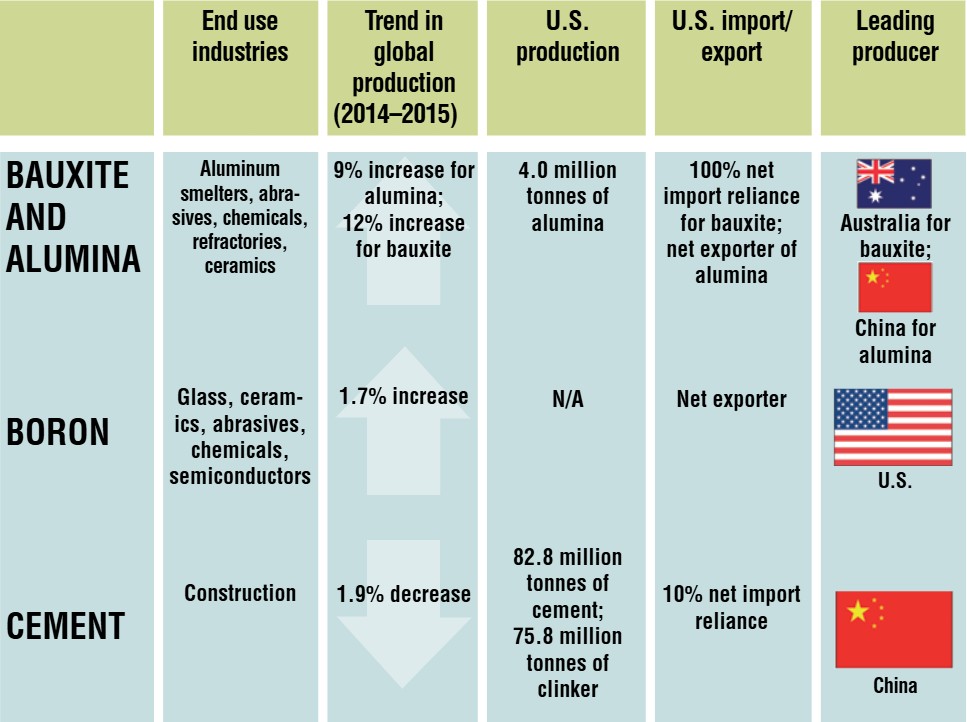
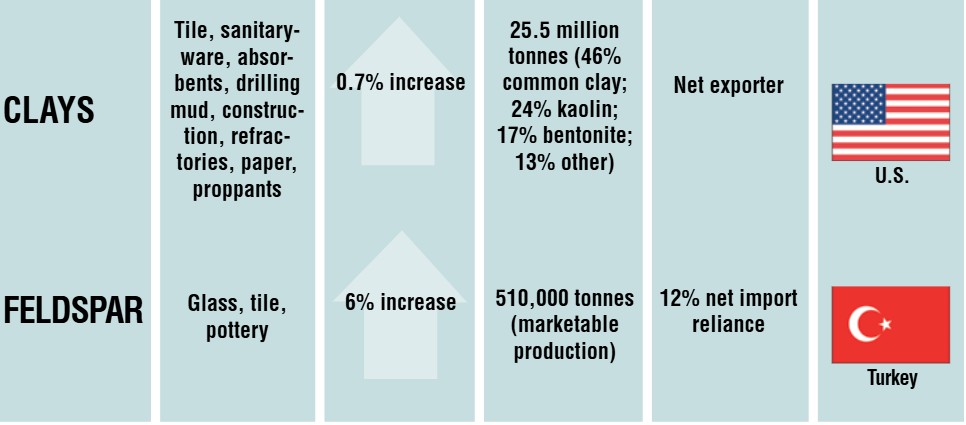
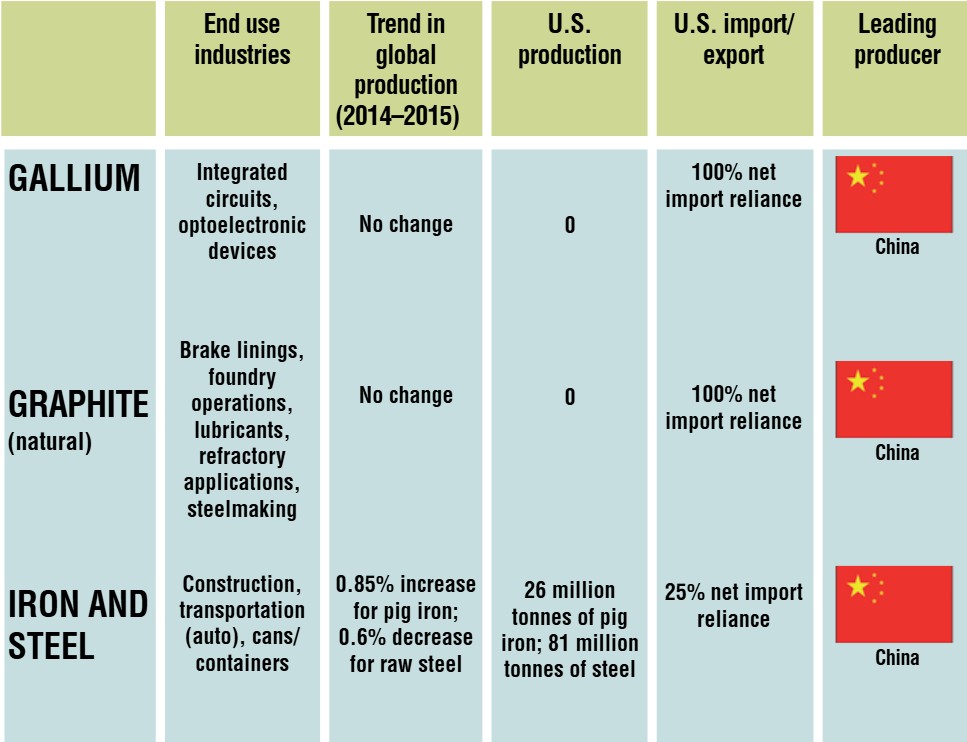
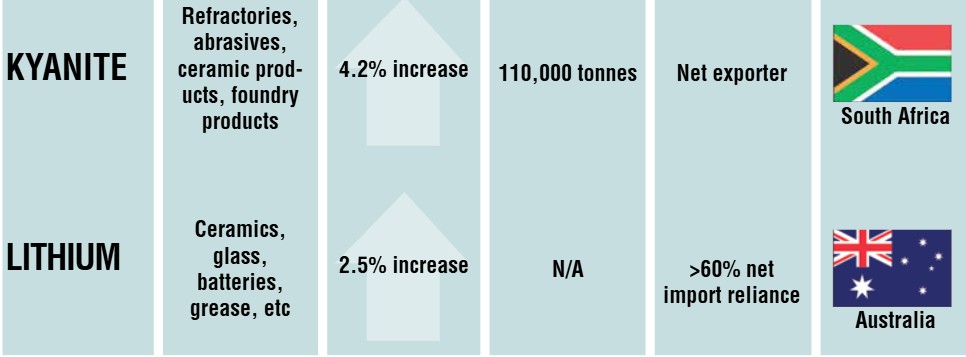
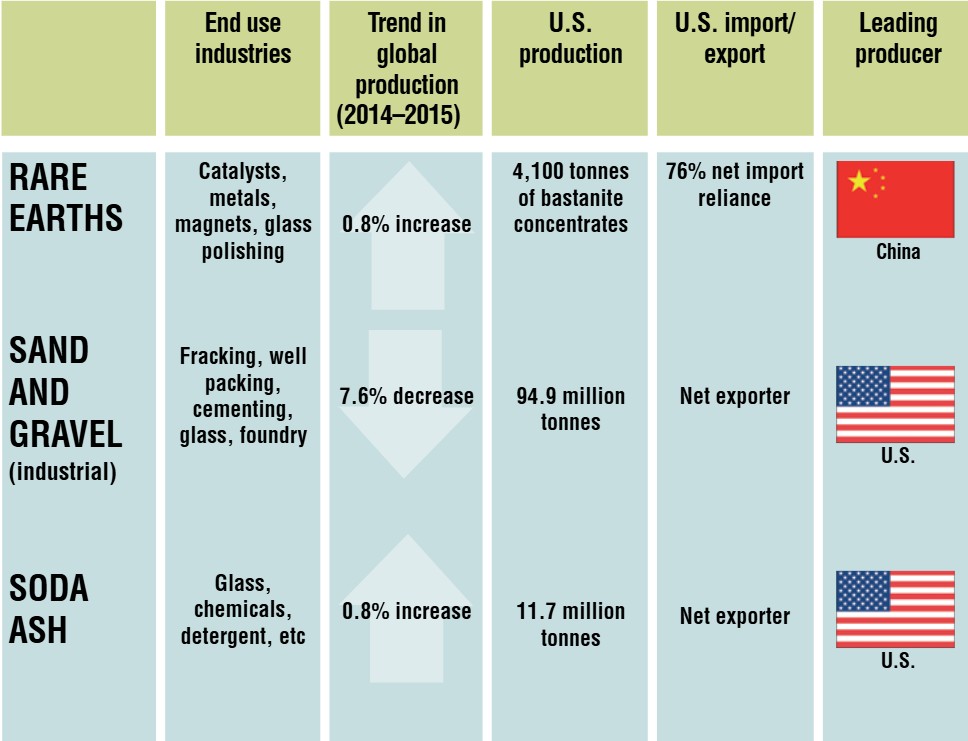
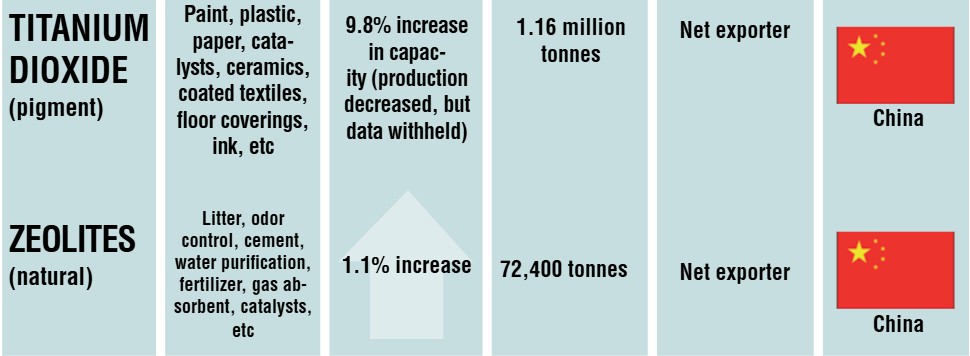
What follows on the next few pages is a summary of some salient statistics and trends for a handful of mineral commodities that are of particular interest in the ceramic and glass industries. Readers are encouraged to access the complete USGS report at https://pubs.usgs.gov/publication/70140094.
Perhaps not surprisingly, China led the world as the supplier of most nonfuel mineral commodities in 2015, with Canada coming in at second place.
In the U.S., estimated total nonfuel mineral production decreased 3% from 2014 to 2015, “mainly as a result of decreased metal prices, especially iron ore, copper, and precious metals,” according to the report. However, production of industrial minerals increased, especially in the construction industry.
Nonetheless, “minerals remained fundamental to the U.S. economy, contributing to the real gross domestic product at several levels, including mining, processing, and manufacturing finished products,” the report states.
The estimated value of mineral raw materials produced at U.S. mines in 2015 was $78.3 billion, a 3% decrease from 2014 figures. The estimated value of metals produced at U.S. mines in 2015 was $26.6 billion, a rather significant 15% drop from 2014 figures. However, industrial minerals production increased 4% from 2014 to 2015, for a total value of $51.7 billion.
A corroborating indicator of the challenging climate of the current world market is that several mines and downstream minerals processors idled or shut their doors in the past year.
We have seen some of those challenges particularly in the alumina industry of late. According to a recent Roskill Information Services report, the alumina and aluminum industries are currently in a state of oversupply, with output continuing despite low demand. Readers can learn more from the Roskill report at prn.to/1RRTEKj.
This imbalance has led to widespread reductions in commodity production and permanent closures of several refineries and smelters. Even larger companies, such as Alcoa, are not immune to the challenges. Alcoa cut capacity at several facilities and announced that in late 2016, the company will split into two separate entities, Alcoa and Arconic.
While operations have idled at other companies’ plants, too, some companies have not been able to survive by simply decreasing production. Sherwin Alumina Co. and Noranda Aluminum Holding Corp. filed for bankruptcy earlier this year, a deeper sign of the troubling state of affairs in this industry.
Although there definitely are challenges in the current market, the future outlook is not completely bleak. According to Mineral Commodities Summary 2016, growth-rate indexes at the end of 2015 indicated that there would be moderate growth in the nonmetallic mineral products industry in 2016.
In fact, we recently reported on Ceramic Tech Today that although the global manufacturing industry is in a current holding pattern, analysts suggest the changes are setting the stage for a firmer global economy.

Related Articles

Bulletin Features
Emerging Professionals: Science for Society & Future Focus
Science for Society articles: Rishabh Kundu and Ryan C. Eaton: “One small tweak to the lens of materials research, one giant leap for mankind” Grace Dunham: “Microwave firing: Inspiring young scientists through rapid ceramic demos” Hossein Libre: “Shaping materials science through policy engagement” Future Focus articles: Kartik Nemani: “Hope and…

Bulletin Features
Emerging Professionals: Research Articles
Experiential learning: Developing the next generation of engineers By Ryan Eaton When a measure becomes a target, it ceases to be a good measure. Goodhart’s law, coined in reference to monetary policy, is readily applicable to engineering education. When students begin optimizing their study habits to pass an exam rather…

Bulletin Features
Durable and programmable metasurfaces enabled by phase change materials
Controlling light with high spatial precision enables technologies ranging from imaging and sensing to communications. Traditionally, optical components such as lenses and filters rely on bulk materials and fixed geometries, which limit their ability to adapt dynamically. Metasurfaces offer a fundamentally different approach. These materials consist of planar arrays of…