
Canada may not be the most prominent nation to appear in industry headlines, but universities, businesses, and government agencies throughout the country are collaborating on impressive advances in ceramic technology. These breakthroughs are being driven by a combination of commercial opportunity and societal demands in areas such as environmentalism, which is a particular concern among students and young professionals.
“Strictly speaking about ceramics, I would say the big focus is in sustainable use of materials, trying to make materials last longer or degrade less or make them out of materials that are going to prevent fracture or degradation,” says Mary Anne White, University Research Professor of Chemistry at Dalhousie University, which conducts ceramics research in the departments of chemistry and engineering. “I think that students are going to be ever more concerned about energy and sustainability, and I think materials hold a lot of answers to some of our major problems.”
Partha Sarkar is principal scientist, environment and carbon management, in the Clean Energy group at Alberta Innovates–Technology Futures, which supports Alberta’s strategy for playing a significant role in the global nanotechnology market. “My projects are geared toward reduction of greenhouse gases and improving environmental sustainability,” he says. “Within our work, we have developed tubular micro solid oxide fuel cells (μSOFC) where we employed an electrophoretic-deposition-based tubular cell manufacturing method. We have developed a novel concept of ‘porous matrix embedded stack’ to improve the µSOFC performance and mechanical robustness.”
Sarkar also is working in partnership with Raj Gupta, a professor at University of Alberta, and AITF’s combustion expert, Allan Chambers, on carbon capture projects related to alternate combustion technology—chemical looping combustion (CLC). “The CLC process has two coupled fluidized-bed reactors, fuel and air,” he says. “In the air reactor, a metal is oxidized in contact with air. The metal oxide is then supplied to the fuel reactor, where it supplies the oxygen required for combustion. The metal oxide is thus reduced and resupplied to the air reactor in a continuous process. The metal/metal oxide solids act as an oxygen carrier. In the CLC process, the fuel does not come in contact with air during combustion, and the fuel reactor exhaust is mainly CO2 and water vapor. The water is condensed and the CO2 is captured.”
Hydraulic fracturing (fracking) presents another area of environmental concern and another field in which Canadian ceramic researchers are seeking solutions in nanotechnology. “Some of the extraction technologies today use a lot of water,” says Ken Brizel, CEO of ACAMP, Alberta Centre for Advanced Micro Nano Technology Products. “The nanocatalysts that are being created would require a lot less water to be able to do the same amount of extraction. That’s work that’s going on in a lot of research areas around Alberta. Everybody wants to get to be greener.”
At McMaster University, Igor Zhitomirsky, professor of materials science and engineering, conducts research focused on nanostructured materials for energy storage and generation. “The most promising project I have is related to electrochemical supercapacitors,” he says. “One of the most important materials for electromechanical supercapacitors is manganese oxide. Our research is focused on fabrication of nanoparticles, fabrication of composite electrodes, and testing of electrochemical devices.” His team is testing a prototype device that should be ready to be offered to industry within the next year or two.
White’s colleague at Dalhousie University, professor Jeff Dahn, is leading a team that has been working on materials for lithium-ion batteries and developing new cathode materials. Dahn reports that there is a 35% chance that material he discovered is found in any given lithium-ion battery on the market today. The materials are manufactured in the United States.
Canadian graduate students also are active in ceramic research. One of White’s students, Carl Romao, is attempting to combine positive thermal expansion and negative thermal expansion materials to create composite materials that are immune to thermal stress.

Low temperature cofired ceramic sections for advanced sensor assemblies and processes. (Credit: ACAMP).
Refractory industry—international and innovative
An interesting characteristic of the refractories sector in Canada is that although it is dominated by national and international corporations, such as Clayburn Refractories and Vesuvius, it also allows space for smaller players. Greg Langlois is president of Refractories Plus Inc. in Hamilton, Ontario. “In our business, a lot of it is personal. There’s still some relationship selling here,” he says. “The big players will work with us here.” His operation is nimble enough to react more quickly than some larger companies. His company has managed to land some big cross-border projects. “I have an arrangement with some trading companies in China that we have our own engineers on the ground over there. We were able to buy better-quality brick at lower cost and bring it over here.”
That interaction between small and big business, often in partnership with academic researchers and government-sponsored initiatives, is seen throughout the Canadian ceramic sector. “There’s one company we work with that’s involved in using titanium dioxide nanomaterials interwoven into aluminum—so they do titanium aluminide. Those are super strong, and they’re used in everything from energy to automotive applications,” Brizel says. “That’s a startup here in Alberta—90% of the companies we tend to work with come right out of universities or someone’s garage.” It is an approach that, although centered on small players, is producing big results in Canada’s ceramic industry.
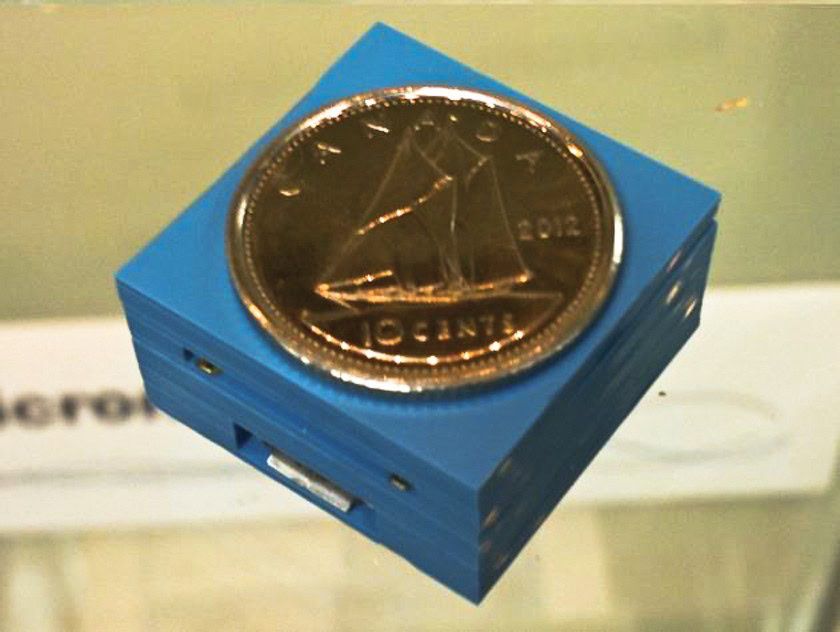
The assembled device is about the size of a Canadian dime. (Credit: ACAMP).
Investing in growth
The Natural Sciences and Engineering Research Council of Canada (NSERC) “supports university students in their advanced studies, promotes and supports discovery research, and fosters innovation by encouraging Canadian companies to participate and invest in postsecondary research projects.” The government agency, which was created in 1978, reports that during the past decade it has “invested more than $7 billion in basic research, projects involving partnerships between postsecondary institutions and industry, and the training of Canada’s next generation of scientists and engineers.” For fiscal year 2011–2012, NSERC awarded grants for pursuit of the following ceramic-related research projects:
- Development of direct fuel injection technology based on piezoceramic actuation. To Ridha Ben Mrad of the University of Toronto’s Mechanical and Industrial Engineering Department.
- MRI characterization of implantable drug delivery bioceramics. To Steven Beyea of Dalhousie University’s Physics and Atmospheric Science Department.
- Mechanical behavior of zirconia-based ceramics for use in CANDU supercritical water nuclear reactors. To Lukas Bichler of the University of British Columbia’s Okanagan School of Engineering.
- Fabrication of porous ceramic from multilayer-coated SiC particles through sol–gel followed by in-situ polymerization. To Jamal Chaouki of the École Polytechnique de Montréal Génie Chimique.
- Advanced ceramic structures and coatings for corrosion protection and thermal insulation for generation IV SCWRs; and Fabrication and potential application of macroporous ceramic materials/structures through chemical sintering. Both to Weixing Chen of the University of Alberta’s Chemical and Materials Engineering Department.
- Solution precursor plasma spray deposition of nanocrystalline functional ceramic coatings. To Thomas Coyle of the University of Toronto’s Materials Science and Engineering Department.
- Metal and ceramic interactions in materials processing. To Robin Drew of Concordia University’s Mechanical and Industrial Engineering Department.
- Ceramic electrolytes and secondary recovery. To Thomas Etsell of the University of Alberta’s Chemical and Materials Engineering Department.
- Development of high-toughness silicon nitride ceramics. To Vladimir Krstic of the Queen’s University Mechanical and Materials Engineering Department.
- Development and characterization of high-performance ceramic–metal composites; and High-performance ceramic–metal composites. Both to Kevin Plucknett of Dalhousie University’s Process Engineering and Applied Science Department.
- Amine–borane functionalized materials: Hydrogen storage media and precursors to boron nitride ceramics. To Eric Rivard of the University of Alberta’s Chemistry Department.
- Synthesis and characterization of novel biomedical glass-ceramic polymer composites. To Amin Rizkalla of the University of Western Ontario’s Chemical and Biochemical Engineering Department.
- Process engineering for smart bioceramic cements. To Tom Troczynski of the University of British Columbia’s Materials Engineering Department.
- Laser machining of ceramics with controlled microstructure. To Gennady Zak of the Queen’s University Mechanical and Materials Engineering Department.
Moreover, NSERC awarded 13 ceramic-related research scholarships for the 2011–2012 fiscal year.
Northern (market) exposure
Although Canada’s land mass is 61,002 square miles greater than that of the United States, its citizens number just 11% of the U.S. population. In fact, fewer people live in all of Canada than in the state of California. In terms of trade with the U.S., however, Canada bench-presses many times its body weight.
It is the world’s number one destination of U.S. exports and is second only to China as a source of goods imported by the U.S. Prominent among those imports are oil, gas, uranium, and electric power.―Canada is the largest foreign supplier of energy to the U.S. The petroleum sector is a particularly significant economic driver, and the country’s proven oil reserves place it third in the world, behind Saudi Arabia and Venezuela. Moreover, Canada is the world’s fifth-largest investor in the U.S.
For 2012, Canada’s purchasing power GDP is estimated at $1.513 trillion, or $43,400 per capita, which reflects a 1.8% growth rate over 2011. This makes Canada the 13th-largest national economy in the world, although it ranks 37 in terms of population. Services generate 69.8% of GDP, followed by industry (28.5%) and agriculture (1.7%).
Canadian export volume for 2012 is estimated at $462.9 billion. Its leading commodity exports include motor vehicles and parts, industrial machinery, aircraft, telecommunications equipment, chemicals, plastics, fertilizers, wood pulp, timber, crude petroleum, natural gas, electricity, and aluminum. Import volume for 2012 is estimated at $474.8 billion. Leading commodity imports include machinery and equipment, motor vehicles and parts, crude oil, chemicals, electricity, and durable consumer goods.
It all adds up to significant economic performance and market opportunity in “an affluent, high-tech industrial society in the trillion-dollar class,” notes the CIA Fact Book. The U.S. State Department terms this bilateral relationship “among the closest and most extensive in the world” and adds that the trading relationship is “the world’s largest and most comprehensive” and “supports millions of jobs in each country.”
For guidance on competing successfully in Canada and connecting with trading or business partners there, contact the American Chamber of Commerce in Canada, the Canada–U.S. Chamber of Commerce, or the Canadian–American Business Council. The U.S. Commercial Service has published Doing Business in Canada, and U.S.–Canada trade news can be followed on the website of the Embassy of the United States in Ottawa.
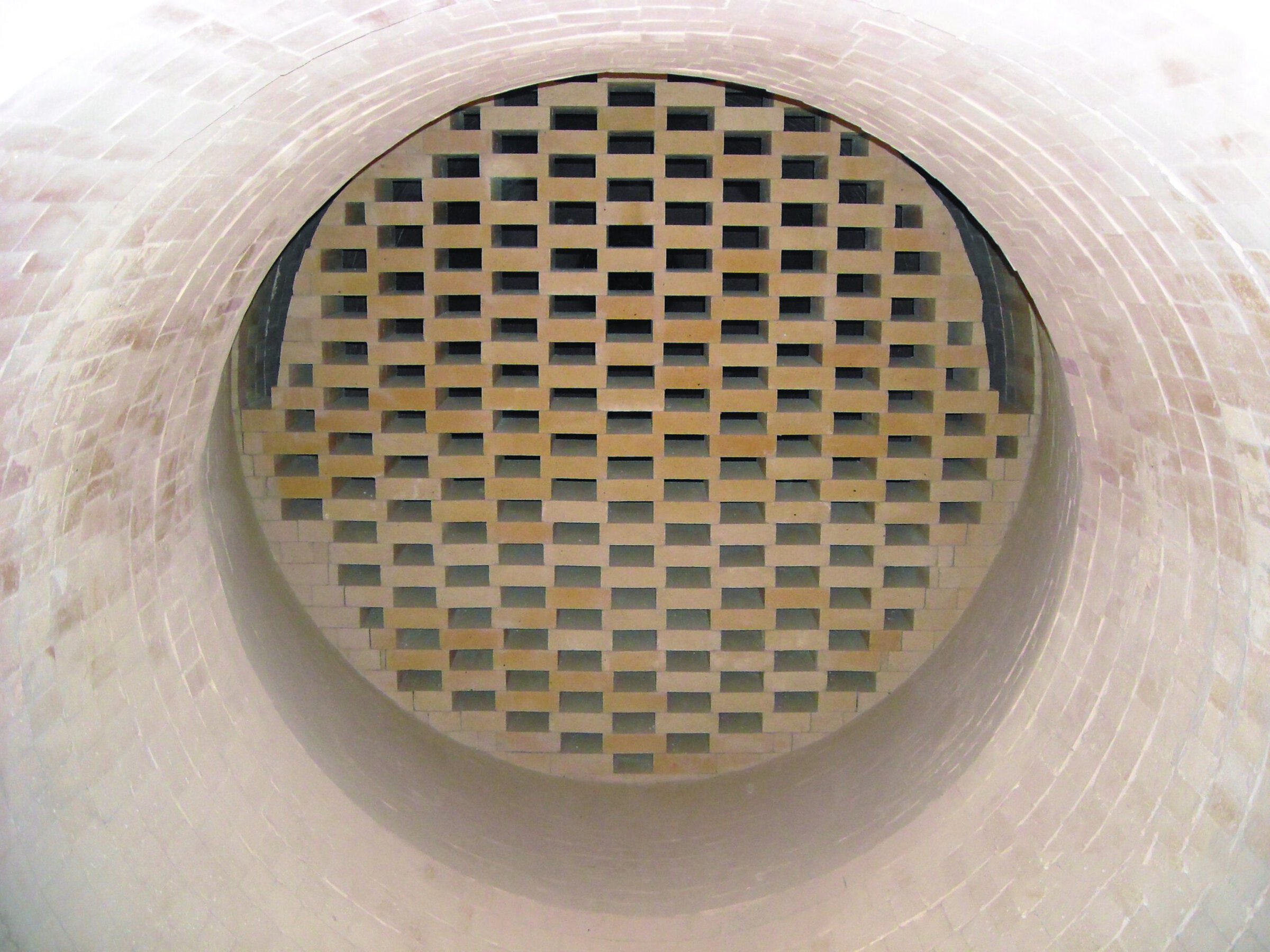
Sulfur recovery unit reaction furnace checker wall in a sour gas plant. Credit: Western Refractory Services Ltd.

Related Articles

Market Insights
Next-gen superconducting ceramics could change how we travel and much more
Forty years ago, two physicists from IBM’s research laboratory in Zürich, Switzerland, reported a groundbreaking discovery: Superconductivity, or the quantum mechanical phenomenon in which certain materials exhibit zero electrical resistance when cooled, could be achieved at higher temperatures using ceramics. Superconductivity had been discovered decades before, but its applications had…

Market Insights
Why most AI manufacturing projects fail and how to fix it
Artificial intelligence is reshaping advanced manufacturing, especially processes involving ceramics, glasses, and other hard or brittle materials. But adopting AI is far more difficult than simply buying software and connecting machines. Manufacturers must understand the advantages and limitations of different models, so they can determine where AI fits best within…

Bulletin Features
Radiation effects on rare earth chemistry in molten salts for nuclear applications
Across the nuclear energy sector, molten salts are shaping the next generation of nuclear technologies, from advanced power reactors to used nuclear fuel recycling. In molten salt reactors (MSRs), molten salts uniquely serve as both the primary coolant and fuel medium, a dual role that sets MSRs apart from conventional…