

Military platforms—such as ships, aircraft, and ground vehicles—rely on advanced materials to make them lighter, stronger, and more resistant to harsh environmental conditions.
Currently, the process for developing new materials frequently takes longer than a decade. This lengthy process often means that developers of new military platforms are forced to rely on decades-old, mature materials, because potentially more advanced materials are still being developed and tested and are considered too large a risk to be implemented into platform designs.
DARPA’s Materials Development for Platforms (MDP) program seeks to address this problem by compressing the applied material development process. MDP aims to achieve its goals through a collaborative, cross-disciplinary model that combines materials science and engineering with the platform development disciplines of systems engineering, design, analysis, and manufacturing.
Motivation for the Materials Development for Platforms program
Today’s process for developing new materials for platform applications is fraught with inherent delays and inefficiencies. To understand why, and how this motivates DARPA’s MDP program, consider the conventional material and process research, development, and deployment cycle shown at the top of Figure 1. The cycle typically proceeds through three phases.
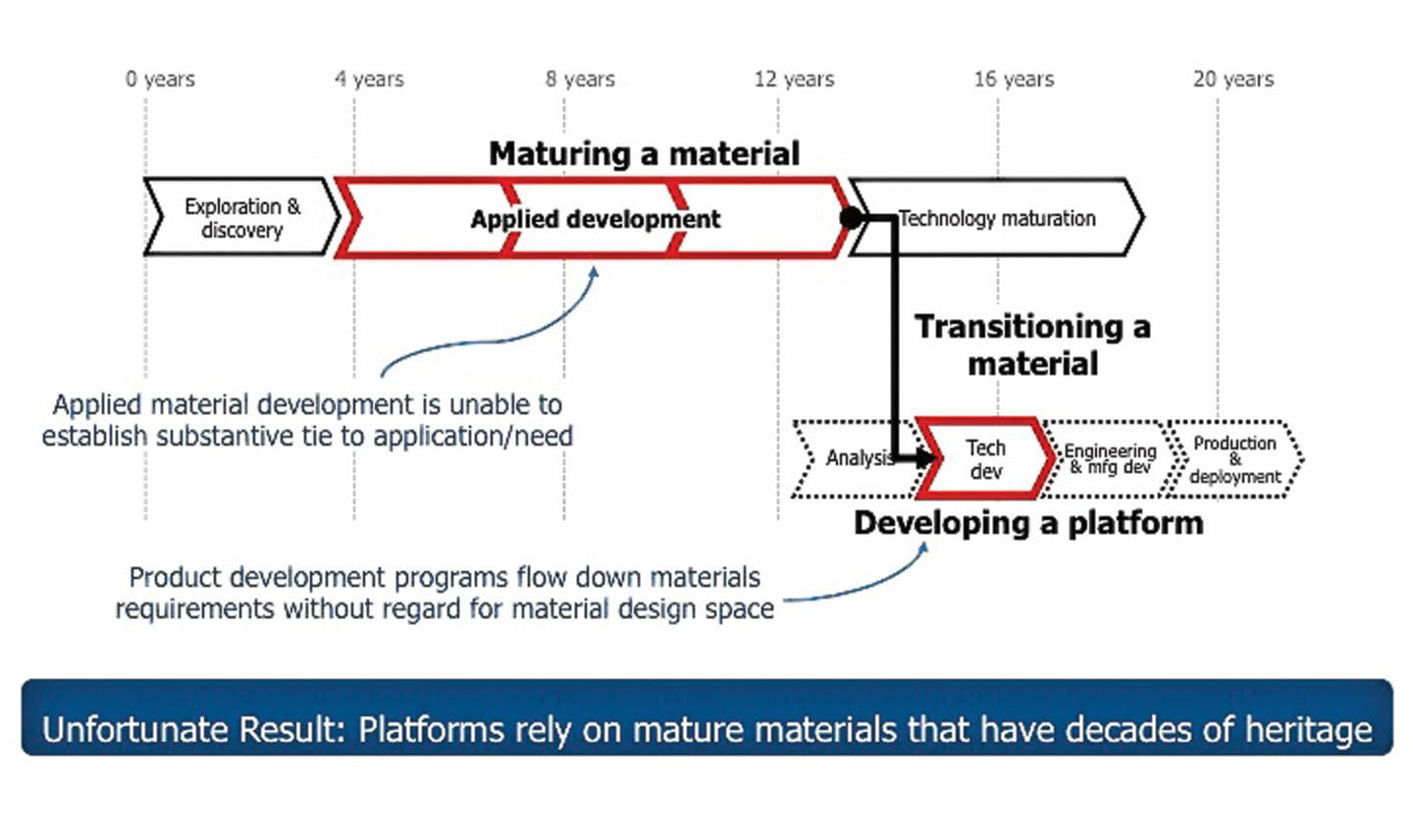
Figure 1. Applied material and process development takes many years and is based on poorly defined needs. Credit: DARPA
- Exploration and discovery is the proof of concept phase that produces candidate materials for which analytical and laboratory studies have physically validated analytical predictions. Often called fundamental materials research, this is a healthy and thriving enterprise that feeds many new ideas into the technology community each year.
- Applied material development is the phase during which a new material matures from proof of concept to prototype demonstration in a relevant environment, where the material technology can be inserted into a new platform program of record. Applied development advances the material through iterative cycles with a specific application in mind.
- Technology maturation is the final phase of material advancement, during which the material is applied in its final form and under mission conditions, such as those encountered in operational tests and evaluations.
From inception through technology maturation, the cycle for a new material or process historically takes 18–20 years—far too long for the material and process community to contribute substantively to the dynamic needs of new and emerging military platforms. The root of the problem is fundamental inefficiency and extended duration—typically 10 years or more—of the applied material development phase (highlighted in red in Figure 1). During this time, the material and process community typically does not establish a meaningful link to a timely application, often creating its own artificial requirements in isolation. The result is a heuristic, science-driven “random walk” approach to implementation, instead of an engineering-driven, “technology pull” directed toward a well-defined application.
Meanwhile, platform and product development (lower Figure 1), which could patently benefit from new and improved materials, mostly proceeds independent of material and process research, development, and deployment efforts. This is because the Department of Defense acquisition cycle has a comparatively short interval between milestones A and B—which “bracket” Technology Development (“Tech Dev” in red, Figure 1)—contrasted with the ≥10 years required to progress a material and process technology. This means that any new material the community offers to platform developers at milestone A already must satisfy the platform’s milestone B requirements.
If it does not—which is usually the case, as indicated above—platform developers do not have the desire, time, funding, or trust to invest in an applied material development cycle on the hope that it could be compressed to less than the usual ≥10 years to meet the platform development schedule. The reality is that the product development program community can exert only very limited “technology pull” on an applied material and process development effort. Likewise, from the perspective of a developer, it is extremely difficult to establish a strong substantive tie to a real need and application.
The ultimate penalty for this poor alignment between the extended materials development cycle and the military platform development cycle is that platform developers usually default to mature, “off-the-shelf” materials and designs with decades of heritage and operational experience. In fact, although platform developers often are willing to take on developments in software, engineering design, and components, they will not engage a material development program. Ultimately, this limits the trade space and capability of new, advanced defense systems.
Specific examples of this are legion. For instance, the F-35 uses the same materials as the F-22, which uses the same materials as the F-18. And although there are many composite armor systems being developed in Army programs, the Army typically uses steel—few new materials are being used on armored vehicles.
This critical need to reduce the time to develop new materials is what motivates the MDP program. MDP aims to develop a methodology and toolset to compress the applied material development sequence from ≥10 years to about 2.5 years.
To focus program efforts, MDP is being applied to the field of hypersonics, where maturation of new high-temperature materials poses a particularly significant need.
Program concept
The MDP program aims to disrupt the current material development paradigm by invoking a materials development framework that artificially simulates the platform or product development sequence for a materials development effort. This framework, guided by design intent, is intended to be an all-encompassing, cross-disciplinary, collaborative methodology that reduces the time required to mature and transition new materials to new products and platforms.
Design intent is the functional role of the materials systems at conceptual design, instead of waiting until a preliminary design has been completed and for design requirements to flow down. Developing new materials based on design intent will allow designers and materials developers to collaborate and optimize solutions based on material attributes and performance needs and will allow rapid assessment, optimization, and maturation of material systems to meet platform design intent and manufacturability requirements.
In the context of MDP, “cross disciplinary” has a specific meaning that begins with, but is not necessarily limited to, integrating materials and processing, manufacturing, and true integrated computational materials engineering (ICME) principles with platform engineering, design, and analysis disciplines. Deliberate focus is placed on true ICME principles—i.e., using modeling and simulation as a tool to guide material development—rather than efforts solely to improve fidelity and accuracy of models and simulations themselves. Further, mature verification, validation, and uncertainty quantification techniques should be used to quantify the accuracy and precision of predictive tools. It is generally accepted that inaccurate and imprecise modeling and simulation outputs can still be useful as long as levels of inaccuracy and imprecision can be quantified.
MDP is experimenting with incorporation of materials informatics disciplines, which aim to apply contemporary data analysis techniques to the disparate sets of data developed during a materials and product development effort. These data could be as varied as processing parameters, micrographic images of morphology, chemical properties, mechanical properties, and stress and thermal distributions—wholly dissimilar sets of information that are usually analyzed in a heuristic fashion by experts and connected via heuristic and knowledge-based processes. Instituting data reduction techniques as required, MDP will determine whether novel interrelationships and new insights can be extracted based purely on a data-analysis approach.
MDP also is exploring the field of metrology to identify whether there is new measurement science for representing environments or operational conditions and for extracting operationally relevant behavior of materials in these environments. This is key, because often platform or product development characterization techniques are too expensive for material developers to leverage, so they typically use smaller-scale, streamlined characterization techniques that may not represent what product developers need. Characteristics that are relevant to product developers must then be extracted or assumed from these small-scale measurements.
MDP’s new methodology will incorporate manufacturing technology capabilities and constraints, or manufacturability, as part of the development cycle. In the traditional acquisition cycle, engineering and manufacturing development begins after milestone B, at which point all the component technologies have been brought forward. Therefore, manufacturing is typically not even considered until the platform’s critical design review has been concluded. MDP aims to bring together manufacturing specialists, materials developers, and designers to integrate their activities very early in the design cycle to facilitate rapid assessment, optimization, and maturation of material systems and designs to meet platform design intent and manufacturability requirements. This allows designers and materials developers to collaborate and optimize final designs in considerably less time.
It is critical that independent verification and validation of MDP subcomponents be incorporated throughout all aspects of this process. More specifically, two levels of testing and assessment will be incorporated: thermostructural characterization at the coupon level using unique methods and instrumentation; and operationally relevant arc-jet testing for accurate extraction of material characteristics of subcomponents that incorporate relevant geometric complexity and relevant size-scale (see sidebar: “MDP use case: Hypersonic vehicles”).
MDP’s overall success relies on its execution component to rapidly assess, optimize, and mature material systems to meet platform design intent and manufacturability requirements. MDP’s vision is that collaborative and rapid design and development iteration cycles will be much more efficient in the overall platform development. In other words, iterative design–build–test cycles will outperform vastly a sequence of design–design–design–design–build–test.
MDP will demonstrate this methodology and tool capability through subcomponent testing. The initial 30-month program phase will establish necessary methodology and toolsets.
Program execution
MDP program execution is summarized in Figure 2. MDP seeks to change the current paradigm by forcing various “stovepiped” fields of expertise to integrate their efforts to compress the timeline for materials development for real applications. Instead of basing material requirements on perceived application needs, design intent will be generated by vehicle and test engineers. Predictive materials engineering—in this case, ICME and materials informatics—will be used to generate a database of virtual material properties, taking into account various loads and design configurations provided at the vehicle level.
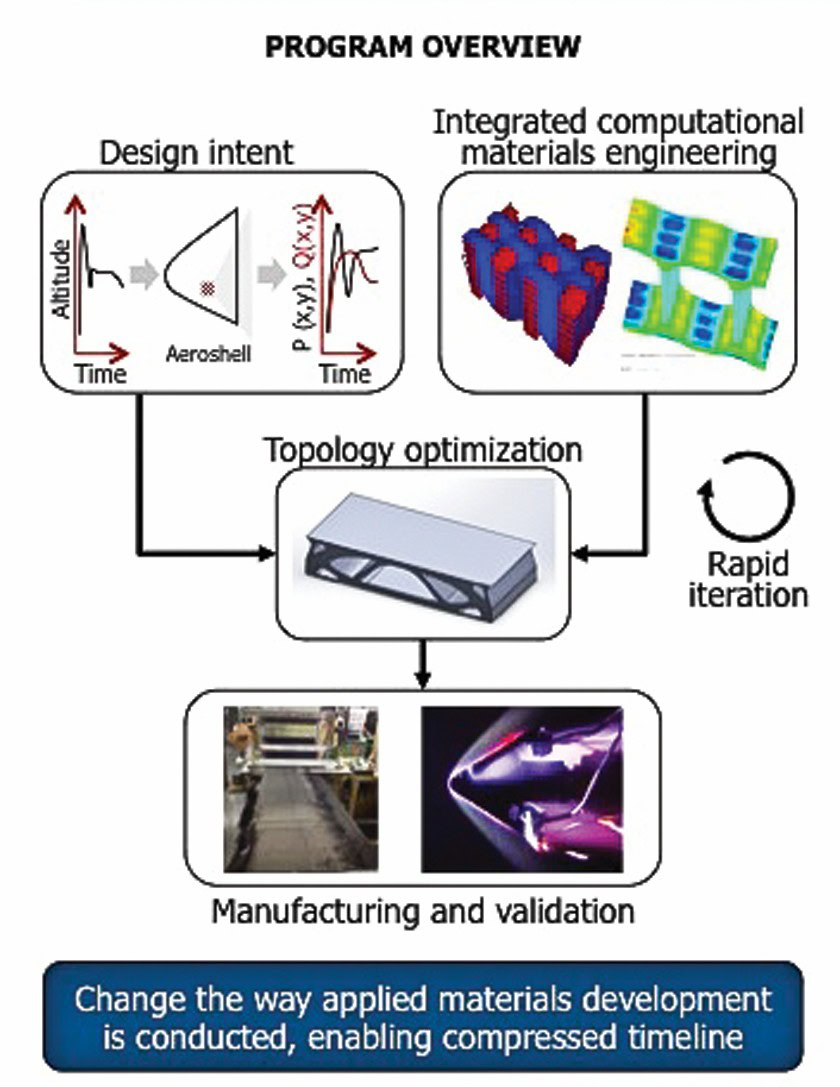
Figure 2. MDP seeks to change the way applied materials development is conducted, enabling a compressed timeline. Credit: DARPA
Iterative and integrated laboratory-scale testing will be used to validate simulations and is key to rapid cycling through potential materials and designs. A topology optimization task will use the materials database and operational conditions to generate nonobvious optimized subcomponent designs for a combined environment (for MDP’s use case, aero–thermal–chemical–structural) testing. Fabrication will iteratively build in complexity, from coupon-level specimens all the way to subcomponents with traceable complex geometry and integration features. An independent verification and validation team will be involved throughout and will conduct laboratory-level and subcomponent validation testing and analysis.
With the use case of a hot structure for hypersonic boost-glide, the MDP program is arranged into four technical areas and an independent verification and validation team.
- Technical area 1—Engineering (design and analysis). In contrast with the status quo to initiate new designs based on heritage platforms, flight conditions and multiphysics topology optimization will be used to develop nonobvious, optimized designs. High-fidelity, multiphysics analysis will be coupled to understand aero–thermal–chemical conditions and behavior. A framework will be created for cross-disciplinary material development.
- Technical area 2—Materials and processing, manufacturing, modeling. Two materials systems are being pursued. The first is based on a 3-D woven ceramic-matrix composite that is a unitized 3-D woven carbon–carbon aeroshell with integrally woven rib stiffeners. This effort will make use of the existing ICME toolset using top-down systems-level parameters and defect-driven microstructural physics models. It also will make use of two densification sources for better understanding of the process and its variability. The second is an integrally woven carbon–silicon carbide ceramic metal-matrix composite sandwich. The existing ICME toolset will be used to generate homogenized, nonlinear time-dependent behavior from high-fidelity models of the weave architecture and its microstructure.
- Technical area 3—Materials informatics. This effort will involve an automated informatics model with genetic optimization and inverse design capabilities. The framework will receive data and requirements from engineers to produce actionable process–structure–property insights. The insight cycles will be sequenced quarterly in materials insight analysis sprints (suggest–collect–describe–model).
- Technical area 4—Metrology. This area will leverage an existing facility that provides enthalpies and pressures that are consistent with necessary testing environments, enabling specialized facility upgrades to nozzles to provide higher-Mach flow, heat exchangers to cool the higher-Mach nozzles, and fixturing to allow testing of multiple specimens per run. The capabilities of the upgraded facility will be unique and will enable a full-fledged hypersonic materials screening facility.
- Independent verification and validation. To provide maximum understanding of the characteristics governing thermal–chemical–mechanical behavior of hypersonic structures, independent verification and validation of subcomponents will be conducted in operationally relevant environments. An independent verification and validation test bed and support team has been established and coordinated by DARPA to provide guidance and enable effective ground testing of flight-configured boost-glide hot-structure aeroshell subcomponent hardware tested in a simulated hypersonic environment with relevant fixturing. Planning, coordination, execution, and analysis of arc heater tests will be conducted in months 12, 20, and 29 at the USAF AEDC H2 or a similar arc heater facility. This team also will gather and compile a historical hypersonic database for archive, curation, and analysis.
As mentioned above, MDP requires ICME to be incorporated into the materials development process, with a focus on true ICME principles.1 Modeling is not conducted merely to improve accuracy and fidelity of process or material property models. MDP integrates relevant sets of processing, materials, and design modeling and simulation tools for meaningful prediction of process–microstructure–property–performance relationships. MDP emphasizes using these models and simulations as tools to accelerate the material development effort and make it more efficient. Therefore, understanding the maturity and uncertainty levels of all modeling and simulation tools is central to implementing ICME in MDP.
The veracity of computational fluid dynamics and structural mechanics analysis (e.g., finite element analysis) is rarely questioned today, because the respective computational models and frameworks were subjected to systematic verification, validation, and uncertainty quantification2,3 during implementation. Therefore, the established systematic, rigorous, and disciplined approach of verification, validation, and uncertainty quantification will be extended to ICME to build confidence that MDP is developing and utilizing robust, trusted models.
Program expectations
The MDP program’s hypersonic vehicle case will develop flight-configured subcomponents developed and integrated with a specific application in mind that drives design and catalyzes various technical teams to work together. Independent verification, validation, and uncertainty quantification methodology will overlay and establish trust in moving parts of the MDP framework in a relevant, operational environment—all with the ultimate goal of providing the hypersonic community with new materials that enable higher-performance capabilities in developing vehicles.
DARPA has established several specific and aggressive goals for MDP:
- Use hypersonic challenge problems to force the material and design communities to integrate their tools;
- Demonstrate ICME tool capabilities through subcomponent testing;
- Deliver a validated set of new hypersonic material systems using a framework that reduces the current development timescale from ≥10 years to 2.5 years, enabling step-change performance and platform concepts;
- Advance MDP materials systems from technology readiness level 3 (Analytical and experimental critical function and/or characteristic proof of concept) to technology readiness level 6 (System/subsystem model or prototype demonstration in a relevant environment) in 30 months, with detailed technical milestones to pace the performance;
- Build confidence in MDP’s integrated materials and design tools by applying rigorous verification, validation, and uncertainty quantification to the program’s computational approaches and tools; and
- Transfer program data to DARPA using the Materials Selection and Analysis Tool (MSAT)/Materials and Processes Technical Information System (MAPTIS) database archival system, accessible by U.S. government personnel.
Achieving success through the validated MDP methodology and toolset will fundamentally and radically change how applied materials development is conducted, enabling dramatically compressed development timelines.
MDP use case: Hypersonic vehicles
MDP has chosen an application to develop and exercise the framework: hypersonic material systems for a boost-glide hot structure aeroshell. Boost-glide defines a specific category of trajectory and platform; aeroshell indicates that this is a single-piece exterior or outer mold line; and hot structure indicates that the outer mold line functions as thermal insulation and as a primary load-carrying structure.
This application is extremely challenging because of the extreme environment and operational conditions, which truly push boundaries of the materials and platform designed. However, the application is relevant, because current operational baselines are limited by available materials, and because there is a large quantity of low- to mid-maturity materials available.
To establish design intent, an MDP Broad Agency Announcement presented a representative boost-glide flight profile that sets the aero–thermal–chemical environment in which the vehicle will operate. An approximate vehicle description also was provided to MDP proposers to help translate the flight profile into vehicle loading conditions. Vehicle integration artifacts, including bulkheads, joints, and seals, must be developed and represented in subcomponent designs to avoid surprises when materials are scaled up from coupons to full-scale articles—a necessary outcome of this interdisciplinary framework guided by design intent.
Independent verification and validation of subcomponents will be conducted in operationally relevant environments, because final MDP materials and designs will be subjected to ground tests that simulate the conditions of representative flight conditions.
The hypersonic vehicle use case will force material design communities to integrate their tools successfully to meet the MDP goal of a 30-month development timeline.

Related Articles

Bulletin Features
Emerging Professionals: Science for Society & Future Focus
Science for Society articles: Rishabh Kundu and Ryan C. Eaton: “One small tweak to the lens of materials research, one giant leap for mankind” Grace Dunham: “Microwave firing: Inspiring young scientists through rapid ceramic demos” Hossein Libre: “Shaping materials science through policy engagement” Future Focus articles: Kartik Nemani: “Hope and…

Bulletin Features
Emerging Professionals: Research Articles
Experiential learning: Developing the next generation of engineers By Ryan Eaton When a measure becomes a target, it ceases to be a good measure. Goodhart’s law, coined in reference to monetary policy, is readily applicable to engineering education. When students begin optimizing their study habits to pass an exam rather…

Bulletin Features
Durable and programmable metasurfaces enabled by phase change materials
Controlling light with high spatial precision enables technologies ranging from imaging and sensing to communications. Traditionally, optical components such as lenses and filters rely on bulk materials and fixed geometries, which limit their ability to adapt dynamically. Metasurfaces offer a fundamentally different approach. These materials consist of planar arrays of…