
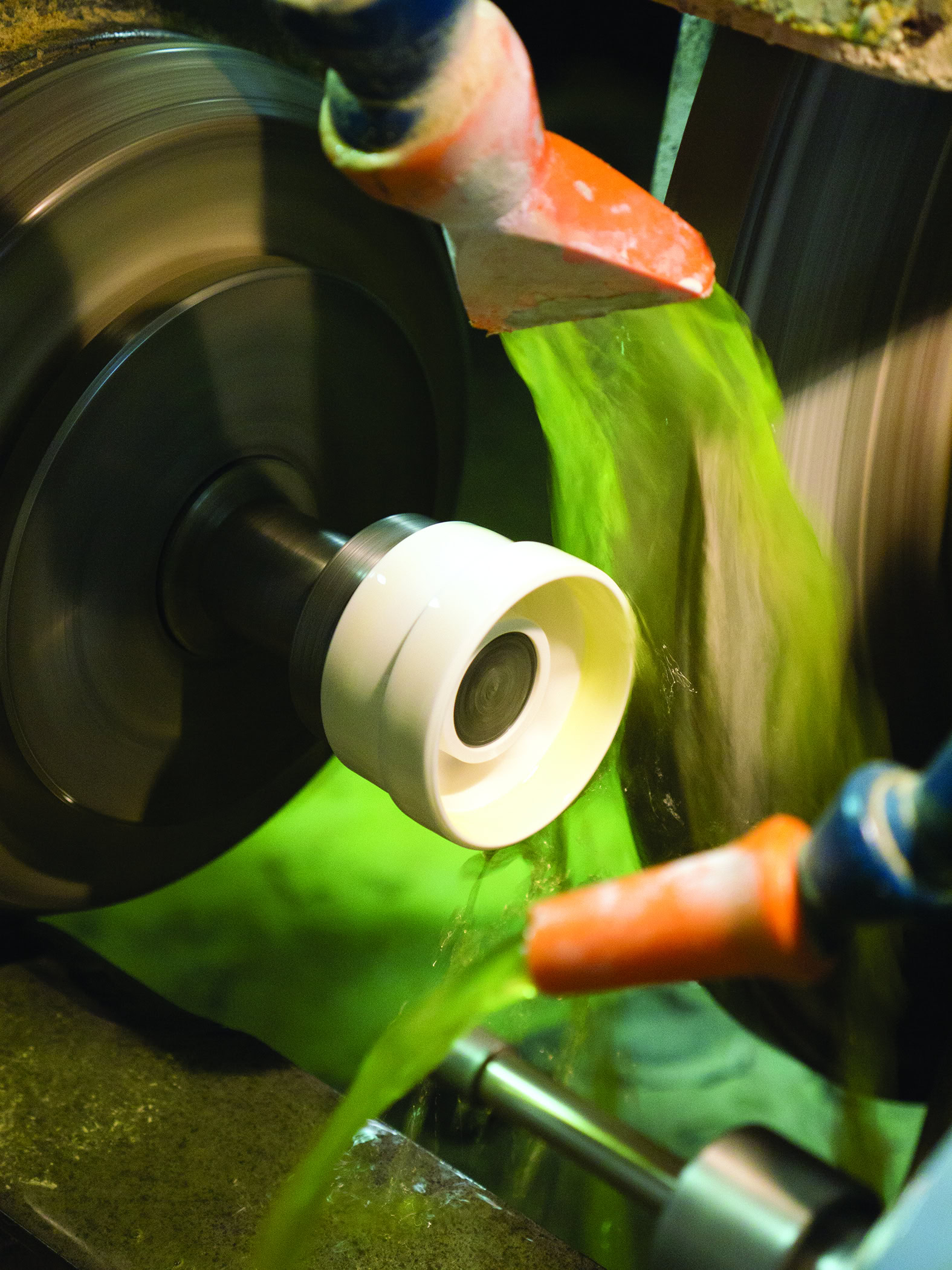
Advanced ceramics have attractive properties—including resistance to corrosion, heat, impact, and chemical attack—that make them competitive in a variety of markets, namely those comprising electronic components, transportation equipment, electrical equipment, chemicals, machinery, and medical products.
Recent technological advances have allowed manufacturers to produce finer and more consistent nanoscale-sized ceramic powders. Small particles improve powder binding and allow deposition of thinner, more uniform coatings, translating into higher performance of finished ceramic components. The cover article of this issue features one such company, Ceramco, that manufactures custom parts using ceramic injection molding of high-quality powders. To embark on a “plant tour” of Ceramco’s facilities and processes, turn to page 26.
Processing advances have taken the advanced ceramics market to new heights, and the materials compete aggressively with nonceramic materials in a variety of markets. Market analysts from research company The Freedonia Group (Cleveland, Ohio) predict market demand for advanced ceramics in the United States alone—which already surpasses $10 billion—will increase 5.1% per year to reach $13.6 billion in 2017.1
The top eight advanced ceramics manufacturers in the U.S.—Kyocera, 3M, CoorsTek, Murata Manufacturing, Vishay Intertechnology, Corning, Vesuvius, and NGK Insulators—analyzed in a recent Freedonia report secured 24% of the market in 2012. Although the U.S. advanced ceramics market is competitive, Japan historically has led the industry and remains a key producer and exporter of advanced ceramic products, particularly electronic components, such as ceramic capacitors and piezoelectric devices.
Although advances in numerous areas and industries drive the market’s upward trend, above-average growth in the medical, transportation, and machinery markets will impact growth of the advanced ceramics market most significantly.
New applications for bioceramics, including dental implants, orbital eye implants, prosthetic components, and orthopedic implants, account for growing demand in the medical market because of the materials’ wear resistance and biocompability. Ceramics’ superior wear resistance also makes them well suited for harsh and demanding manufacturing environments, for example, in the machinery market.
In the transportation sector, more stringent efficiency and emission standards will continue to drive demand for advanced ceramics, with applications in vehicle ceramic filters, catalyst supports, and engine parts. Ceramic-matrix composites also are integral to the transportation market and represent one of the fastest-growing advanced ceramic product markets. Market analysts predict ceramic-matrix composites will experience a compound annual growth rate of 13.81% through 2019, when the market will reach a value of $2.40 billion. The aerospace industry represents a significant proportion of this demand, alone accounting for $1.01 billion of the 2019 ceramic-matrix composite market.2
Despite the explosive growth of ceramic-matrix composites, however, monolithic ceramics remain the most significant class of advanced ceramics and account for almost 81% of current market demand. Ceramic-matrix composites hold 6.5% of the advanced ceramics market, with ceramic coatings accounting for the final 12.5%.
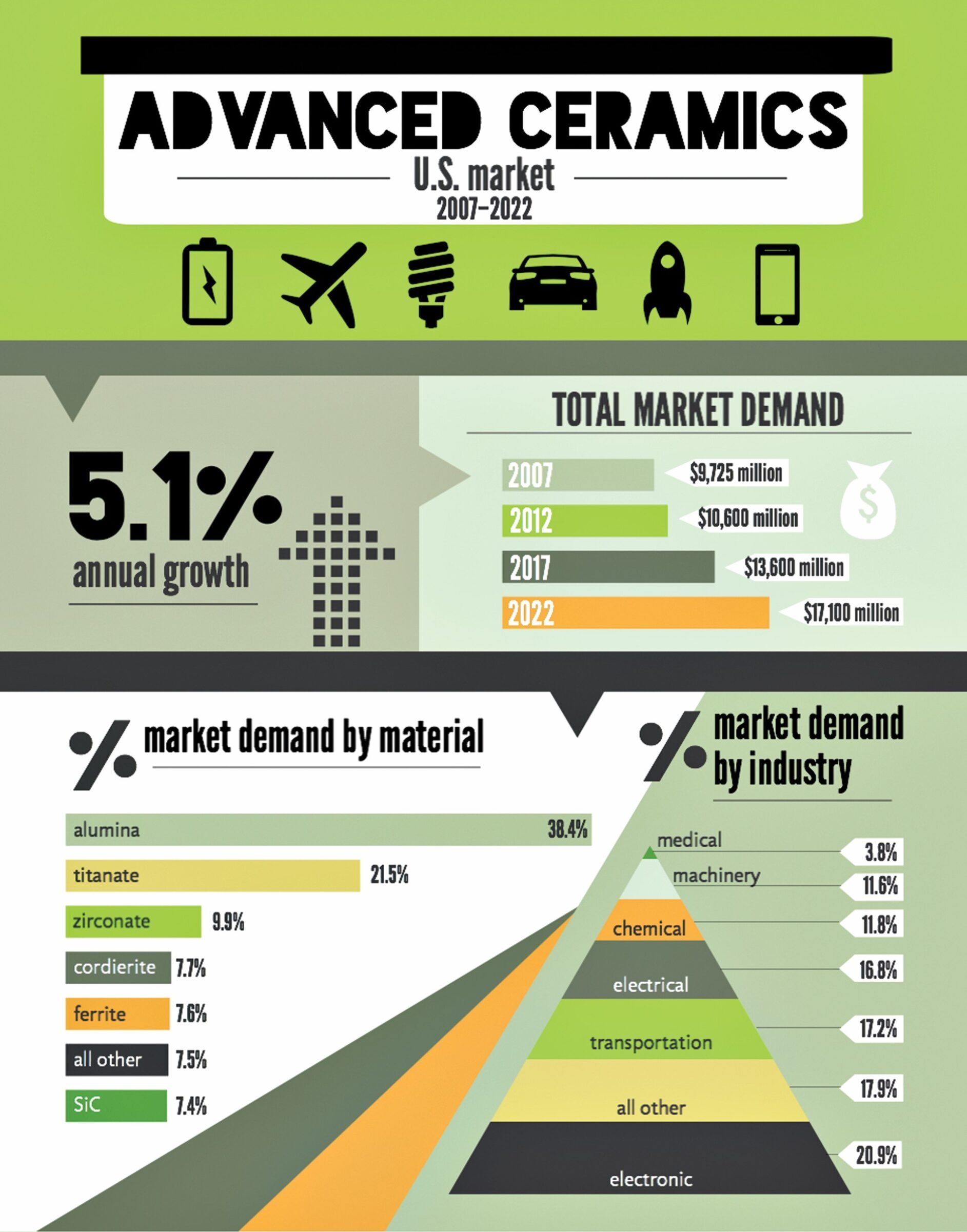
Credit: A. Gocha. Source: The Freedonia Group, “Advanced Ceramics.” 2013.
After experiencing a peak in 2007, the defense market for advanced ceramics is predicted to remain depressed consequent to U.S. troop withdrawal and military surpluses. Future growth of the market is expected to depend on ballistic applications, such as helmets and armor.
Alumina is the material of choice for advanced ceramics and commands 38% of the total U.S. market. And, although zirconates are in much less demand—just 10% of the U.S. market—than alumina, growing use in medical applications is expected to make zirconates the fastest growing material market for advanced ceramics.
Electrical and electronic parts and catalyst supports are the two highest in-demand advanced ceramics products. Together, these products carry more than a third of the total growth forecasted in the advanced ceramics market through 2017. Demand for electronic and electrical parts is predicted to grow at an annual rate of 3.3%, while catalyst supports are expected to see 4.1% annual growth.
Continuously improving properties and manufacturing advances will push advanced ceramics markets to grow as applications for these versatile materials expand. See the opposite page for an infographic of some of the key figures and statistics from the advanced ceramics market. For more information, visit Freedonia’s 2013 industry report, “Advanced ceramics,” at www.freedoniagroup.com/industry-study/3091/advanced-ceramics.htm.

Related Articles

Market Insights
Next-gen superconducting ceramics could change how we travel and much more
Forty years ago, two physicists from IBM’s research laboratory in Zürich, Switzerland, reported a groundbreaking discovery: Superconductivity, or the quantum mechanical phenomenon in which certain materials exhibit zero electrical resistance when cooled, could be achieved at higher temperatures using ceramics. Superconductivity had been discovered decades before, but its applications had…

Market Insights
Why most AI manufacturing projects fail and how to fix it
Artificial intelligence is reshaping advanced manufacturing, especially processes involving ceramics, glasses, and other hard or brittle materials. But adopting AI is far more difficult than simply buying software and connecting machines. Manufacturers must understand the advantages and limitations of different models, so they can determine where AI fits best within…

Bulletin Features
Radiation effects on rare earth chemistry in molten salts for nuclear applications
Across the nuclear energy sector, molten salts are shaping the next generation of nuclear technologies, from advanced power reactors to used nuclear fuel recycling. In molten salt reactors (MSRs), molten salts uniquely serve as both the primary coolant and fuel medium, a dual role that sets MSRs apart from conventional…