

The phrase “Mexican ceramics” may first call to mind images of objects of art and tableware created by artisans whose work follows centuries-old and even pre-Columbian traditions. That’s understandable: In Mexico City, Puebla, and other major urban areas, there are multistory buildings whose entire exteriors are covered in handcrafted tile as shown in the image to the left. But those images do not begin to encompass the full range of advanced technological projects being researched, developed, and manufactured in contemporary Mexico’s ceramic sectors.
Nanotechnology is one area of strong focus and will be in the spotlight during the Nanotech Biotech 2013 New Venture Competition being held November 7–8 in Monterrey, one of the country’s largest business and industrial centers. Its purpose is to spark the launch of high-value businesses—in particular, small and medium enterprises—that work with emerging technologies.
Since 2000, the ceramics industry in Mexico has been advancing its work in research and development of applications in the area of nanotechnology. Growth in this area has been promoted by such institutions as the National Council of Science and Technology (CONACYT), the National Petroleum Institute, the National Polytechnic Institute, and the National Autonomous University of Mexico.
Work in the area of nanotechnology engineering has resulted in the launch of a range of new products and applications related to the manufacture of electricity-generating equipment and electrical apparatuses and computers, communications, and peripheral equipment. Product development has focused on the use of nonmetallic minerals in the manufacture of glass, cement, ceramics, refractories, and abrasives.
In the research arena, the Advanced Materials Research Center (a division of CONACYT known by its Spanish acronym CIMAV) published articles during 2013 on
- Microemulsions as reaction media for the synthesis of mixed oxide nanoparticles: Relationships between microemulsion structure, reactivity, and nanoparticle characteristics;
- Antimicrobial activity, cytotoxicity, and inflammatory response of novel plastics embedded with silver nanoparticles;
- Corrosion behavior of AISI 409Nb stainless steel manufactured by powder metallurgy exposed in H2SO4 and NaCl solutions;
- Density functional theory study of indigo and its derivatives as photosensitizers for dye-sensitized solar cells;
- Influence of sugar-cane bagasse ash and fly ash on the rheological behavior of cement pastes and mortars;
- Magnetic susceptibility studies of the spin-glass and Verwey transitions in magnetite nanoparticles;
- Effect of sintering temperature on the electric properties and microstructure of SnO2–Co3O4–Sb2O5–Cr2O3 varistor ceramics;
- ZnO-Ag ceramics for ethanol sensors;
- Essential work of fracture: An approach to study the fracture behavior of acrylic bone cements modified with comonomers containing amine groups; and
- Alumina-toughened zirconia (ATZ) nanocomposite incorporating Al2O3 whiskers.
For a full listing of this year’s research projects—there are 45 in all—and English-language abstracts, visit http://cimav.edu.mx/investigacion/listado-articulos/listado-articulos-2013/#articulo1.
This research is based on current industrial needs and on projections of future economic opportunity. According to a study by NANOTECH, Mexico’s National Nanotechnology Lab, worldwide demand for specialists in microtechnology and nanotechnology will grow to two million jobs by 2015. Companies and universities, therefore, see the field as one that will help Mexico remain competitive in the world economy.
Another area of activity that reflects global concerns relates to sustainability. Leticia Torres, of the Department of Ecomaterials and Energy at the Autonomous University of Nuevo León’s Institute of Civil Engineering, leads an investigation into the development of advanced materials that can aid the improvement of the environment through the use of clean technologies and processes. Her areas of inquiry center on superfunctional materials and clean, nonrenewable energy alternatives that offer integrated solutions to promote environmental decontamination. The goal is to generate energy based on technologies that are emerging internationally.
Torres and her team work in collaboration with industry to bring the fruits of their research to market. “Our research has had an indirect impact on the U.S. market, because the majority of the businesses with which we’ve worked on development are transnational and offer their products in the international market,” she says. With market globalization, companies have come to recognize the connection between supporting research into advanced technologies and sustaining cross-border competitiveness.
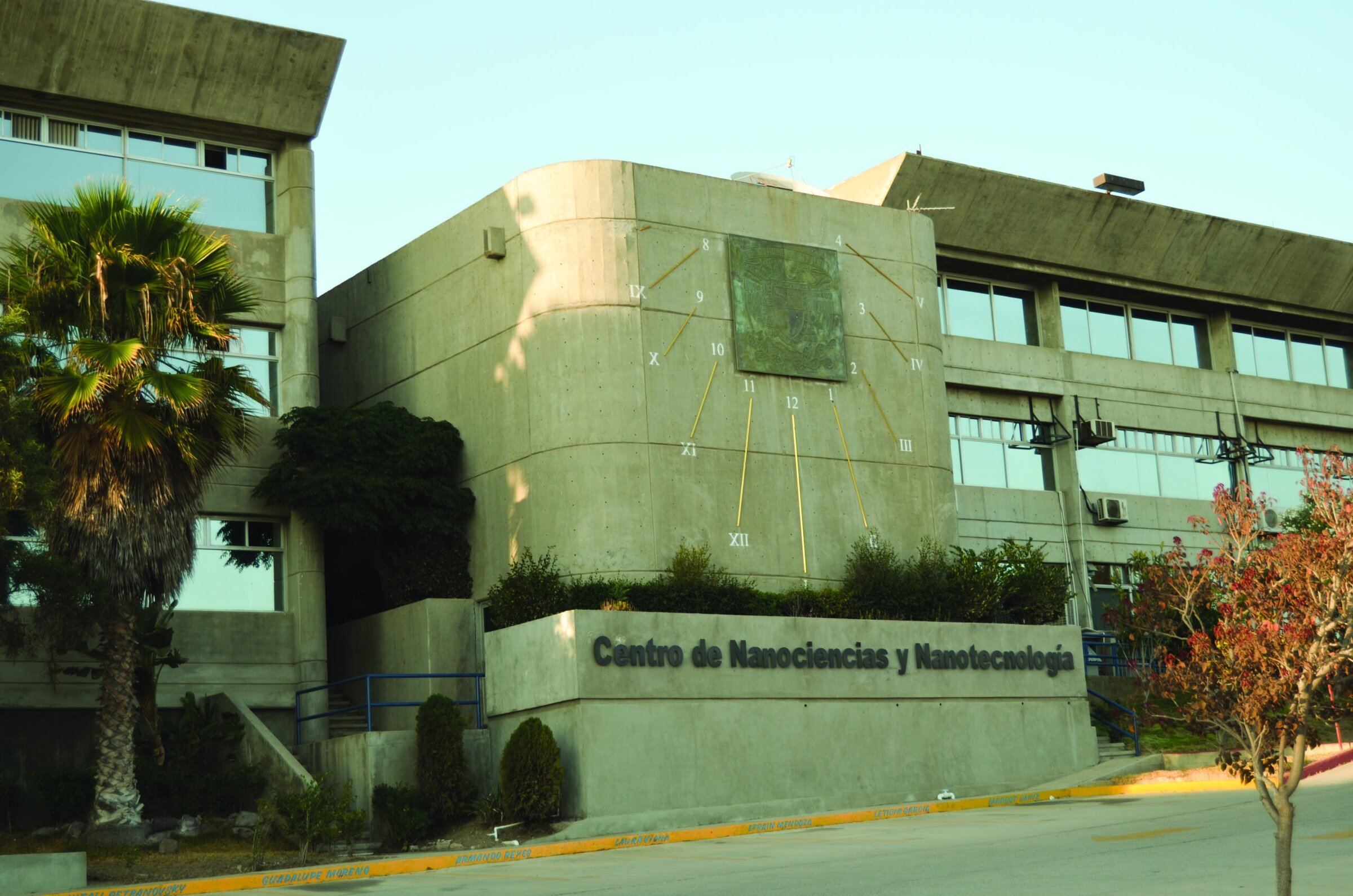
Scientists at the Center for Nanoscience and Nanotechnology (CNyN) in Ensenada, Mexico, have engaged in ceramics research since its founding in the 1980s, including work on doped oxides, ferroelectrics, and catalysts. (Credit: CNyN)
Dental ceramics—Restoring smiles
Ceramic dental prostheses are another area of focus in Mexico. Statistics reported by the country’s National Oral Health Program indicate that an elevated number of people in the country are suffering from severe dental problems. For this reason, businesses and laboratories that specialize in ceramic dental prostheses are working on advances that use CAD/CAM and robotic technology in the construction of devices made of metal–porcelain and zirconia.
One of the advances in dental technology involves the development and use of porcelain veneers, a process that is more economical and improves the aesthetics of a partial reconstruction of a broken tooth. The technique is the work of Mexico’s American Academy of Dental Technology. Further ceramic-based innovations in odontology have led to the development of metal-free implants that incorporate new applications of such materials as lithium silicate, fluorapatite, and zirconium oxide.
Ivoclar Vivadent is among the Mexican companies leading the exploration of these new applications. “The development of ceramics that our brand has implemented and disseminated has established us as pioneers in fields related to cosmetic dentistry. This has sparked considerable global fanfare with regard to the strength of metal-free ceramics, which are without a doubt one of the alternatives preferred by both middle and high-end customers in need of dental restoration,” says Sergio Hernandez, coordinator of the company’s Council for Open and Distance Education’s Professional Services.
“Today we explore possibilities that involve the use of diverse materials, including lucite, lithium silicate, and zirconium, in order to realize a wide range of restorative procedures in the reconstruction of lost dental structures. Our objective is to achieve a solution that delivers an excellent long-term biological, functional, and aesthetic integration. At the global level we see high rates of successful application of this type of restoration, with product lifespans in excess of five years.”
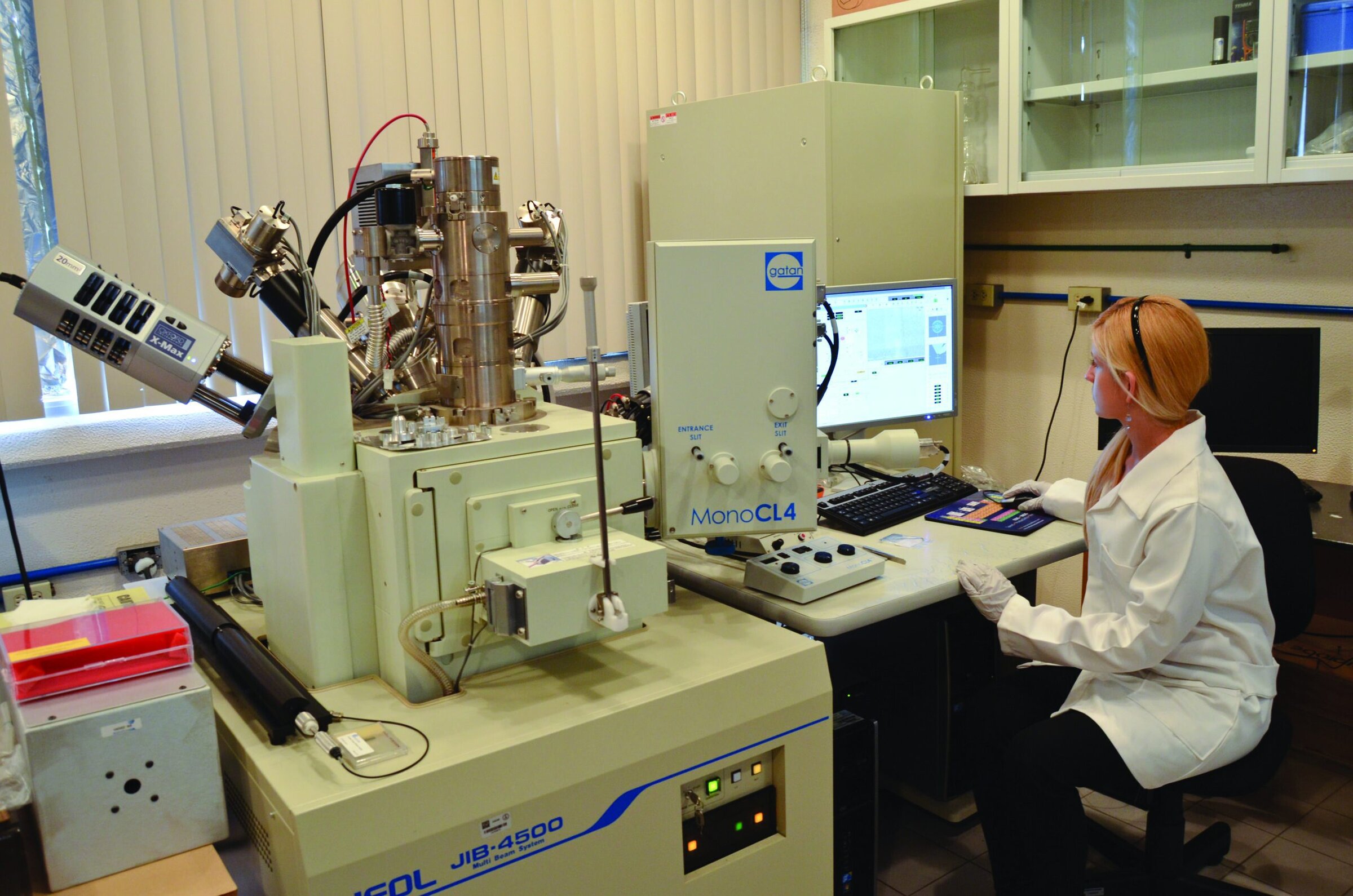
Graduate student Luz Zavala studies cathodoluminescence of doped hydroxyapatite materials to determine dopant distribution in powders and films at CNyN. This laboratory is under the direction of Manuel Herrera. (Credit: Herrera; CNyN)
Refractories—Steel and cement enablers
Of course, refractories also play a prominent role in Mexico’s ceramic industry and national economy. Mexico’s history of ceramic production dates to pre-Columbian times. The city of Monterrey, capital of the border state of Nuevo León, began its ascent to business and economic prominence with the growth of its steel and cement industries.
Steel production, which stood at 13.3 million tons in 2001, rose to 17.6 million tons by 2007 but plummeted following the global economic crisis to 14.1 million tons in 2009. By 2012 the industry had recovered and surpassed that 2007 high. Production last year reached a volume of 18.1 million tons, according to CANACERO, the country’s national chamber of the iron and steel industries. However, production remains on unsteady footing: The organization announced on July 8 that volume had fallen from 1.6 million tons in March to 1.4 million tons in April, the most severe drop in the preceding 13 months.
In March, Alonso Ancira Elizondo, CANACERO’s president, told the Mexican daily newspaper El Universal that he anticipates a “tsunami” of steel imports into Mexico. Skyrocketing automobile manufacturing in Mexico will spur part of that increased import demand. An April 17 Bloomberg article reported that Mexico’s automobile production nearly doubled since 2009 and that the steel industry was investing $3 billion on factory improvements to catch up to that hike in production, which the Mexican Automobile Industry Association projects will grow to four million vehicles a year by 2017.
In Mexico, the manufacture of crucibles for induction stoves is advancing via the use of graphite clay, which allows nonferrous metals, such as zinc, tin, bronze, and aluminum, to be heated to high temperatures without melting. Among the Mexican companies manufacturing crucibles to this standard is C.E. Fire, which specializes in crucibles and refractories for walls, vaults, work areas, and doors that can withstand a variety of heat treatments.
Another essential advance for the industry in Mexico is the development of concrete refractories to construct structures that contact molten metals or abrasive environments. They resist thermal shock and can be used for repairs in high-temperature environments.
Each of these areas of research, development, and new product launches builds on Mexico’s long history of using and commercializing a wide spectrum of ceramic products and technologies. As the world sees continued demand for further advances in ceramic applications, Mexico is investing in the academic, technological, and human resources necessary to remain an important global player in the industry’s future.
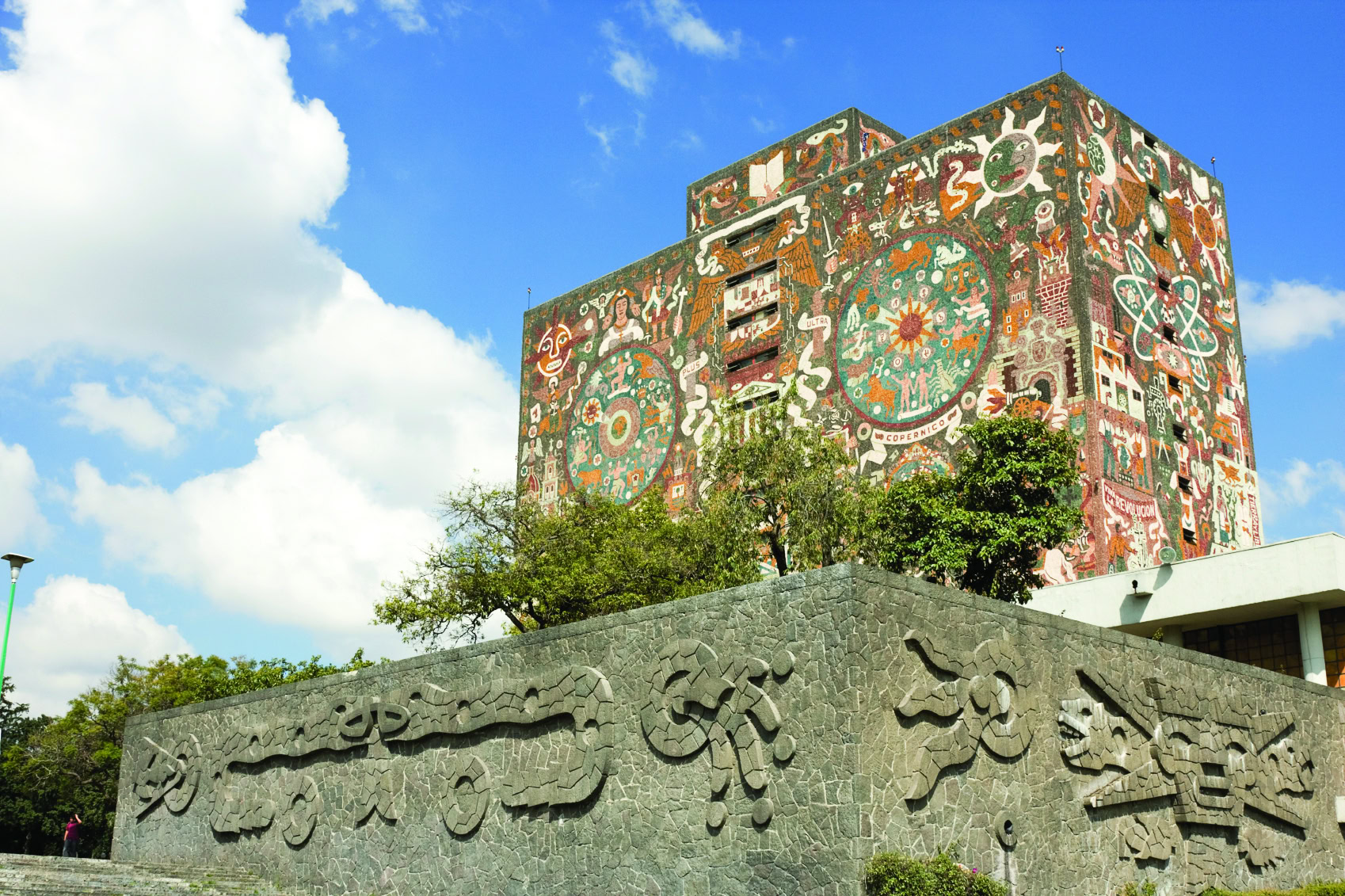
Central University Campus of the Mexico National Autonomous University. The image shows the Central Library Building covered with tile works from Juan O’Gorman. (Credit: iStock.com/abalcazar)
Billion-dollar (a day) border
Mexico’s 758,449 square miles of territory are home to a population of 116,220,947. With an economy in the trillion-dollar class, this market is attractive to U.S. businesses because of its proximity and free trade agreements and because of the size of the opportunity it represents. “The United States and Mexico trade over $1.25 billion in goods and services each day, a number we expect to grow as we help more U.S. companies succeed in Mexico,” says U.S. ambassador to Mexico E. Anthony Wayne.
The CIA Fact Book reports that since the North American Free Trade Agreement (NAFTA) went into effect in 1994, Mexico’s share of U.S. imports has increased from 7% to 12%. The U.S. is the destination of 78% of Mexican exports and the source of 50.5% of the country’s imports. “Mexico is the United States’ second-largest export market (after Canada) and third-largest trading partner (after Canada and China),” the U.S. State Department notes.
For 2012, Mexico’s purchasing power GDP is estimated at $1.799 trillion, or $15,600 per capita, which reflects a 3.9% growth rate over 2011. On that basis, Mexico is the 11th-largest national economy in the world. Services generate 61.8% of GDP, followed by industry (34.2%) and agriculture (4.1%). The industrial production growth rate for 2012 in estimated at 3.6%. Key industries include food and beverages, tobacco, chemicals, iron and steel, petroleum, mining, textiles, clothing, motor vehicles, consumer durables, and tourism.
Mexican export volume for the year is estimated at $370.9 billion, up from $349.4 billion in 2011. Leading commodity exports include manufactured goods, oil and oil products, silver, fruits, vegetables, coffee, and cotton. Import volume for the year is estimated at $370.8 billion, up from $350.8 billion in 2011. Leading commodity imports include metalworking machines, steel mill products, agricultural machinery, electrical equipment, car parts for assembly, repair parts for motor vehicles, aircraft, and aircraft parts.
For guidance on competing successfully in Mexico and connecting with trading or business partners there, contact the United States–Mexico Chamber of Commerce or the American Chamber of Commerce of Mexico. In addition, the U.S. Commercial Service has published Doing Business in Mexico. U.S.–Mexican business news and links to business data can be found on the website of the Embassy of the United States in Mexico City.

Related Articles

Market Insights
Next-gen superconducting ceramics could change how we travel and much more
Forty years ago, two physicists from IBM’s research laboratory in Zürich, Switzerland, reported a groundbreaking discovery: Superconductivity, or the quantum mechanical phenomenon in which certain materials exhibit zero electrical resistance when cooled, could be achieved at higher temperatures using ceramics. Superconductivity had been discovered decades before, but its applications had…

Market Insights
Why most AI manufacturing projects fail and how to fix it
Artificial intelligence is reshaping advanced manufacturing, especially processes involving ceramics, glasses, and other hard or brittle materials. But adopting AI is far more difficult than simply buying software and connecting machines. Manufacturers must understand the advantages and limitations of different models, so they can determine where AI fits best within…

Bulletin Features
Radiation effects on rare earth chemistry in molten salts for nuclear applications
Across the nuclear energy sector, molten salts are shaping the next generation of nuclear technologies, from advanced power reactors to used nuclear fuel recycling. In molten salt reactors (MSRs), molten salts uniquely serve as both the primary coolant and fuel medium, a dual role that sets MSRs apart from conventional…