

Whether seeking to explain physical phenomena, as did such luminaries as Huygens in 1690,1 Newton in 1704,2 and Maxwell in 1873,3 or routes to truth and enlightenment, as did Shakespeare in 1598 (“Light, seeking light, doth light of light beguile”),4 light fascinates us.
Beyond the physical, metaphysical, and poetic, light is immensely useful and central to modern life as detailed in the recent report “Optics and photonics, essential technologies for our nation,” published by the National Research Council of the National Academies.5 For example, the report notes that photonics enables more than $7 trillion in global products, equivalent to about one-half of the Gross Domestic Product (GDP) of the United States. The European Physical Society, representing the 41 national physical societies in Europe, is coordinating a proposal for the proclamation by the United Nations for an International Year of Light in 2015. This proposal received enthusiastic support from UNESCO.
The technological utility of light is remarkably broad. Therefore, for the purposes of this report, let us focus on one subset: optical fiber. Beyond the awarding of the 2009 Nobel Prize in Physics to Charles Kao “for groundbreaking achievements concerning the transmission of light in fibers for optical communication,” present and future demands for information have caused a dramatic shift from long haul and regional deployments to broadband. As a result, optical fiber production is projected to increase from about 150 × 10+6 km/year of fiber at present to much more than 200 × 10+6 km/year by 2017.6
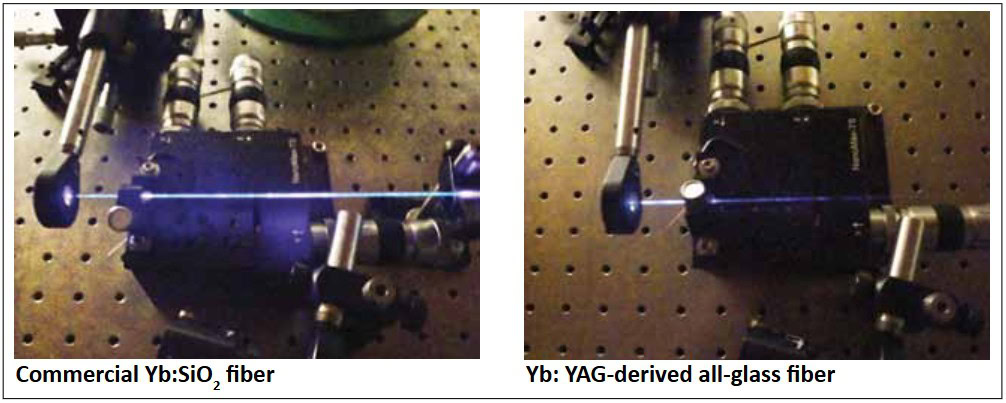
Cooperative up-conversion from an infrared laser excited sample of Yb-doped conventional optical fiber (left) versus that from an all-glass fiber whose core is made from YAG crystal under equivalent excitation conditions. Such visible up-conversion of light is deleterious to the desired infrared performance and so less is better. Credit: P. Dragic; UIUC.
Although the vast majority of this fiber will be for “conventional” telecommunication applications, there are growing needs for specialized optical fibers, i.e., those providing greater or enhanced functionality. Specific applications drive demand for higher-performance optical fibers, for example:
- Deep-well gas and oil sensors deployed at extreme temperatures, pressures, and chemical environments;7
- High-energy laser systems, where optical nonlinearities, such as stimulated Brillouin scattering (SBS), limit continued power-scaling;8 and
- Highly nonlinear glasses for all-optical signal processing (not just amplification), in optical communication systems.9
Two general trends contribute to enhanced performance from fibers. Historically, new materials with properties not available in conventional optical glasses (like silica) are developed. Examples include fluoride glasses for reduced losses and more efficient light emissions from active dopants, or tellurite and chalcogenide glasses for extended infrared transparency and stronger optical nonlinearities (e.g., strong nonlinear refractive index, n2).
The more recent trend accepts the material limitations of silica and focuses instead on inducing optical behaviors through the microstructure. Examples of microstructure engineering include microstructured optical fibers (MOFs) or photonic crystal fibers (PCFs). Periodicity in the refractive index, which comes from periodic combinations of silica rods and tubes constructed and drawn into fiber, controls various aspects of the electromagnetic mode propagating down the fiber. Such MOFs and PCFs can exhibit marked changes to the fiber’s dispersion, nonlinearity, and spectral loss even though the composition is still silica.
This report proposes a third option: novel fibers from not-so-novel materials and a return to simplicity. Specifically, the article summarizes recent developments using materials that are new with respect to optical fibers but familiar to the broader materials community, such as silicon and sapphire. They are commodity materials in their own right but novel and nonobvious materials with respect to glass optical fibers. These materials offer a variety of extraordinary properties and provide a rich playground for continued materials science, including novel all-glass,10,11 glass-clad crystalline core,12 and crystalline optical fibers.
New approach for drawing fiber
Several methods exist to fabricate optical fiber from nontraditional and dissimilar core and clad materials, and each has distinct advantages and disadvantages. Early techniques include the Taylor wire method,13 which implements fast quenching rates to create glass-coated metal wires in a relatively inexpensive manner. The Wollaston wire approach also has been used to draw fibers from differing core and cladding materials, particularly those exhibiting steep viscosity–temperature behaviors.14 The Wollaston method is useful for drawing fibers from materials that tend to devitrify, such as fluorozirconate glasses. However, materials must be chosen with care to ensure the chemically aggressive fluorozirconate melt does not attack the cladding glass.
A “core-suction” technique fabricates multicomponent glass-core preforms by melting and drawing-up the core glass melt into a cladding tube under vacuum.15 The core material must necessarily melt at a lower temperature than the cladding tube material.
With respect to crystalline fibers, laser-heated pedestal growth (LHPG) and micro-pull-down techniques have been well studied and used with increasing success.16 However, these methods are slow in the grand scheme of fiber fabrication methods (e.g., draw), and achieving a high-quality core–clad interface can be difficult.
Success using these approaches to make fibers from glasses (fluorides, tellurites, chalcogenides) and crystals (metallic and oxide) varies.
Another class of materials—semiconductors—has profoundly impacted electronic and optoelectronic applications. Indeed, silicon photonics is a rapidly growing area of global interest,17 and extending semiconductors to optical-fiber formats would open up entirely new opportunities. The field of semiconductor optical fiber, though nascent, relies on two principal fabrication methods.
The first method is a high-pressure microfluidic chemical vapor deposition (CVD) of the semiconductor inside a silica microstructured optical fiber.18 This method is a sufficiently low-temperature process that either amorphous or crystalline semiconductors can be deposited as can layers of different semiconductors to fabricate in-fiber optoelectronic junctions. Further, the deposition can be done in silica MOFs with small core sizes. However (relative to a molten-core method described next), CVD is limited by slow deposition rates and relatively short fiber lengths. To date, silica-clad fibers with cores of amorphous or crystalline silicon and germanium have been made as have zinc selenide-based fibers.19
Semiconductor optical fibers also have been made using a powder-in-tube method20 and a melt-infiltration approach.21
The second method, an alternative approach—and the focus of this article—is the molten-core method, which allows the direct fiberization of a range of unconventional core materials, either amorphous or crystalline. It is versatile, practical, and yields long lengths of optical fiber.
In general, a precursor core phase is set inside a tube, which serves as the cladding glass (Figure 1). At the temperature where the cladding glass tube draws into fiber, the core precursor phase is molten. As the cladding glass draws into fiber, the fluent core melt goes “along for the ride” and ultimately solidifies as the fiber cools. Originally developed as a means to make all-glass fiber with core compositions not stable enough to form into rods and draw directly,11 the molten-core method enables making long lengths of fiber directly from a simple preform and from a range of common materials such as silicon, germanium, YAG (Y3Al5O12), and alumina.22–24
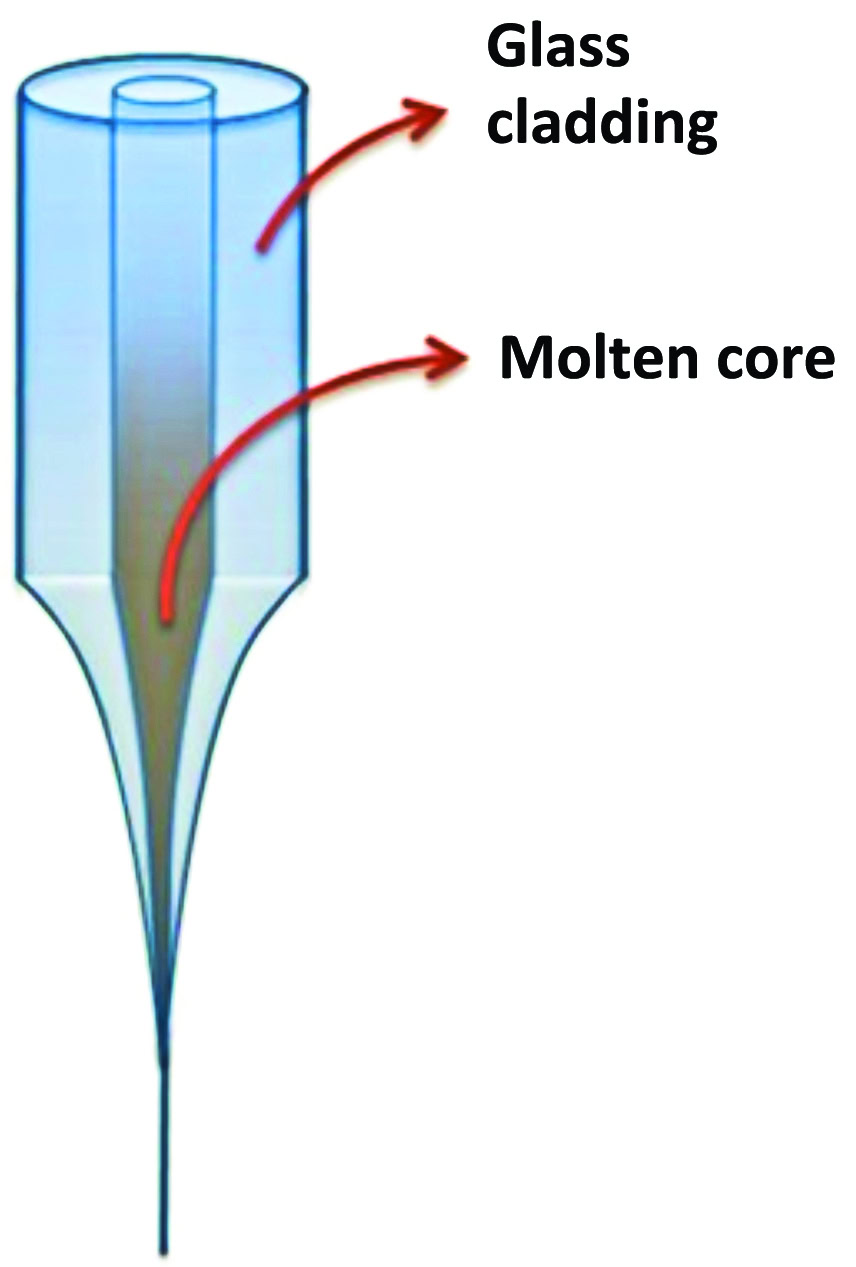
Figure 1. Schematic representation of the molten-core approach. Credit: Ballato; Clemson University
Although the process is straightforward, the materials science of what happens during the process is not. The melt (core) contacts the softened glass (clad) at the interface, and the two necessarily interact via dissolution and subsequent diffusion. Because dissolution is a thermally activated process, higher draw temperatures lead to more dissolution. The composition shifts from the precursor phase to the final core phase. In actuality, the cladding actively dopes the core during fiber drawing.
This is fundamentally different, and in many ways opposite, from the conventional approach to making fiber compositions where the silica host is doped with the modifying additives either in the vapor phase or in the solution phase. With the molten-core approach, the molten core dissolves some of the glass cladding and brings its constituents into the resulting core phase. Thus, a wider range of core compositions is possible. This dissolution and compositional “drift” is a blessing and a curse depending on what is desired in and of the fiber.
Novel all-glass crystal-derived optical fibers
Technically, as long as the initial core phase is molten at the draw temperature, there is no reason any particular phase cannot be used. However, practical considerations limit selection, such as restricting materials with high vapor pressures, which can (and do) blow out the softened glass cladding tube during the draw. That said, whether the initial core phase is a glass, single crystal, polycrystal (ceramic), or powder is immaterial as long as it melts at the draw temperature. In the case of powders, bubbles in the melt resulting from the porosity of the powder can be a concern.
An advantage of starting with crystalline core phases is the ability to use phases that cannot otherwise be made into glass. Two exemplars of this are YAG-derived23–25 and sapphire-derived24 optical fibers fabricated using the molten-core approach. Yttria and alumina additions to silica reduce the glasses’ Brillouin gain, which thereby lessens the potential for stimulated Brillouin scattering (SBS) in optical fibers. SBS is a principal limitation in high-power fiber lasers and high-capacity telecommunication systems. Liquid–liquid immiscibility in the Y2O3–SiO2 and Al2O3–SiO2 melt restricts the range of compositions to those with high silica content. However, in both cases, silica dissolves into the core from the (pure silica) cladding glass at the approximately 2000°C draw temperature and promotes the formation of yttrium aluminosilicate (for YAG-derived) or aluminosilicate (for sapphire-derived) glass cores because of the high quench rates of the drawn optical fibers.
The resultant core glasses contain much higher yttria and alumina concentrations than would otherwise be possible, opening the door to “novel fibers from common materials” (just not common when it comes to optical fibers). For example, the YAG-derived fibers with high yttria and alumina contents have shown less cooperative up-conversion and photodarkening than conventional silica-based fibers (demonstrated in images at top of article on previous page). As another example, the sapphire-derived fibers have alumina concentrations up to about 54 mol%, which is the highest alumina concentration reported for a silicate glass not made using more extreme methods, such as melt levitation.
By comparison, given the immiscibility and time–temperature requirement on conventional CVD optical fiber preforms, the typical limit to alumina content is about 8 mol%. Also, the melt viscosity increases and liquidus temperature decreases as the alumina melt dissolves the silica cladding glass, further hindering the phase-separation of the high-alumina-content core glass. The lowest reported Brillouin gain coefficient—nearly 100 times lower than conventional silica fibers—was in sapphire-derived high-alumina-content aluminosilicate glass optical fibers (Figure 2). Further, an aluminosilicate composition was shown to be Brillouin athermal (i.e., the Brillouin frequency does not change with temperature), which could have applications in novel sensor and laser systems with Brillouin performance immune to temperature fluctuations. There also are compositions that conceivably could exhibit zero Brillouin scattering, so- called zero Brillouin activity (ZeBrA) fibers. The structural origins of zero Brillouin, hence no photoelasticity, glasses are under study and could be exceedingly useful to future fiber-based laser and communication systems.
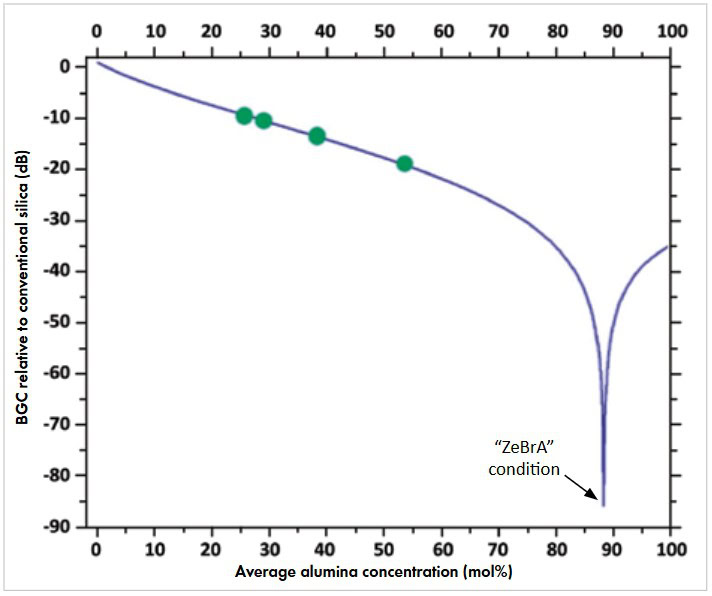
Figure 2. Calculated Brillouin gain coefficient for sapphire-derived fibers (recast from Ref. 24). The green dots represent fiber core compositions that have been fabricated to date.
Novel glass-clad crystalline-core optical fibers
As noted previously, it is reasonable to expect that molten-core-derived fibers will have amorphous cores, given the quench rates of the drawn fibers. However, although it is nonobvious, the process also yields long lengths of glass-clad fibers with polycrystalline cores. For example, Figure 3 shows cross sections of fibers drawn from technologically important unary and binary semiconductors, including silicon, germanium, and InSb. As before, a tube of glass clads a rod of the crystalline phase. The glass composition is chosen such that it draws above the core material’s melting point. Successful glass-clad-core compositions include silica cladding for silicon, borosilicate glass cladding for germanium, and phosphate glass cladding for InSb.
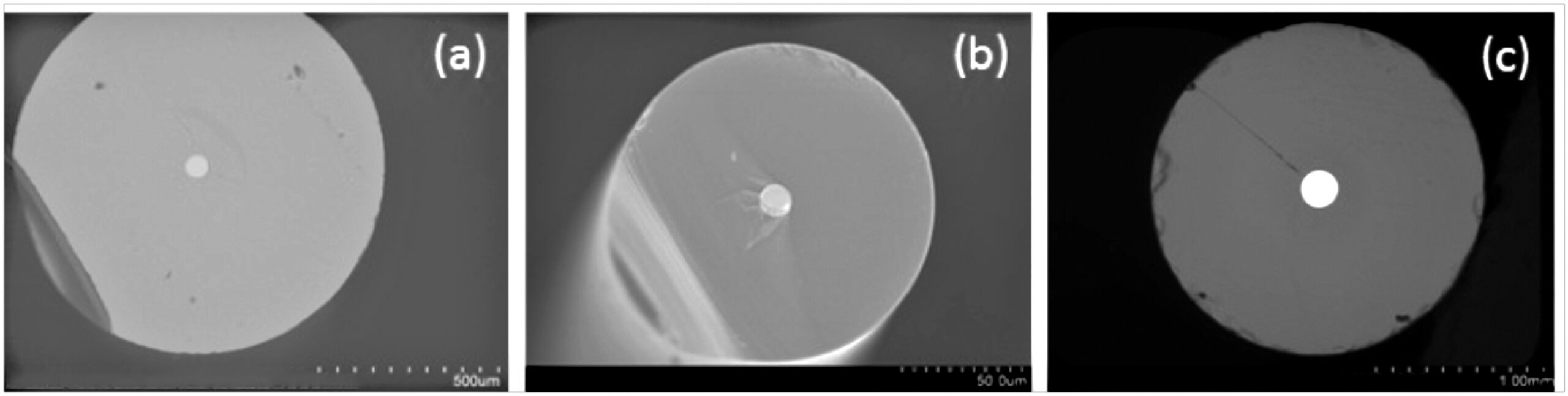
Figure 3. Electron micrographs of (a) silicon, (b) germanium, and (c) InSb crystalline core optical fibers. (After Ref. 22)
Because silicon, germanium, and InSb have cubic crystal structures and are, therefore, optically isotropic, polycrystallinity itself is not problematic. In terms of the polycrystallinity, X-ray diffractometry (XRD) studies show that single-crystal grains are up to 15 mm long. This is quite remarkable for a fiber drawn at a speed of about 1 m/s. That said, impurities tend to aggregate at grain boundaries, which can lead to scattering and increased losses. Additionally, even in the lowest-temperature case (InSb drawn at about 700°C), the melt dissolves some of the cladding glass and brings those species into the core. In the aforementioned case of the YAG-derived and sapphire-derived fibers, the cladding species facilitates glass formation, for example, silica dissolves into the Y2O3 + Al2O3 melt. In the case of semiconductor cores, these (oxide) cladding glass species in the melt precipitate out as amorphous nanophases, but still permit the formation of polycrystalline semiconductor phases. The precipitated oxides scatter light as it propagates down the fiber. This is a key issue that needs resolution for the technology to advance. Nonetheless, the molten-core-derived silicon and germanium fibers remain the lowest-loss semiconductor fibers fabricated to date.
These crystalline-core fibers present an intriguing fundamental question concerning the interplay between thermodynamics and kinetics in this system. An advantage of the molten-core approach is the ability to create long lengths of fiber at commercially relevant speeds. If one assumes that the rate of crystallization of an amorphous material is roughly equivalent to the critical velocity for amorphization, then the upper limit of draw speeds has yet to be approached.22
These unary semiconductors behave as anomalous liquids, i.e., the solid floats on top of the liquid (melt). This phenomenon combined with the molten-core approach prevents undissolved material from passing through the neck-down region and into the drawn fiber, thus assuring greater core homogeneity.
Further investigations will define the roles of fiber structure–property relationships, such as the influence of core geometry on the crystallography of the semiconductor-core phase and the influence of tapering. For example, fibers fabricated with square cores have higher degrees of single crystallinity, and the <110> crystallographic direction is dominantly aligned with the longitudinal axis of the fiber, a significant departure from the 35 percent exhibited in the round-core fibers.26
Reactive molten-core fabrication
A particularly fascinating and important feature of the molten-core approach to optical fiber fabrication is that chemical reactions can occur in-situ during the fiber drawing as part of the process. That is, species can volatize away from reactive metals, or chemical reactions can take place. Either mechanism leads to final core compositions very different from those of the precursor phases.
With respect to chemical reactions during fiber formation, the molten-core approach was used to fabricate oxygen-free, silica-clad crystalline silicon cores despite being processed at 2000°C.27 In this example, SiC powder mixed with the precursor silicon acts as a getter for the oxide that enters the core melt from the silica cladding tube dissolution. The reaction byproducts at the draw temperature are solid silicon and SiO(g) and CO(g), both of which evolve out of the fluent melt. A crystalline silicon-core optical fiber clad in silica with negligible oxygen results, as shown in Figure 4. Although there still are optical losses, probably because of other impurities or defects in the silicon, scattering reduces measurably, an important step.
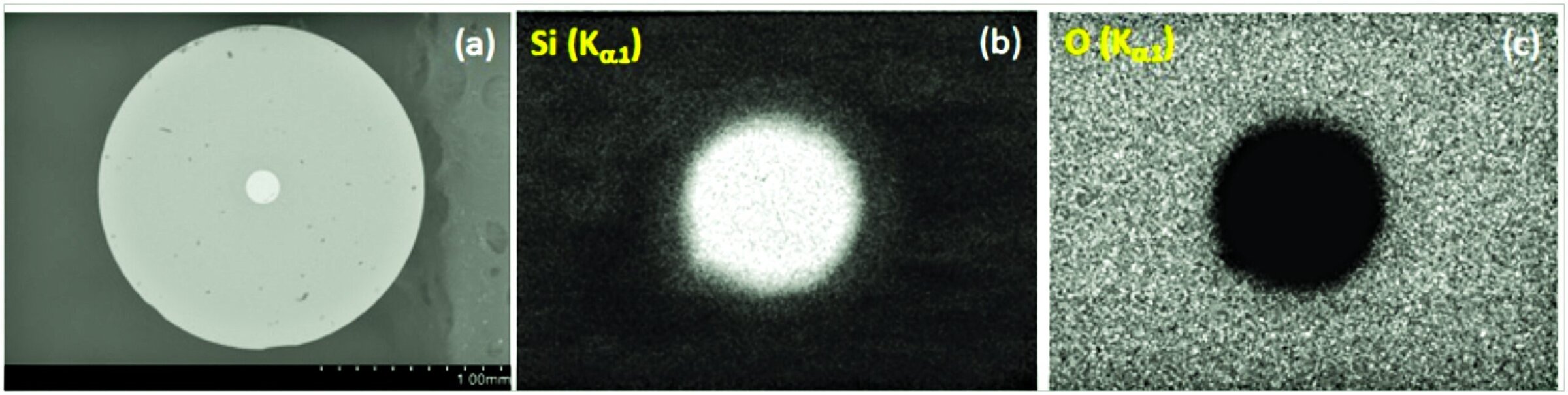
Figure 4. (a) Scanning electron micrograph of a silica-glass-clad silicon-core optical fiber drawn using a reactive molten core of Si + SiC. Energy dispersive spectroscopic spatial maps qualitatively show the concentration of (b) silicon and (c) oxygen, where the brighter region indicates higher elemental content. (After Ref. 27)
Volatility, as a form of reactive chemistry, was originally used in 1989 to produce novel silica-glass fibers for optical amplification.10 Recently, molten-core drawing achieved glass-clad crystalline oxide core optical fiber in the Bi2O3–GeO2 system. In this case, a borosilicate glass cladding tube filled with precursor crystalline powders of stoichiometric Bi12GeO20 yielded either amorphous or crystalline optical fibers, depending on the draw conditions.28 The all-glass fibers had core compositions with about 70 mol% Bi2O3, which is significantly higher than previously reported values for bismuth-containing fibers. Powder XRD showed the crystalline core fibers were biphasic, containing Bi2O3 and Bi2GeO5.
Although the polycrystallinity and multiphase nature led to high levels of light scattering, these results were significant. For the first time, an industrially scalable manufacturing process was employed to make optical fibers with crystalline oxide phases. Also, Bi2GeO5 is acentric which, with further development, could lead to long lengths of glass-clad optical fibers with useful optoelectronic properties, including piezo-optics, second-harmonic generation, and related optical nonlinearities.
More opportunities ahead
The molten-core approach is a flexible method for producing optical fibers from unconventional materials—crystalline and amorphous—over long lengths using scalable processes. From in-situ reactive melt chemistries to the realization of concentrations of alumina otherwise unattainable, this method allows fabrication of novel optical fibers for applications ranging from high energy lasers to telecommunications and sensing. Equally important, there are rich opportunities for materials science experiments using this method, including fundamental studies of thermodynamics, kinetics, crystallization, and phase diagrams.
Acknowledgments
The authors wish to thank the following individuals for thoughtful and timely input: Bob Rice (Dreamcatchers Consulting), Pete Dragic (University of Illinois), Anna Peacock (Southampton University), Thomas Hawkins (Clemson University), Paul Foy (Clemson University), and Roger Stolen (Clemson University).
A Brillouin glossary
Leon Brillouin (1889–1969) earned his PhD from the University of Paris in 1920, where he later became a professor of theoretical physics (1928–1932). He emigrated to the United States in 1941 and conducted research in applied mathematics and solid-state physics at Columbia University (1943–1945) and Harvard University (1947–1949) prior to joining IBM.
Brillouin scattering is a form of anelastic scattering between a light wave and phonons from the material through which the light is propagating.
Brillouin frequency is the anelastic nature of the scattering that results in a shift in the frequency (energy) of the light wave, which is analogous to the classical Doppler shift. This frequency shift is equal to the energy of the interacting phonon and, hence, is characteristic of the material and depends on the wavelength of the incident light.
Brillouin gain (coefficient) occurs if the light wave is sufficiently intense. Then, the Brillouin scattering can become stimulated whereby the forward propagating beam interacts strongly with an electrostrictively induced back-scattered wave. The strength of this gain is given by a gain coefficient. Although Brillouin first predicted the phenomena in 1922, Russian physicist, Leonid Mandelstam (1879–1944) is believed to have theorized the same scattering in 1918. However, Mandelstam did not publish his work until 1926. To give complete credit, the effects also are referred to as “Brillouin–Mandelstam scattering.”

Related Articles

Market Insights
Next-gen superconducting ceramics could change how we travel and much more
Forty years ago, two physicists from IBM’s research laboratory in Zürich, Switzerland, reported a groundbreaking discovery: Superconductivity, or the quantum mechanical phenomenon in which certain materials exhibit zero electrical resistance when cooled, could be achieved at higher temperatures using ceramics. Superconductivity had been discovered decades before, but its applications had…

Market Insights
Why most AI manufacturing projects fail and how to fix it
Artificial intelligence is reshaping advanced manufacturing, especially processes involving ceramics, glasses, and other hard or brittle materials. But adopting AI is far more difficult than simply buying software and connecting machines. Manufacturers must understand the advantages and limitations of different models, so they can determine where AI fits best within…
Bulletin Features
Radiation effects on rare earth chemistry in molten salts for nuclear applications
Across the nuclear energy sector, molten salts are shaping the next generation of nuclear technologies, from advanced power reactors to used nuclear fuel recycling. In molten salt reactors (MSRs), molten salts uniquely serve as both the primary coolant and fuel medium, a dual role that sets MSRs apart from conventional…