

Across the nuclear energy sector, molten salts are shaping the next generation of nuclear technologies, from advanced power reactors to used nuclear fuel recycling.
In molten salt reactors (MSRs), molten salts uniquely serve as both the primary coolant and fuel medium, a dual role that sets MSRs apart from conventional reactor designs. In parallel, molten salts enable pyrochemical reprocessing of used nuclear fuel, allowing the recovery of valuable fissile material that can be fabricated into new fuel, supporting both energy security and nuclear waste management.
In both applications, nuclear radiation continuously modifies the salt’s chemistry; understanding exactly how it does so is critical to making these technologies work safely and efficiently. Recent work from our group is beginning to map radiation-induced changes in detail, contributing to a mechanistic understanding of how fission products (FPs) behave and how radiation drives nonequilibrium chemistry in high-temperature molten chloride salt systems.
Fission product behavior in molten salts
In pyrochemical reprocessing, used nuclear fuel is dissolved in a molten chloride salt matrix, enabling chemical reduction of uranium dioxide and other FPs to the metallic state. This process is followed by electrochemical reduction to selectively isolate desired materials, such as uranium, onto a solid cathode.1
However, some FPs are thermodynamically stable in the salt matrix, resulting in their accumulation over time. Accumulation of FPs gradually degrades the salt’s usefulness and limits its recyclability, leading to additional nuclear waste.
In this regard, multivalent rare earth elements pose significant challenges because they are notoriously difficult to separate and tend to undergo comproportionation and disproportionation reactions, complicating recovery efforts. Neodymium, for instance, is typically recovered at efficiencies below 55%.2
The same rare earth element FPs pose challenges for MSRs because some are strong neutron poisons, absorbing neutrons needed to sustain a nuclear chain reaction. Their accumulation must be carefully controlled, making effective management of these FPs essential for long-term reactor performance.
Accurately predicting the long-term behavior of these hard-to-separate rare earth elements requires a fundamental understanding of how ionizing nuclear radiation influences their chemistry in molten salts, an area that remains largely underexplored despite its importance to both reactor operation and salt waste management.
Radiation-induced speciation of neodymium ions
In our recent work,2 we explored what happens to neodymium ions when they are exposed to nuclear radiation in molten lithium chloride–potassium chloride (LiCl–KCl) eutectic salt.
When the salt absorbs radiation energy, it generates two key reactive species: 1) strongly reducing solvated electrons (eS–) and 2) oxidizing chlorine atoms (Cl•), which rapidly react with surrounding chloride anions (Cl–) to form dichlorine radical anions (Cl2•–). In a pure salt with no other solutes, eS– either reduce trace metal ion impurities or recombine with Cl•, while Cl2•– predominantly undergo disproportionation, ultimately generating chlorine gas (Cl2). In the presence of neodymium ions (Nd2+ and Nd3+), predicting the radiolytic redox landscape becomes more complex. Mapping out these interactions required us to combine electrochemistry, spectroscopy, and a time-resolved technique called electron pulse radiolysis.
Electron pulse radiolysis works by firing intense, ultrashort pulses of high energy electrons into a sample, generating a burst of reactive species (eS– and Cl• among them) in concentrations large enough to monitor in real time. Using transient absorption spectroscopy, researchers can watch these species form and decay on timescales ranging from nanoseconds to milliseconds, directly observing radiation-induced reaction pathways and deriving their chemical kinetics.
Our experiments were performed at the Brookhaven National Laboratory Laser Electron Accelerator Facility,3 a specialized facility designed for exactly this kind of ultrafast, time-resolved work. We measured how the molten salt absorbed light at different time intervals after each electron pulse, both with and without neodymium ions present, building up a picture of how the chemistry evolved in real time (Figure 1).
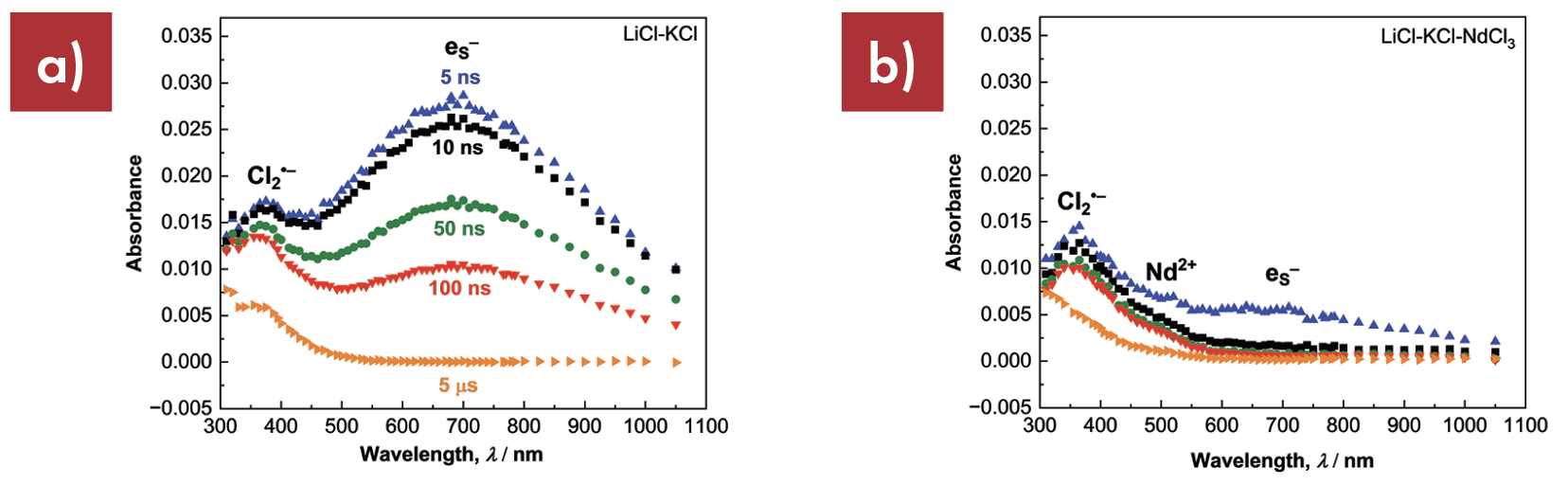
Figure 1. Transient absorption spectra for molten LiCl-KCl eutectic in the a) absence and b) presence of 10 mM NdCl3 at select times following an electron pulse at 673 K. Reprinted with permission from Reference 2. Copyright 2026 American Chemical Society. Credit: Baldivieso et al., Inorganic Chemistry
These measurements revealed that irradiating molten LiCl–KCl eutectic produces two dominant radiolytic species: short-lived eS– (< 5 μs) and longer lived Cl2•– (> 5 μs) (Figure 1a). Adding Nd3+ to the salt drastically changed the absorption landscape (Figure 1b). The eS– signal essentially vanished, indicating that Nd3+ rapidly reacts with them to become reduced to Nd2+.
Using these spectra, we analyzed the decay kinetics of the eS– signal at 700 nm and found that the data are consistent with the reduction of Nd3+ at 673 K. Meanwhile, Cl2•– (350 nm absorption maximum) remained detectable as a transient species. We also observed a small but consistent increase in absorbance in the region between 450 and 500 nm, suggesting the formation of Nd2+, which was confirmed by complementary electrochemical measurements as well.
In molten LiCl–KCl eutectic salt, neodymium ions are predominantly stable in the +3 oxidation state,4 but under the right conditions, they can be reduced to the +2 oxidation state. Using spectroelectrochemistry, we demonstrated that the 450–500 nm feature corresponds to the characteristic absorption of Nd2+, confirming that ionizing radiation can drive this reduction directly in molten chloride salts.
Additional insights into the behavior of Nd2+ were gained with a simpler experiment: immersing a neodymium metal rod into a molten NdCl3–LiCl–KCl salt mixture. Under these conditions, the metal rod reacted with the salt through comproportionation, steadily forming Nd2+ (Figure 2). Leaving the rod submerged for more than 30 minutes noticeably shifted the overall neodymium speciation in the salt, reinforcing the idea that both radiolytic and electrochemical pathways can generate Nd2+ under these conditions.
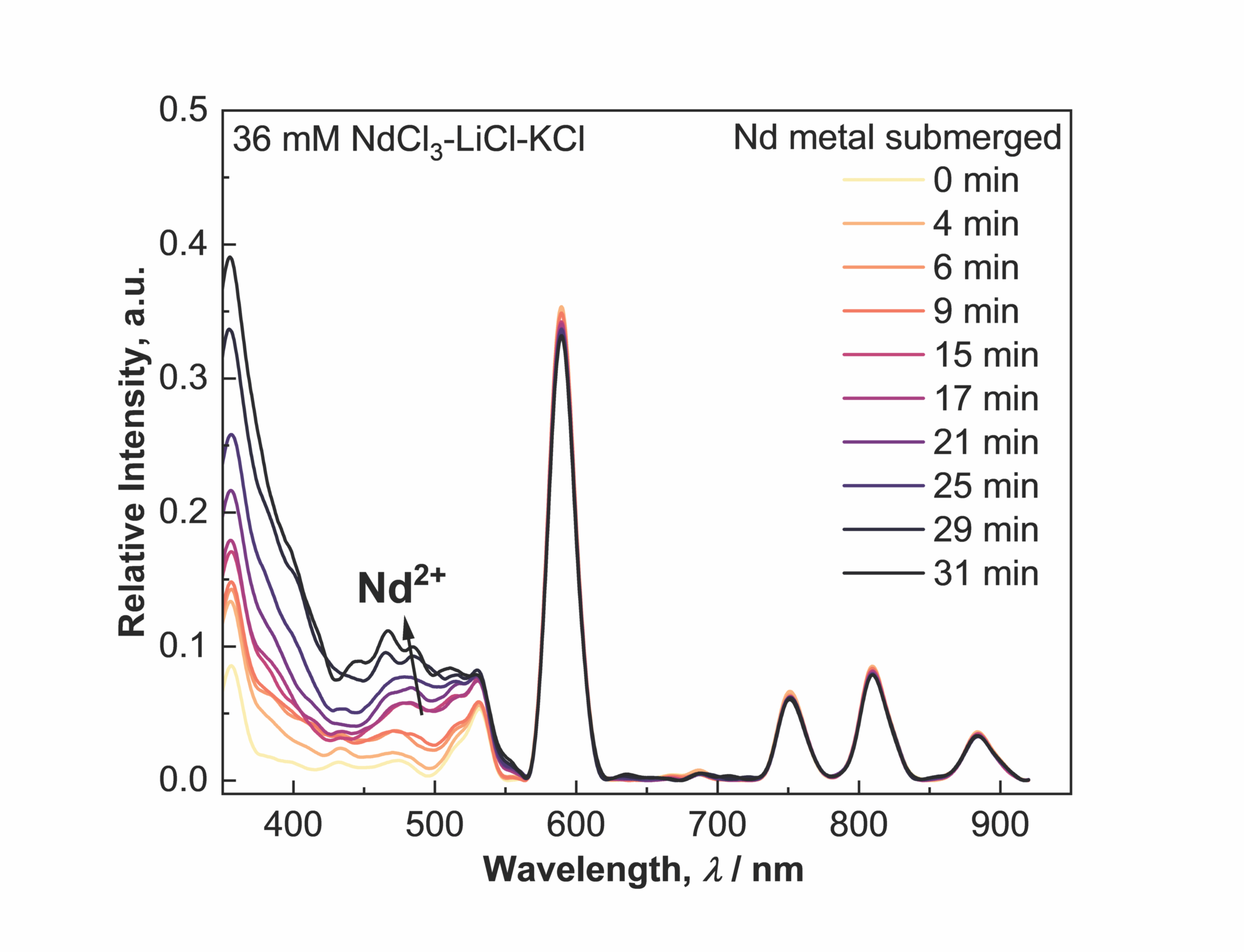
Figure 2. Absorption spectra for molten 36 mM NdCl3-LiCl-KCl at select times after submerging a neodymium metal rod at 773 K. Reprinted with permission from Reference 2. Copyright 2026 American Chemical Society. Credit: Baldivieso et al., Inorganic Chemistry
Toward a safer and more reliable nuclear future
As pyrochemical reprocessing and MSRs continue to mature, understanding how radiation shapes the chemistry of FPs in molten salts will be essential for improving process efficiency, predicting long-term materials behavior, and designing more robust nuclear fuel cycles. Our findings highlight the importance of considering both radiation driven and electrochemical pathways when evaluating multivalent rare earth element behavior in molten salts. They contribute to the ever-growing institutional knowledge of molten salt radiation chemistry, thereby helping pave the way for safer and more reliable nuclear technologies.

Related Articles

Market Insights
Digging into the development of uniform global mining standards
Mining standards and regulations have historically varied by region, nation, or locale, making for a patchwork of guidelines and laws for environmental protection, water and emissions management, proper waste disposal, worker rights, and engagement with Indigenous communities. Multinational mining companies, manufacturers, downstream customers, and socially conscious investors have for years…

Market Insights
Rethinking Arctic research: CIFAR report proposes pathways for the Arctic’s future
Although organized, multinational scientific research in the Arctic has taken place since the late 19th century,1 the past two decades have seen a surge in activity alongside the rapid ecosystem changes (Figure 1).2 Yet these scientific studies are increasingly mired in geopolitical tensions and economic interests,3 which means that scientists…

Market Insights
Global markets for lithium and green mining
The electrification and digitization of modern life drive increased demand for certain minerals, but they also drive the need for more environmentally conscious mining practices. Two recent BCC Research reports investigate the global markets for lithium mining and green mining, respectively. This Bulletin content is for ACerS members and registered…