

As an independent federal agency of the United States government, the National Science Foundation (NSF) funds basic research conducted at America’s colleges and universities. NSF’s Ceramics Program in the Division of Materials Research resides within the Mathematical and Physical Sciences Directorate. There are six other science and engineering research and education directorates at NSF, including Engineering.
The mission of the Ceramics Program is to support fundamental scientific research in ceramics (e.g., oxides, carbides, nitrides, and borides), glass-ceramics, inorganic nonmetallic glasses, ceramic-based composites, and inorganic carbon-based materials. The program aims to increase fundamental understanding and to develop predictive capabilities for relating synthesis, processing, and microstructure of these materials to their properties and ultimate performance in various environments and applications. Proposals relating to discovery or creation of new ceramic materials are welcome, as are the development of new experimental techniques or novel approaches. The Ceramics Program supports research at universities and colleges of all sizes, from research universities to colleges that serve undergraduates. The principal investigators (PIs) of these projects include faculty at all levels from assistant to full professors.
This article marks the fourth annual summary of NSF Ceramics Program awards to appear in ACerS Bulletin 1, 2, 3 and the second year that the Ceramics Program has been piloting no-deadlines for submissions (NSF 16-597). This approach has been used in the Geosciences and Engineering Directorates at NSF and by foreign agencies. In June 2018, the Engineering Directorate announced removal of deadlines for many of its core programs (NSF 18-082).4
Eliminating deadlines better accommodates the schedules of PIs and encourages submission of emerging ideas. In addition, it opens the door to better proposal quality and spreads the workload for reviewers and NSF program directors more evenly throughout the year, resulting in quicker review and award cycles. Under this pilot, PIs submitting to the Ceramics Program are requested to suggest reviewers, and annual budget requests are typically $110,000 to $160,000 per year for each project, subject to the availability of funds; smaller budgets are permissible. Budgets in excess of $160,000 per year may be returned without review.
The number of full proposals received by the Ceramics Program continues to be fewer than years with a deadline. However, the number of submissions increased significantly between 2017 and 2018. There are about 130-150 active awards in the Ceramics Program at any given point in time.
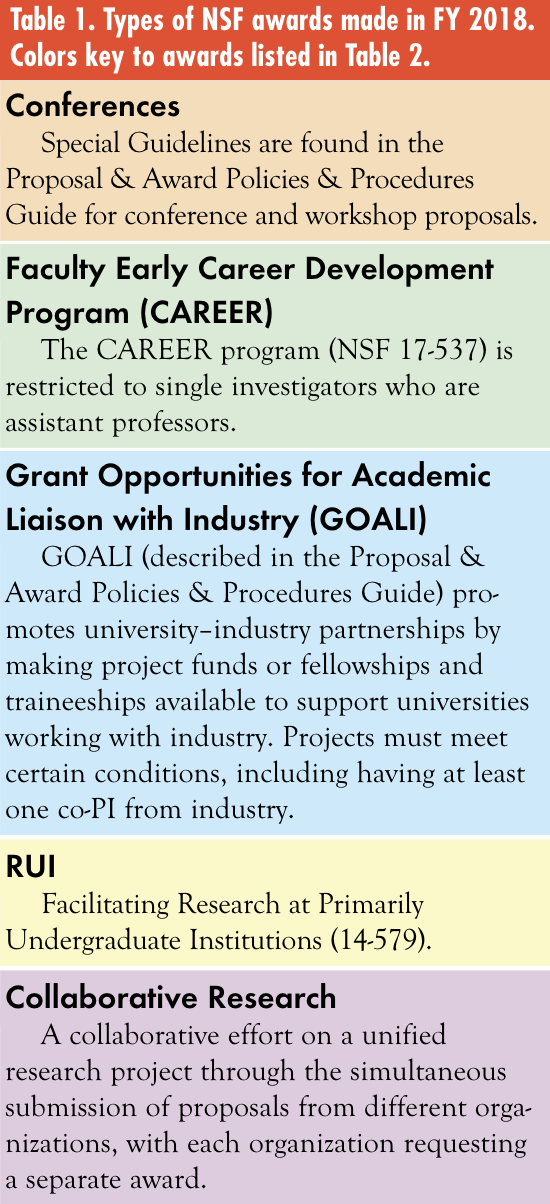
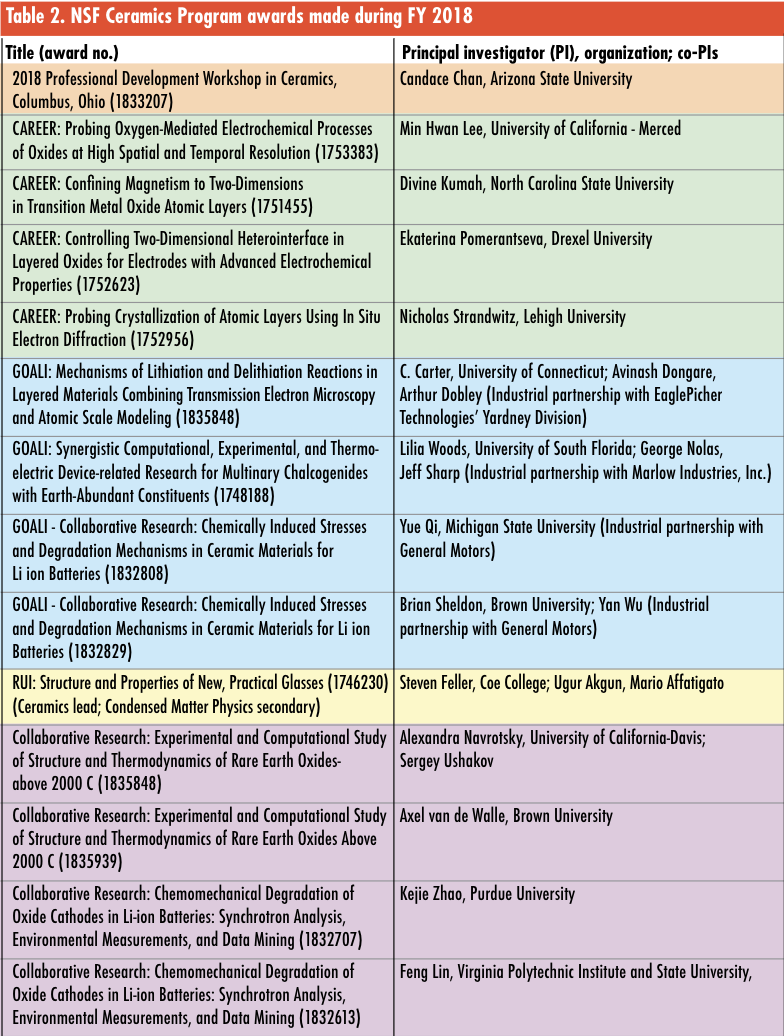
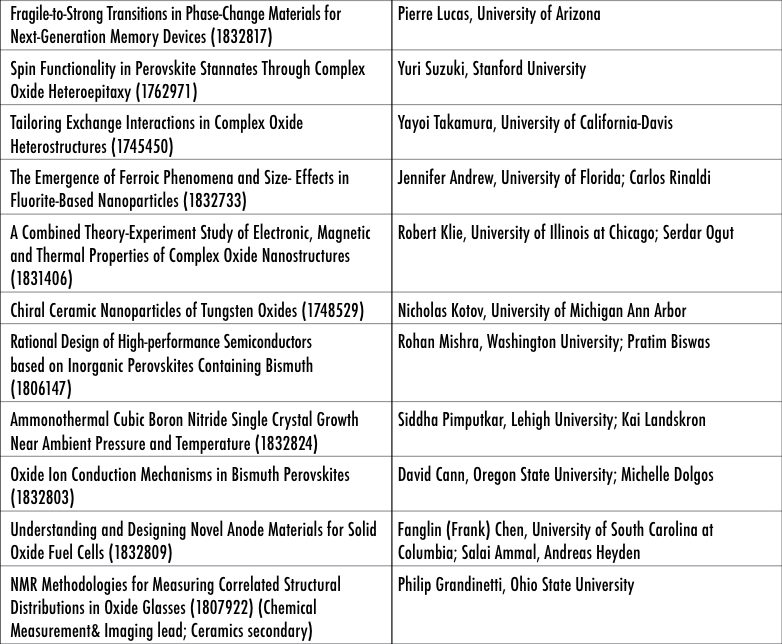
Table 1 provides a key to types of grants awarded in FY 2018 by the NSF Ceramics Program, and Table 2 lists FY 2018 awards. Detailed information on any NSF award is available by adding the 7-digit award number to the end of www.nsf.gov/awardsearch/showAward?AWD_ID= or by searching the NSF awards database. Additional ceramics research is supported through centers, group grants, instrumentation awards, and other programs focused on one or two investigators (e.g., in the Engineering Directorate).
FY 2019 began Oct. 1, 2018, and the first awards have appeared. NSF recommends submitting full proposals 9–12 months before the funds are needed to allow six months for review and time to process awards. Supplemental proposals are best submitted in February. In particular, NSF encourages supplemental requests for the addition of veteran and underrepresented minority graduate students to projects (through MPS-GRSV: NSF 15-024 and AGEP-GRS: NSF 16-125), Career–Life Balance supplements (for leaves of absence for dependent care responsibilities), collaborations with NIST (NSF-NIST 11-066), and interactions with industry (through GOALI or INTERN NSF 17-091).
PIs must acknowledge NSF support in any publications or presentations. An example of appropriate wording is: “This material is based upon work supported by the National Science Foundation under Grant No. (NSF grant number).” Annual reports are due in the spring (regardless of anniversary date). All products listed in the reports should acknowledge NSF support. See www.nsf.gov/funding for full information about proposal submission and award requirements.

Related Articles

Market Insights
Next-gen superconducting ceramics could change how we travel and much more
Forty years ago, two physicists from IBM’s research laboratory in Zürich, Switzerland, reported a groundbreaking discovery: Superconductivity, or the quantum mechanical phenomenon in which certain materials exhibit zero electrical resistance when cooled, could be achieved at higher temperatures using ceramics. Superconductivity had been discovered decades before, but its applications had…

Market Insights
Why most AI manufacturing projects fail and how to fix it
Artificial intelligence is reshaping advanced manufacturing, especially processes involving ceramics, glasses, and other hard or brittle materials. But adopting AI is far more difficult than simply buying software and connecting machines. Manufacturers must understand the advantages and limitations of different models, so they can determine where AI fits best within…
Bulletin Features
Radiation effects on rare earth chemistry in molten salts for nuclear applications
Across the nuclear energy sector, molten salts are shaping the next generation of nuclear technologies, from advanced power reactors to used nuclear fuel recycling. In molten salt reactors (MSRs), molten salts uniquely serve as both the primary coolant and fuel medium, a dual role that sets MSRs apart from conventional…