
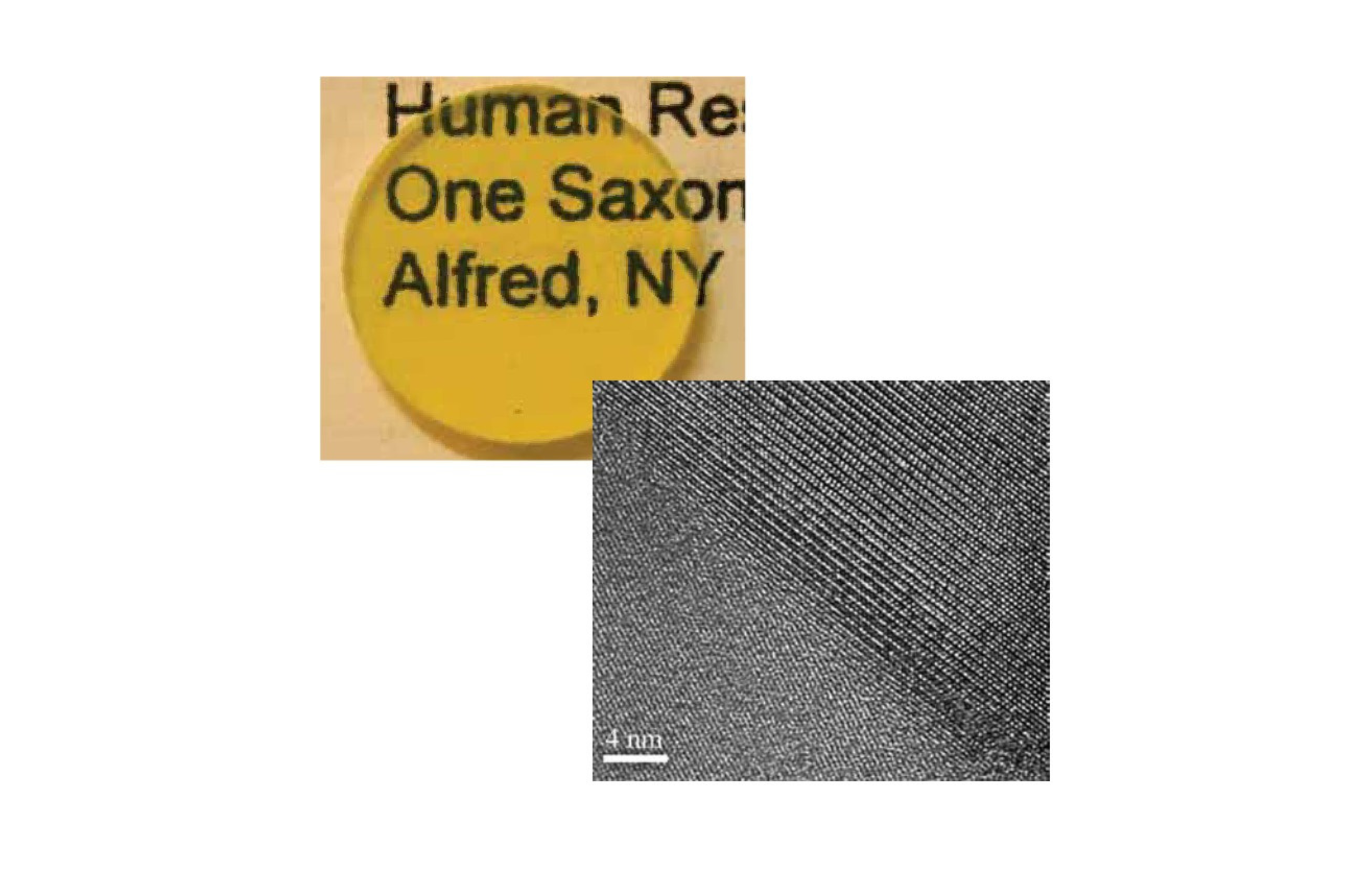
New opportunities for transparent ceramics
Transparent ceramics are emerging as a highly promising alternative to current glass and single-crystal technologies in a number of diverse application fields that include armor, optical fiber, lasers, infrared domes, and high-energy radiation detection. In this context, the term “transparent” refers to a ceramic material with at least 90 percent of the theoretical transmission over the wavelengths of interest. With this property, transparent polycrystalline ceramics can provide unique and versatile optical materials highly suitable for scintillators, optical components, solid-state lasers, and nonlinear optics.
In general, polycrystalline ceramic materials, which normally contain a high content of optical scattering sources, can be engineered to be transparent by eliminating defects. Grain boundaries, residual pores, secondary phases, double refraction, inclusions, and surface roughness can, more or less, act as elastic scattering sites that prevent incoming light from passing straight through conventional ceramics, which are composed of randomly oriented microcrystallites.1 When the size of the governing scattering sites, known as residual pores, become larger than approximately 10 percent of the wavelength of the incident light, engineers can use a Mie scattering model to demonstrate the relationships between pore size, porosity, and scattering losses, and obtain a general idea about the transmission properties of a ceramic material.2 For optical anisotropic materials (most of which are non-cubic-phase materials with different refractive indexes along different optical axes), birefringence is another important factor that prevents light from propagating without extinction.