
Transparent ceramics with cubic crystal structures can exhibit optical performance comparable to—or even surpassing—that of single crystals, and their application in high-technology devices such as lasers and optical isolators is already underway.
In contrast, transparent ceramics with noncubic crystal structures have found only limited use in optical applications, for example, as arc tubes for high-pressure sodium lamps.1 This limitation is due to the birefringence arising from their crystallographic symmetry.
Some noncubic-structured ceramics demonstrate superior mechanical properties compared to cubic-structured ceramics, so they would offer more options as optical materials in physically demanding environments (e.g., ballistic armor and missile domes). But does their intrinsic birefringence limitation mean that they have no future as optical materials?
Not necessarily. This article demonstrates how a deeper understanding of the relationship between microstructure and optical properties in noncubic-structured ceramics could enable their design for widespread optical applications.
Cubic-structured ceramics in optical applications
In 1995, my colleagues and I developed high-quality neodymium-doped yttrium aluminum garnet (Nd:YAG) ceramics that achieved highly efficient laser oscillation.2 While transparent ceramics existed prior to this paper, this study was the first time that optical properties rivaling those of single crystals were achieved in a polycrystalline ceramic.
This breakthrough not only marked the starting point for the development of a wide range of laser ceramics specifically, but it also attracted significant attention worldwide to the topic of transparent ceramics in general. As a result, functionalities and power scaling that surpassed single crystal optical materials were realized.3 For example, my colleagues and I developed polycrystalline terbium aluminum garnet and terbium yttrium oxide Faraday rotators,4,5 which now have been industrially applied in isolator devices for high-power fiber lasers. Meanwhile, some advanced spinel ceramics have exceeded the ultraviolet–visible performance of single crystals.6
Notably, all the transparent ceramics described above possess cubic crystal structures, which means their crystal lattices consist of three equal axes intersecting at right angles. This symmetry allows cubic-structured ceramics to behave isotropically, i.e., demonstrate uniform properties in all directions, which inherently frees them from birefringence.
The following section provides a deeper look at the phenomenon of birefringence and how it hinders the development of noncubic-structured transparent ceramics.
Birefringence in noncubic-structured ceramics
In the 1950s, R.L. Coble succeeded in preparing translucent alumina ceramics through precise microstructural control, overturning the prevailing concept that alumina was inherently opaque.1 This material was subsequently employed in arc tubes for high-pressure sodium lamps, but in recent years, such discharge-based light sources have been largely replaced by quantum-based light generation technologies, namely high-efficiency white light emitting diodes.
The reason Coble’s alumina ceramics were translucent rather than fully transparent is because of alumina’s noncubic structure. In contrast to cubic structures, which have three equal axes, noncubic structures consist of unequal axes or angles. As a result, their physical and mechanical properties are anisotropic, meaning the material’s behavior depends on the direction in which it is measured.
In the case of alumina, it crystallizes with a hexagonal structure. As light passes through the individual alumina grains, the unequal axes cause extraordinary rays to be generated in directions different from that of the incident beam (i.e., birefringence). Consequently, coherent light is progressively transformed into diffuse light, thereby deteriorating the alumina’s optical performance and making even passive optical uses, such as windows, extremely challenging.
Enabling isotropic optical properties in noncubic-structured ceramics
In principle, the primary method for improving the in-line transmittance of noncubic-structured ceramics is the extreme refinement of grain size, as smaller grains reduce scattering efficiency. However, from the standpoint of optical physics, the fundamental requirement is the elimination (or effective suppression) of birefringence.
Previous studies on improving the optical properties of noncubic-structured ceramics have focused primarily on the processing methods and measured transmittance values while presenting little or no discussion of the birefringence property itself.7,8 In two recent papers,9,10 my colleagues and I centered the discussion on birefringence by integrating optical characterization techniques with microstructural observation and property evaluation.
In the first paper,9 we focused on the optical properties of birefringence and transparency and their relationship to microstructure by comparing three alumina morphologies: conventional alumina (processed using a magnesium oxide sintering aid), advanced alumina (processed using a zirconia sintering aid), and c-axis single crystal sapphire.
While both magnesium oxide and zirconia contribute to suppressing grain growth and reducing the volume of internal pores, zirconia is a significantly more effective inhibitor for a couple reasons. First, there is generally less grain growth when sintering at lower temperatures. While magnesium oxide additives require sintering temperatures of about 1,400‒1,500°C, zirconia additives sinter at about 1,200‒1,300°C. Second, magnesium oxide and zirconia suppress grain growth through slightly different mechanisms. Magnesium oxide will react with the alumina to form a spinel phase that remains near the grain boundaries, slowing but not fully stopping grain growth. On the other hand, zirconia additives do not react with the alumina and will ultimately dissolve evenly into the alumina grains, leaving none detected at the grain boundaries and effectively restricting grain growth.
Figure 1 demonstrates the optical tradeoffs between the three alumina morphologies for a mobile phone screen application.9 Figures 1a and 1b show a fluorescent lamp observed through conventional alumina and the advanced alumina, respectively (both 0.3 mm thick). The conventional alumina appears frosted and lacks image clarity, whereas the advanced alumina allows clear visualization. When these materials, together with the reference c-axis sapphire single crystal, are placed directly on a mobile phone screen (Figure 1c), we observe distinct differences between them. The advanced alumina exhibits screen performance comparable to that of the c-axis sapphire, while the conventional alumina not only distorts the image but also significantly reduces sharpness.
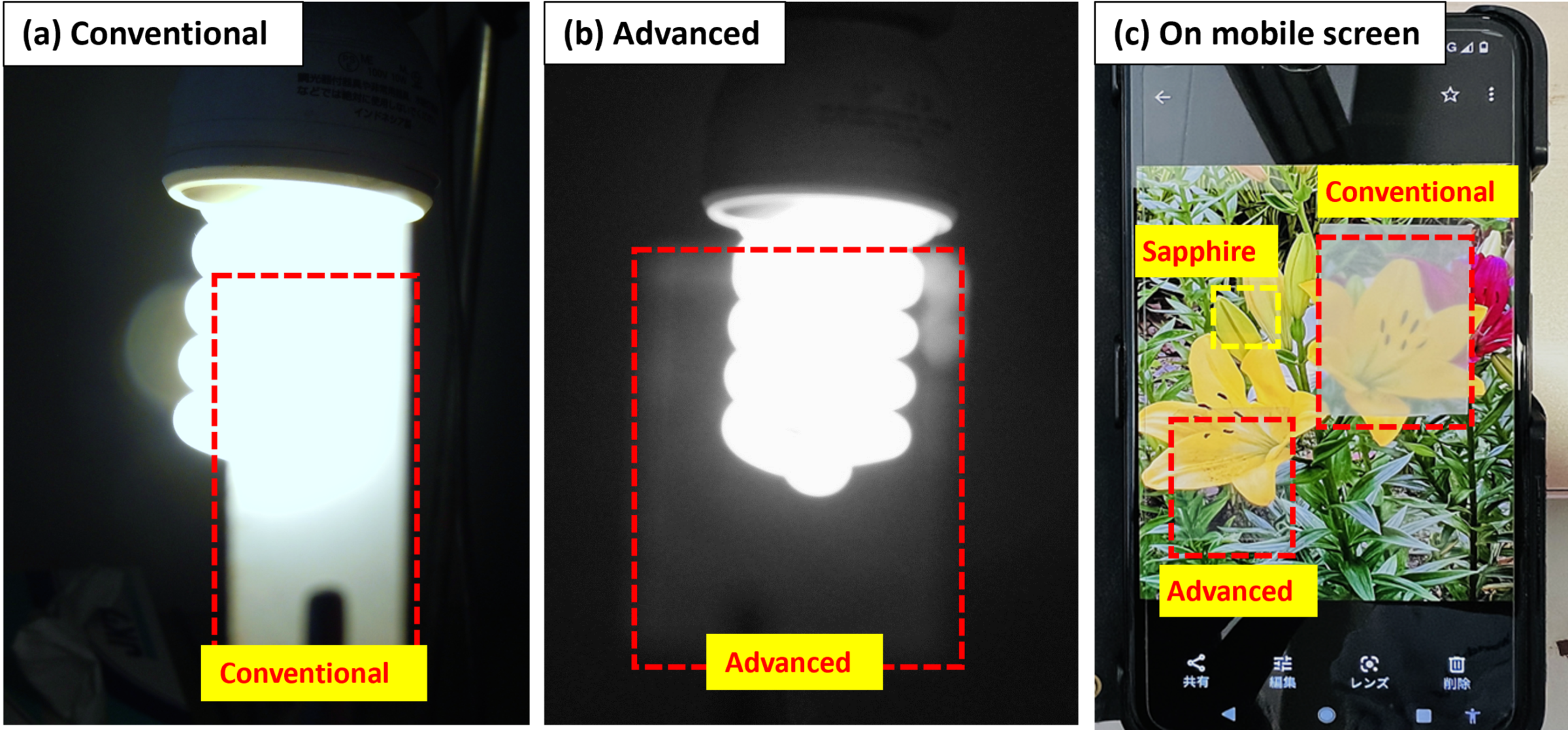
Figure 1. Fluorescent lamp observed through a) conventional and b) advanced alumina ceramics. c) Appearance of conventional and advanced transparent alumina ceramics and c-axis sapphire crystal placed on a mobile phone screen. Images republished from Reference 9. Credit: Ikesue and Aung, Journal of Advanced Ceramics (CC BY 4.0)
For thin optical components such as display cover plates, the advanced type may appear satisfactory at first glance; however, fundamental underlying issues remain, as discussed in our second paper.10
Figures 2a-1 and 2b-1 present polarized-light observations in the visible wavelength region for conventional alumina (average grain size ~10 μm) and advanced alumina (average grain size ~0.4 μm), respectively, with optical glass (an isotropic optical material) used as a reference.10 With conventional alumina, a large amount of birefringence is clearly detected. In contrast, the advanced alumina exhibits only trace levels of residual birefringence (although even a minute amount can be fatal for certain demanding optical applications). As expected, no birefringence is observed in the optical glass.
Figures 2a-2 and 2b-2 show analogous observations performed using a near-infrared camera operating in the 1.2–1.7 μm wavelength range. The conventional alumina still exhibits pronounced birefringence in the infrared region, whereas birefringence becomes undetectable in the advanced alumina, similar to the glass reference.
Figures 2a-3 and 2b-3 display the beam patterns of laser light (λ = 1 μm) transmitted through the same specimens. In the conventional alumina, the beam profile is severely degraded: The central intensity is weakened and distorted, and scattered light spreads into the periphery. By contrast, the beam transmitted through the advanced alumina maintains a strong central intensity and preserves a near-original Gaussian mode, indicating a high beam quality state.
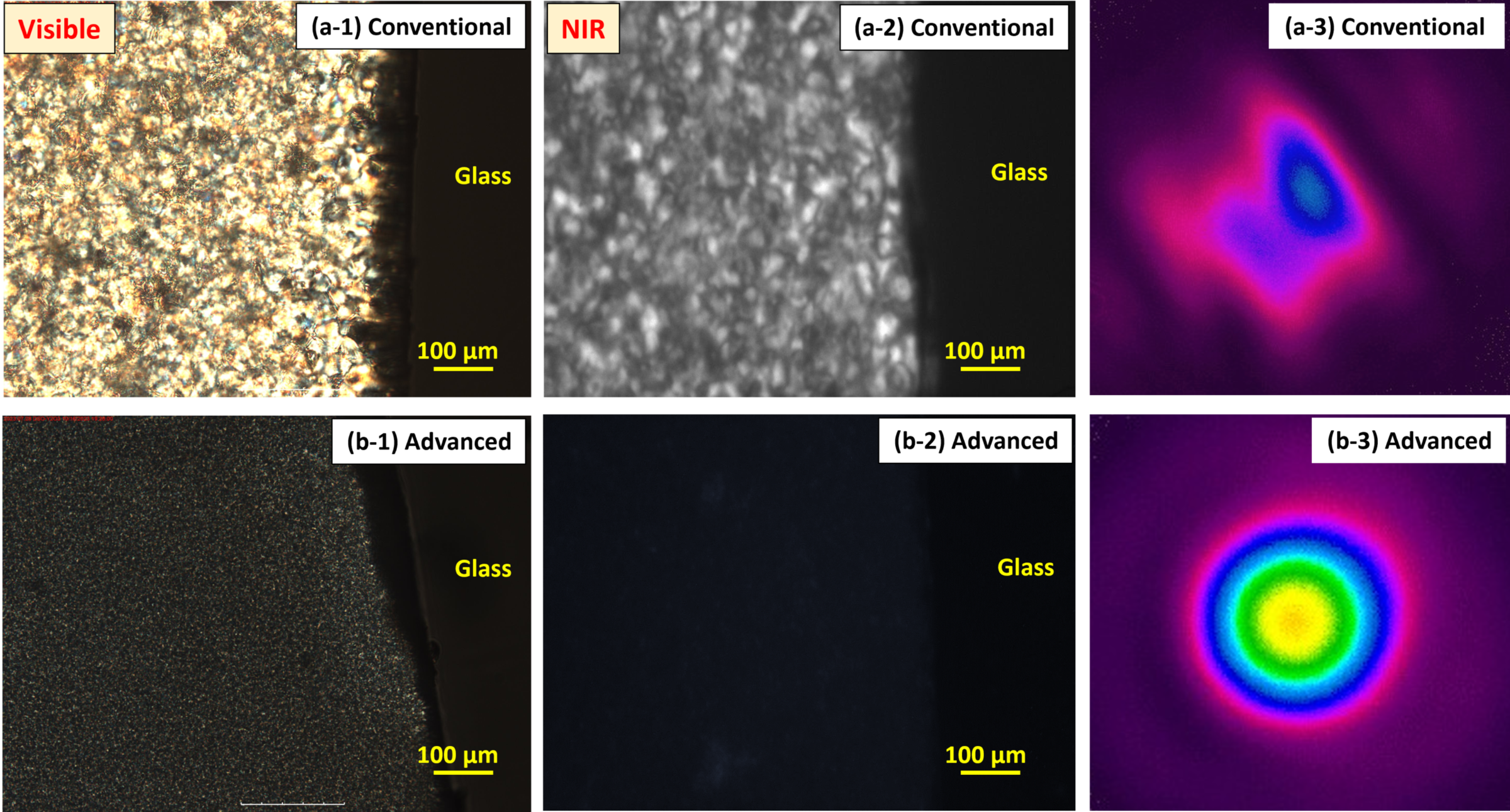
Figure 2. Polarizing transmission microphotographs of conventional and advanced translucent alumina ceramics at visible (a-1, b-1) and near-infrared (a-2, b-2) wavelength area, and laser beam pattern after passing through each ceramic specimen (a-3, b-3). Images republished from Reference 10. Credit: Ikesue and Aung, Journal of the American Ceramic Society
Figures 3a and 3b quantitatively present the wavelength dependence of total transmittance and the intrinsic birefringence of noncubic-structured ceramics measured under crossed polarizers for 1-mm-thick specimens.10 The c-axis sapphire single crystal exhibits a high transmittance of 85–86% across the entire measured wavelength range. The advanced alumina shows some reduction in transmittance in the short-wavelength region due to intrinsic birefringence; however, at measuring wavelengths in the near-infrared (780–2,500 nm) and longer, its transmittance becomes comparable to that of the single crystal. In contrast, the conventional alumina exhibits extremely low transmittance even when the thickness is reduced by 60%.
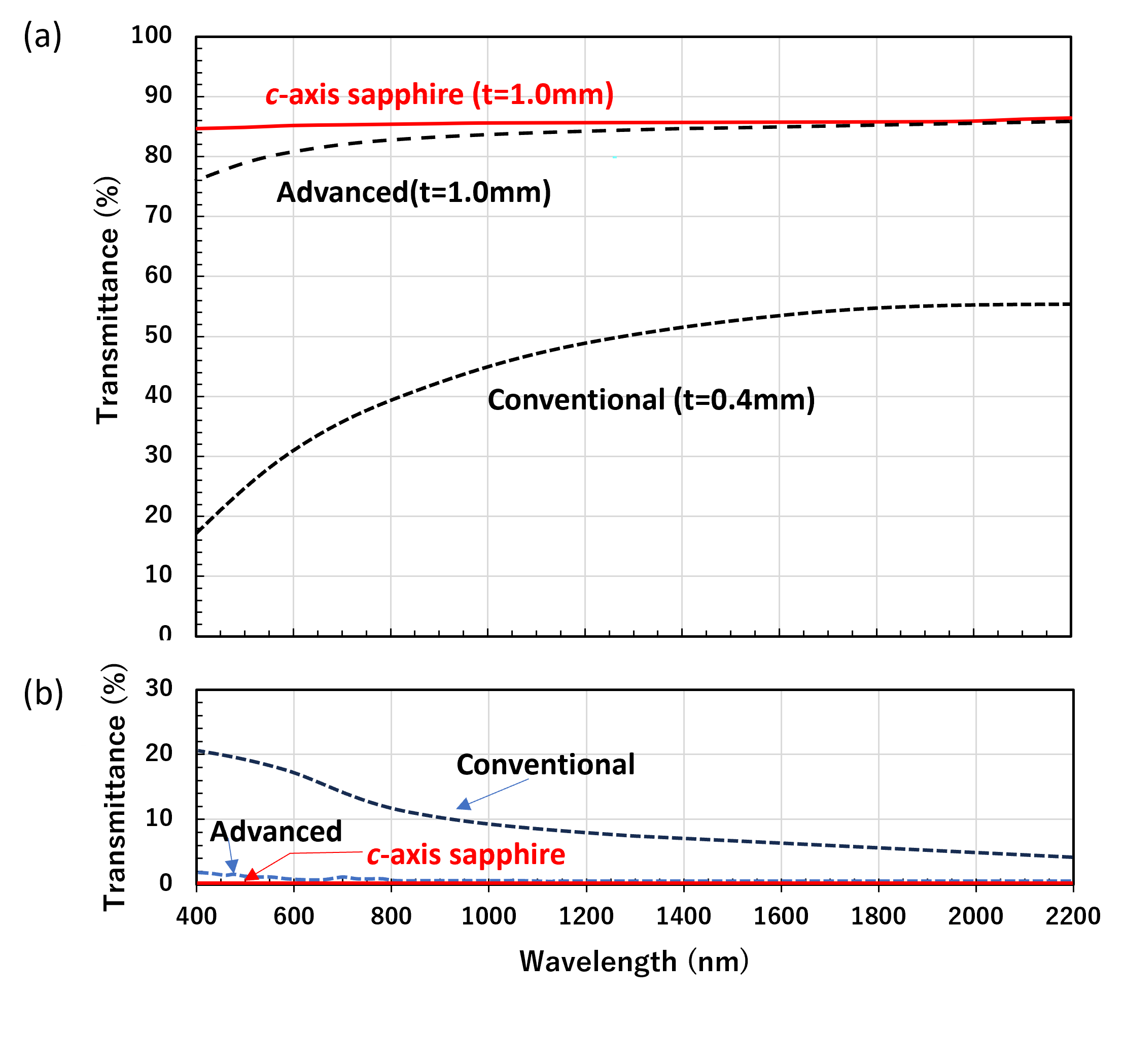
Figure 3. a) Total transmittance spectra of conventional and advanced alumina ceramics and c-axis sapphire crystal. b) Wavelength dependence of leaked light (transmittance) measured with crossed polarizers. Graphs adapted from Reference 10. Credit: Ikesue and Aung, Journal of the American Ceramic Society
With respect to the leaked light under crossed polarizers (the quantitative measure of birefringence), the advanced alumina exhibits values comparable to those of c-axis sapphire and optical glass. In particular, in the near-infrared and longer wavelength regions, birefringence becomes nearly undetectable. X-ray diffraction analysis confirms that the advanced alumina retains the hexagonal crystal structure of conventional alumina, suggesting that it has evolved into a noncubic-structured ceramic possessing pseudo-optical isotropy. Furthermore, Fourier transform infrared spectroscopy measurements of a 4-mm-thick advanced specimen reveal an in-line transmittance of 86% in the mid-infrared region (2.5–5 μm), equivalent to that of c-axis sapphire crystal.11
Figures 4a–d show near-infrared camera images of the author’s hand observed through different window materials: no window (blank), conventional alumina, advanced alumina, and c-axis sapphire single crystal.10 Compared with the blank image, photographs taken through the advanced alumina (6 mm thick) and the c-axis sapphire single crystal (4 mm thick) appear equally bright and sharp. In contrast, images obtained through a thinner conventional alumina window (2 mm thick) are dark and severely distorted. The conventional alumina retains intrinsic birefringence within individual grains even in the infrared region, a characteristic feature of noncubic-structured ceramics. As a result, both low transmittance and poor image quality become evident limitations.
Figures 4e and 4f present images of dome- and disk-shaped advanced alumina specimens (each 4 mm thick), which were taken using a mid-infrared camera operating in the 3–5 μm wavelength range. In these images, the ceramic appears transparent, comparable to optical glass. This behavior arises because birefringence in the advanced alumina is effectively eliminated, as demonstrated in Figure 2, resulting in pseudo-optical isotropy and enabling the transmission of highly coherent light. Because no residual pores remain in the ceramic, Mie scattering, which is caused by structural defects larger than the wavelength of light, is absent. Moreover, by suppressing birefringence, the refractive index dependence on the crystallographic orientation among the constituent grains is effectively removed.
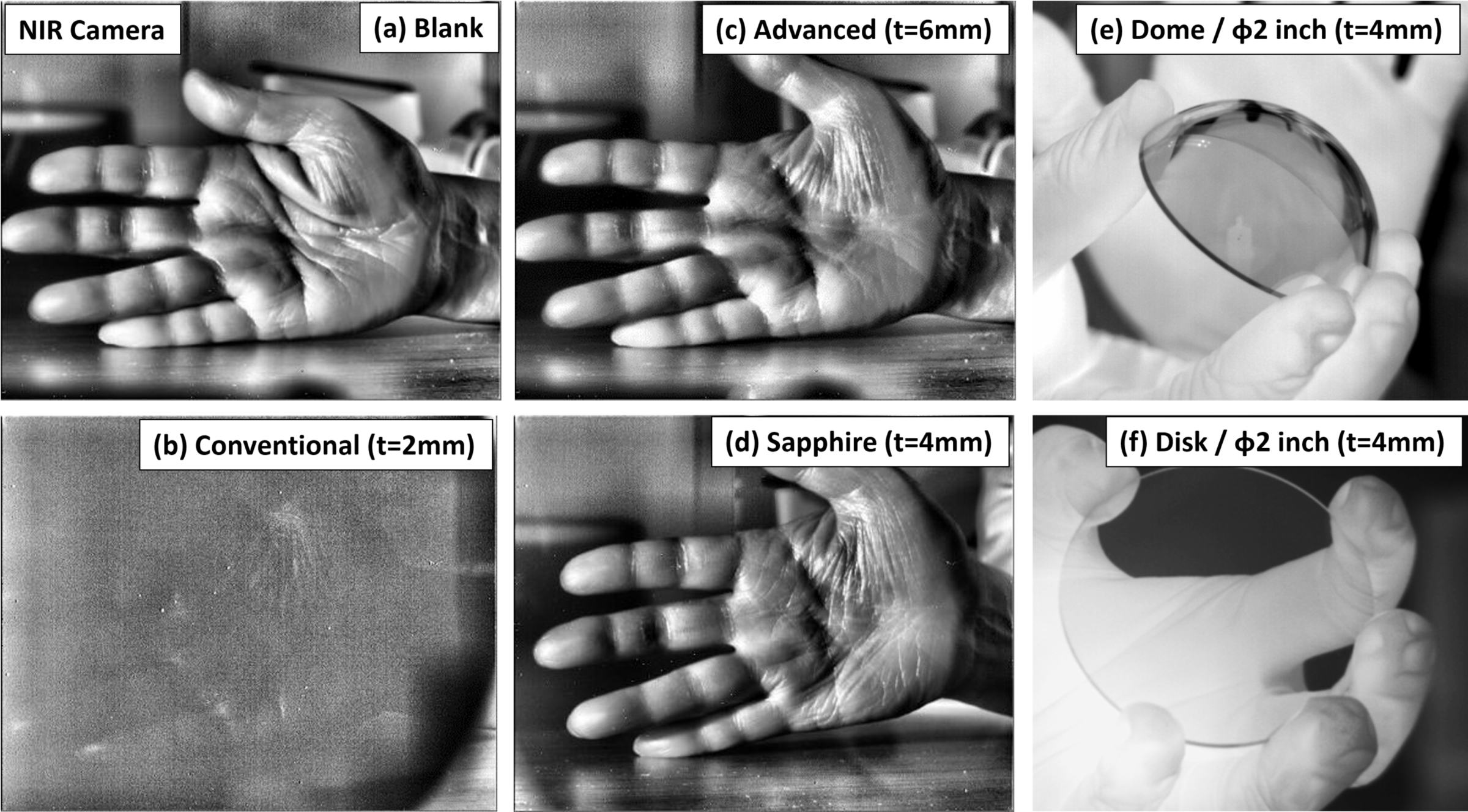
Figure 4. Hand image observed by near-infrared camera for a) blank, b) conventional alumina (2 mm thick), c) advanced alumina (6 mm thick), and d) c-axis sapphire single crystal (4 mm thick).10 Appearance of e) dome and f) disk-shaped advanced alumina observed by mid-infrared camera. Credit: a–d) Ikesue and Aung, Journal of the American Ceramic Society; e,f) Ikesue
Notably, we achieved these impressive optical results even though the average grain size of the advanced alumina is relatively large (~0.4 μm). This fact is significant because it demonstrates that the critical issue to engineering optical-grade noncubic-structured ceramics is how to eliminate birefringence rather than simply decreasing the grain size. However, grain size remains an important factor. We estimate that further refinement of the advanced alumina ceramics to about 0.1 μm could yield high transparency even in the visible region, enabling true optical-grade components.
A clearer future for noncubic-structured transparent ceramics
In the 1990s, it was widely believed that the synthesis of polycrystalline ceramics with optical properties comparable to single crystals was theoretically impossible, even for materials with cubic crystal structures. When our pioneering 1995 paper proved otherwise, it opened the door to new research and development pathways that have since led to the commercialization of optical-grade cubic-structured ceramics.
Now in the 2020s, we stand at the cusp of a novel optical paradigm based on noncubic-structured ceramics, if we can successfully overcome the problem of birefringence. It is my hope that the insights provided in this article can inspire future research that ultimately opens the door to new technological frontiers.

Related Articles

Market Insights
Digging into the development of uniform global mining standards
Mining standards and regulations have historically varied by region, nation, or locale, making for a patchwork of guidelines and laws for environmental protection, water and emissions management, proper waste disposal, worker rights, and engagement with Indigenous communities. Multinational mining companies, manufacturers, downstream customers, and socially conscious investors have for years…

Market Insights
Rethinking Arctic research: CIFAR report proposes pathways for the Arctic’s future
Although organized, multinational scientific research in the Arctic has taken place since the late 19th century,1 the past two decades have seen a surge in activity alongside the rapid ecosystem changes (Figure 1).2 Yet these scientific studies are increasingly mired in geopolitical tensions and economic interests,3 which means that scientists…

Market Insights
Global markets for lithium and green mining
The electrification and digitization of modern life drive increased demand for certain minerals, but they also drive the need for more environmentally conscious mining practices. Two recent BCC Research reports investigate the global markets for lithium mining and green mining, respectively. This Bulletin content is for ACerS members and registered…