
At the US National Science Foundation, the Faculty Early Career Development (CAREER) Program has an annual competition that provides five-year grants to assistant professors. This article provides some background information on the CAREER Program, an introduction to the 2013 awardees in the Ceramics Program, information about supplemental opportunities, and a few remarks about CAREER workshops.
Four articles about the CAREER program have been published in previous issues of this magazine. Each highlighted one year’s recipients of the NSF CAREER award in the Ceramics Program. The first of these covered 2009 grantees and provided a historical perspective and overview of the CAREER program.1 The next covered the 2010 grantees and mentioned the pilot of a CAREER workshop designed to provide feedback from experts on the principal investigators’ developments in their CAREER projects and overall career progression.2 These workshops have continued in subsequent years, and the most recent was held in conjunction with the International Conference & Exhibition on Advanced & Nano Materials3 in Québec City, Canada in August.
The 2011 article described the new Career-Life Balance initiative at NSF4 and associated supplemental awards available.5 The current article also provides information about this and other opportunities. The next article in the series focused on 2012 grantees and provided statistical and geographic details from the perspective of the Ceramics Program.6
NSF made five awards from the summer of 2012 CAREER submissions to the Ceramics Program. These projects began in 2013. Following is a summary of the new CAREER grantees and their research.
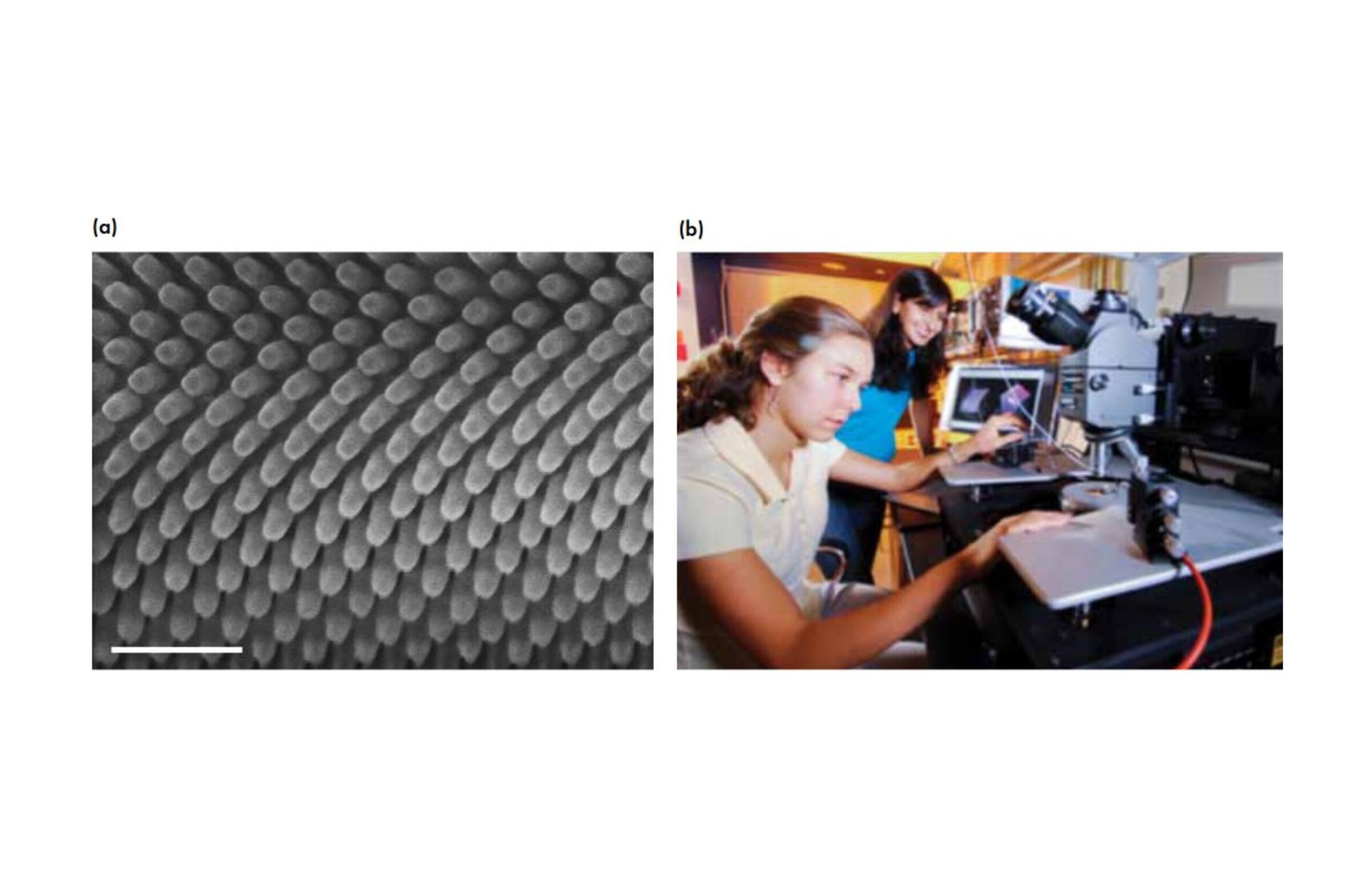
Nazanin Bassiri-Gharb of the Georgia Institute of Technology proposed a timely CAREER project focused on flexoelectricity, which capitalizes on the spontaneous electrical polarization of a dielectric material when it is subjected to strain or electric field gradients. She will examine flexoelectric micro- and nanocomposites with lead-free compositions and geometric confinement. The work will entail original fabrication approaches and should advance the fundamental understanding of the underlying physics of flexoelectricity and explain the discrepancies between experimental observations and theoretical predictions (Figure 1). In turn, this work may enable new transduction approaches in micro- and nanosystems. Bassiri-Gharb also will guide graduate and undergraduate students, mentor new women engineering students, and engage in high school student–parent day camps that focus on women. (Award 1255379)
Shen J. Dillon of the University of Illinois at Urbana-Champaign proposed a challenging CAREER project to quantitatively establish relationships between properties of individual heterojunction nanowires and their performance as photocatalysts. His approach includes in-situ transmission electron microscopy (TEM) to quantify the rate of photocatalytic gas evolution at individual nanostructures, ex-situ characterization to extend the structural and chemical information, and electrical measurements to obtain photoconductivity and relaxation data (Figure 2). This work will help to optimize high-efficiency, low-cost heterojunction photocatalysts that might lead toward new approaches to enhancing photocatalytic efficiency and new experimental methods for studying photochemistry at the nanometer scale. Dillon also will involve a diverse group of undergraduate and graduate students in this research, work closely with two K–12 teachers annually, and foster an inquiry-based approach to learning in his classes. (Award 1254406)
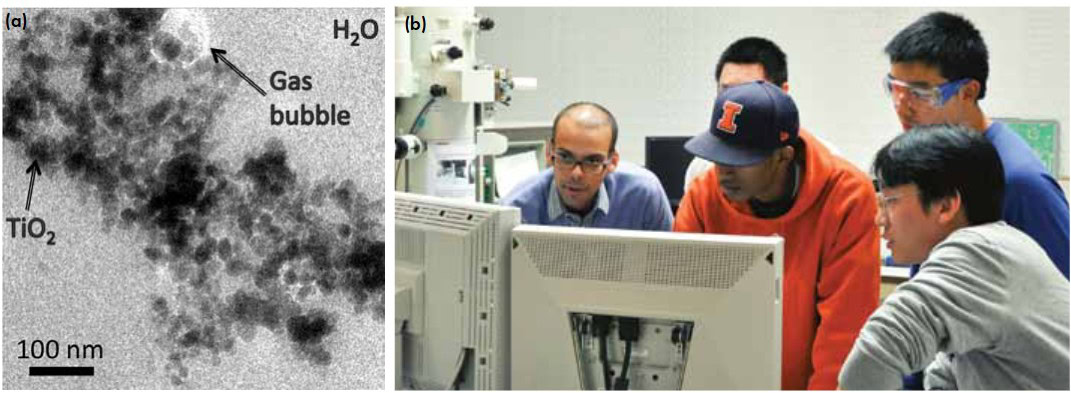
Figure 2. (a) Preliminary in situ photocatalysis demonstrating gas evolution after ~20 minutes of UV irradiation. Direct imaging of nanoscale bubbles provides a very sensitive measure of photocatalytic gas production. (b) Shen Dillon (left) working with undergraduate researchers Meng Huang (partially hidden, back middle), Jordan Turner (with hat), and Mingou Zhang (right rear) and postdoctoral associate Kaiping Tai (right front). Credit: S. Dillon.
Liping Huang of Rensselaer Polytechnic Institute, Troy, N.Y., proposed an original CAREER project with new concepts that use a combination of experimental and computational approaches to examine the role of elasticity in strengthening glasses. Her plans include use of in-situ light scattering techniques for measuring elastic moduli, development of models for multicomponent glasses, and use of faster and less expensive virtual testing protocols (Figure 3). Ultimately her work may prove useful in the design of tailored glasses, and benefits may derive from her development of a structural probe for understanding materials under extreme conditions. Huang also will integrate computation and modeling into courses, and she will motivate K–12 students, especially women and underrepresented minorities in high school, to pursue science and engineering careers. (Award 1255378)
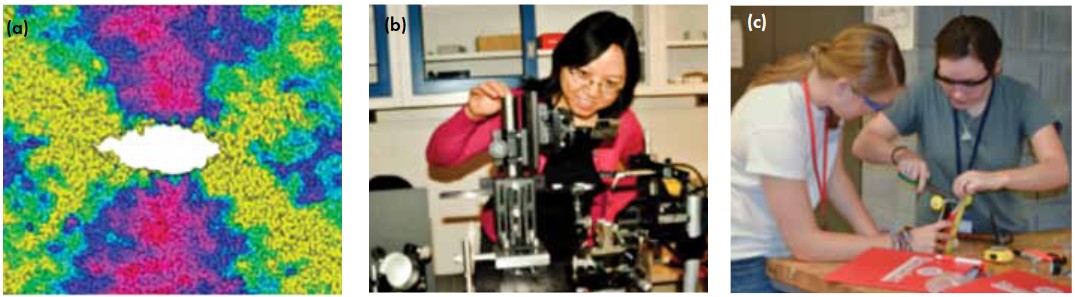
Figure 3. (a) Map of shear deformation around a pre-existing crack during tensile test of densified silica glass. Yellow color indicates a high degree of deformation. (b) Liping Huang sets up optics for studying the elastic properties of glass under high temperature, pressure, and strain conditions. (c) Outreach effort with high school students at the Engineering Institute for Young Women, Niskayuna, N.Y. Credit: L. Huang.
Alexander Orlov of the State University of New York at Stony Brook proposed a CAREER project that will develop novel biomimetic-inspired photosynthesis (the so-called Z-scheme) for water splitting by synthesizing heterostructured metal oxides (e.g., rhodium-doped SrTiO3 and BiVO4 photocatalysts) that could provide higher efficiency than traditional catalysts. These structures mainly will be examined using surface science techniques to ascertain their surface morphology, electronic structure, and interactions with water (Figure 4). A possible outcome of this research is the development of a new approach to the utilization of solar power. Orlov will continue with the development of an innovative computer game and educational platform called Enviropedia to teach sustainability concepts, engage undergraduate and graduate students in research, develop curriculum, and continue his interactions with high schools. He also will endeavor to apply photocatalytic materials in additional self-cleaning applications. (Award 1254600)
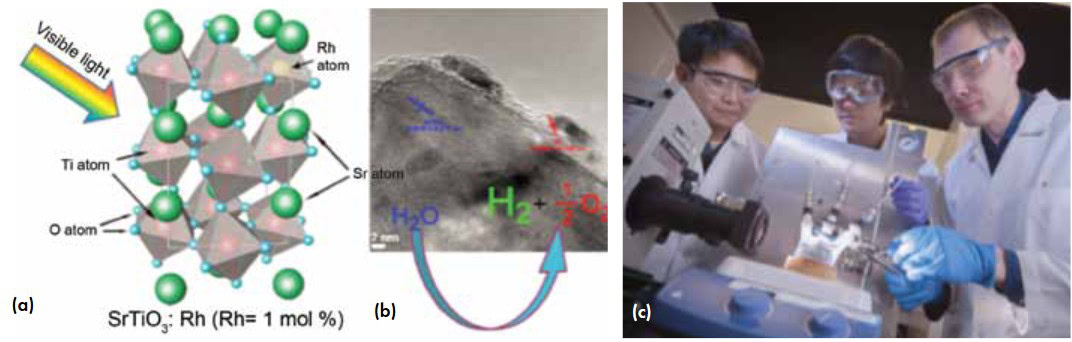
Figure 4. (a) Hydrogen production from water and sunlight on doped Rh-SrTiO3. (b) Transmission electron microscopy image shows Pt-modified Rh-doped SrTiO3, which serves as an H 2 production site for biomimetic Z-scheme based ceramics. (c) Alexander Orlov (right) with his students Peichuan Shen (left) and Shen Zhao and a photochemical reactor. Credit: SUNY at Stony Brook.
Xueyan Song of West Virginia University, Morgantown, proposed a comprehensive and focused CAREER project to optimize, through nanoscale engineering approaches, the energy interconversion properties of the p-type oxide thermoelectric material Ca3Co4O9 (Figure 5). Her approach includes doping of the lattice to enhance the electrical transport properties as well as the simultaneous insertion of nanoscale-sized inclusions to reduce the thermal conductivity. This research ultimately will serve to improve thermoelectric materials for waste heat recovery. Song intends to include a diverse set of undergraduate and graduate students in her research efforts and to engage high school teachers through the existing WVU Teacher Research Experience for the Advancement of Knowledge (TREK) program. (Award 1254594)
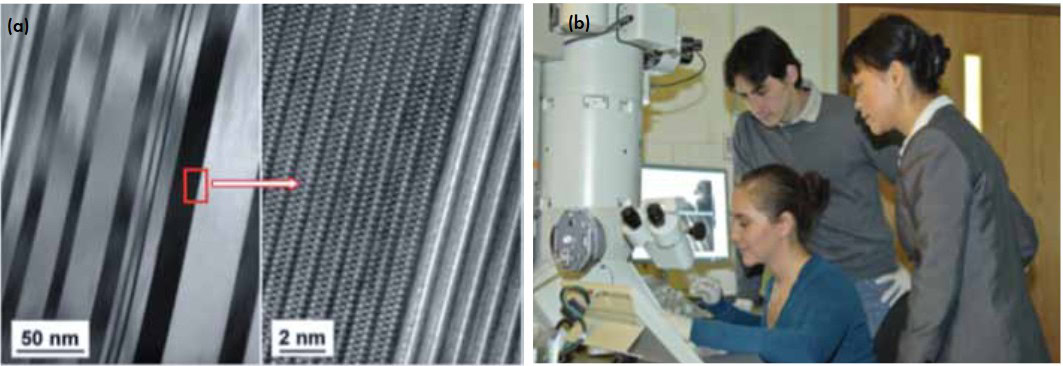
Figure 5. (a) TEM image from the nanoscale lamellas in calcium cobaltite, and high-resolution TEM image from the grain boundary region. (b) Song (right) with graduate students Maria Torres Arango and Diego Palacio. Credit: X. Song.
Other funding opportunities
Career-life balance. The NSF-wide CLB initiative, which outlines new workplace flexibility policies to support scientists and their families, was announced jointly by the White House and NSF in 2011. Gender-neutral policies and practices are critical to attracting and retaining top scientists to academic positions. The CAREER Program page7 describes a special supplemental funding opportunity under CLB (NSF 13-075) and invites requests to support additional personnel when principal investigators are on family leave. Funding is available to sustain research for up to three months or $12,000 of salary support for research technicians or equivalent plus indirect costs. In FY 2012, 27 supplements were provided to support CLB across NSF, including several to CAREER grantees in the Ceramics Program.
Graduate research supplements for underrepresented groups. The Mathematical and Physical Sciences Dear Colleague Letter (NSF 13-071) describes a supplemental funding opportunity that emphasizes broadening participation of underrepresented minorities. Requests for these supplements require a connection to an existing or previous grant under the Alliances for Graduate Education and the Professoriate program. Supplements provide up to approximately $60,000 per year, renewable for up to three years. MPS made 29 supplements in FY 2012, the program’s inaugural year, and recommended 39 in FY 2013. The Ceramics Program approved eight of these, including several to CAREER grantees.
Collaborations between European and American researchers. Under an agreement signed by NSF and the European Commission in 2012, the European Research Council (ERC) will identify researchers seeking to host junior NSF-funded investigators for up to one year. US-based scientists and engineers supported either by a CAREER award or through one of NSF’s Postdoctoral Research Fellowships may be invited to join an ERC team. If they are selected, they can apply to NSF (through a supplemental proposal) for travel expenses. In-Europe costs may be covered by the ERC grant. NSF Dear Colleague Letter 13-050 provides more details about this opportunity.
Workshops. NSF has sponsored dozens of career-focused workshops over the years; some focus on CAREER grantees while others target pre-CAREER awardees. Topics have included educating junior faculty about NSF, career planning, preparing an NSF CAREER proposal, and assisting junior faculty in navigating the tenure process.
Since 2011, the Ceramics Program has sponsored a series of annual professional development workshops focused on mentoring of CAREER awardees. The first of these, piloted by William Fahrenholtz in 2011 (Award 1048443), focused on 2010 Ceramics Program CAREER grantees. Participants received an intensive two-day technical and professional development workshop with more than a dozen colleagues and peers from the international scientific community. CAREER grantees received critical and constructive comments about their research plans and progress, education efforts, and career development.
These sessions were augmented with presentations on topics such as entrepreneurship, professional society goals, and research priorities. Other participants, including additional assistant professors as well as postdoctoral associates, benefited greatly from the scientific and professional presentations and ensuing discussions. The aim of these workshops is to positively impact the research of participants, foster exchange of best practices for teaching and training students, and forge new cooperation and collaborations worldwide. Erica Corral, one of the Class of 2010 CAREER awardees, then organized and hosted the next workshop (Award No. 1240580). Ricardo Castro continued this tradition and hosted the 2013 workshop (Award 1338627).
Supplemental opportunities
Researchers with active NSF awards may request supplemental funding based on justification and the availability of program funds. Some requests are easily justified, e.g., an unanticipated need for additional funds for special equipment or repairs, or for assistance to facilitate participation by persons with disabilities in an NSF-supported project. Selected supplemental opportunities have some set-aside funds, which are often described in NSF Dear Colleague letters. Following are guidelines for Supplemental Support as described in the Jan. 2013 NSF Award and Administration Guide (Chapter I, Section E.4).
- In unusual circumstances, small amounts of supplemental funding and up to six months of additional support may be requested to assure adequate completion of the original scope of work. Such requests for supplemental funding support should be submitted to the cognizant NSF Program Officer at least two months prior to the need for the additional funds and must be adequately justified. Program officers may make decisions regarding whether or not to recommend a small supplement without merit review of the supplemental request. Requests for larger supplements may require external merit review.
- A request for supplemental support must be submitted electronically via FastLane and must include: (i) A summary of the proposed work; (ii) A justification of the need for the supplemental funds; and (iii) A budget, highlighting the use by budget category of the additional funding as distinguished from the original funding provided in those categories of cost. Authorized Organizational Representatives are required to electronically sign the supplemental funding request via the AOR Functions in FastLane.
- NSF will not approve requests for supplemental support for such purposes as defraying the costs of increases in salaries, wages or staff benefits or for additional indirect cost reimbursement, whether caused by a change in the indirect cost rate or by changes in direct cost expenditures which affect the indirect cost base.
- If approved, the NSF Grants and Agreements Officer will amend the grant to provide additional funding for the current support period. The amendment notice will specify both the amount of supplemental funding and the cumulative amount awarded through the expiration date, which normally will remain unchanged.
- Special NSF programs such as Research Experiences for Undergraduates may provide their funding through supplements to other NSF grants. In such instances, the guidance in this section may not be applicable.
Acknowledgments
The author thanks the CAREER grantees for providing images, and the thoughtful input of her colleagues, including Ashley A. White, Richard N. Smith and Graham H. Harrison. NSF publication clearance number 1300142.

Related Articles

Market Insights
Next-gen superconducting ceramics could change how we travel and much more
Forty years ago, two physicists from IBM’s research laboratory in Zürich, Switzerland, reported a groundbreaking discovery: Superconductivity, or the quantum mechanical phenomenon in which certain materials exhibit zero electrical resistance when cooled, could be achieved at higher temperatures using ceramics. Superconductivity had been discovered decades before, but its applications had…

Market Insights
Why most AI manufacturing projects fail and how to fix it
Artificial intelligence is reshaping advanced manufacturing, especially processes involving ceramics, glasses, and other hard or brittle materials. But adopting AI is far more difficult than simply buying software and connecting machines. Manufacturers must understand the advantages and limitations of different models, so they can determine where AI fits best within…

Bulletin Features
Radiation effects on rare earth chemistry in molten salts for nuclear applications
Across the nuclear energy sector, molten salts are shaping the next generation of nuclear technologies, from advanced power reactors to used nuclear fuel recycling. In molten salt reactors (MSRs), molten salts uniquely serve as both the primary coolant and fuel medium, a dual role that sets MSRs apart from conventional…