
When it comes to sustainability, that conundrum can lead to greenwashing. In the Nordic region, however, public and private entities are collaborating on meaningful climate action. Here, we look at the impact their initiatives are having on green performance in the mining, energy, and construction sectors.
Norway’s Fen Carbonatite Complex levels the rare earths playing field
What would be better than identifying continental Europe’s biggest deposit of rare earth elements in the form of bastnäsite, parisite, monazite, and other rare earth minerals? Finding that resource in a fortuitous location.
The source of the Fen Carbonatite Complex is a 580-million-year-old volcanic conduit situated less that a two-hour drive from Oslo and just 22 miles from Herøya, the Norwegian processing industry’s largest industrial park. It is the latest chapter in the long mining history of Nome, a municipality that offers well-developed infrastructure and a location close to a skilled workforce and harbor facilities, in addition to easy access to hydropower energy.
Rare Earths Norway is responsible for developing the deposit into a long-term source of sustainably processed rare earths for European and allied countries. Following the completion of several stages of feasibility studies, an R&D pilot is slated to launch in 2027.
Mineral separation, hydrometallurgical processing, radioactivity handling, and project economics are the key challenges addressed in the feasibility studies, Rare Earths Norway CEO Alf Reistad states in an email. He notes that as this development is a greenfield project, in-depth economic analysis is a critical step.
The enterprise will use raise mining to manage environmental impact. This underground mining method, nicknamed “the invisible mine,” was developed in close cooperation with Austria’s Technical University of Leoben (Montanuniversität Leoben) with European Union funding support from REEsource. The method “is suitable for electrification and automated/autonomous operations and offers a high recovery rate,” Reistad says. “It is also well suited for back-filling, which reduces the need for a surface tailings storage facility.”
He adds that the Rare Earths Norway mining concept is characterized by a “significant reduction of the need of TSF [tailing storage facilities], security for the people living on the top of the deposit, and high utilization of the deposit,” all targets that align with Norway’s national mineral strategy, which calls for Norway to develop the world’s most sustainable minerals industry. The project’s planned remediation processes include backfilling tailings, recirculation of process water and material streams, regeneration of chemicals, and continuous TSF rehabilitation. Plans also include investigating the potential to develop byproducts in support of circularity targets.
Working in collaboration with leading European and North American institutes, the project leaders seek to develop sustainable processing technologies. “The focus is on adapting processes to Fen’s mineral composition to minimize energy and chemical use, implementing closed-loop systems to eliminate pollution, and enabling by-product valorization with safe handling of radioactivity,” a Rare Earths Norway document shared by Reistad states.
Transparency and community engagement count as additional priorities. The document lists such commitments as “supporting local businesses by sourcing services and products locally whenever possible and collaborating with local educational institutions to develop the future workforce.”
To date, two family-owned companies have financed Rare Earths Norway. Hustadlitt AS, which has operated in the mining sector for more than 75 years, has the majority stake, and its founder, Sturla Steinsvik, serves as project advisor and chairman of the Board. Ulefos Cappelen Group, whose history of iron ore mining and foundry operations dates to 1657, also has a stake. “The Norwegian parliament is currently assessing participation in the project,” Reistad says.
Sand enables large-scale thermal energy storage
Polar Night Energy sums up its mission statement in just a few words: The Finnish company “develops high-temperature thermal storage systems to reduce combustion, boost renewables, and combat climate change.” Based just on that, you might not guess the key to achieving those goals is sand.
The company describes its Sand Battery as “a large-scale, high-temperature thermal energy storage system that uses sand or similar materials as its storage medium.” How does that work? Lead scientist Ville Kivioja cannot divulge the particulars of the spec sheet, but he says in a ACerS interview that the insulating materials are “mainly quite basic…because we are able to handle the temperature levels. We don’t go too high near the insulators, so even if we go to about 600°C in the heating part in the resistors, the insulators are never going to experience 600 degrees.”
That approach is in keeping with the company’s philosophy of keeping solutions simple, off-the-shelf, and inexpensive wherever possible.
“We have this patented closed loop air circulation. The air is flowed through the heat transfer pipes that are in the storage silo, and the same air transfers the heat to the heat exchangers of the customer. That sounds very simple, but it is not so simple to make cheaply,” Kivioja says. “We have all those pipes and ducts that are thermally expanding and contracting. Handling those things cheaply enough is the major challenge.”
The Sand Battery is expected to last for decades and to retain heat for months at a time with minimal energy loss. Erosion of the sand occurs over time but “does not really affect us, because the same amount of mass will be there,” Kivioja says. “Even if the grain size of the sand would somehow get a little bit different over time, that doesn’t really affect in any meaningful way the performance of the system.”
The sand’s chemical composition (for example, its percentage of silica content) can have an impact on heat capacity and efficiency, but there are other considerations, such as the cost of transporting potentially preferred sand across long distances versus sourcing sand locally.
A 2-MW Sand Battery model is currently available. The company markets the system as suitable for “decarbonizing energy systems” and as ideal for industrial processes, energy companies, district heating networks, and space-heating applications.
First-year benchmarking of the world’s largest Sand Battery (Figure 1) was announced on June 11, 2026. The press release stated, “The Sand Battery built by Polar Night Energy for Loviisan Lämpö has now been in operation for one year. With the help of the Sand Battery, climate emissions from the Pornainen district heating network have been reduced by 70 percent.”a
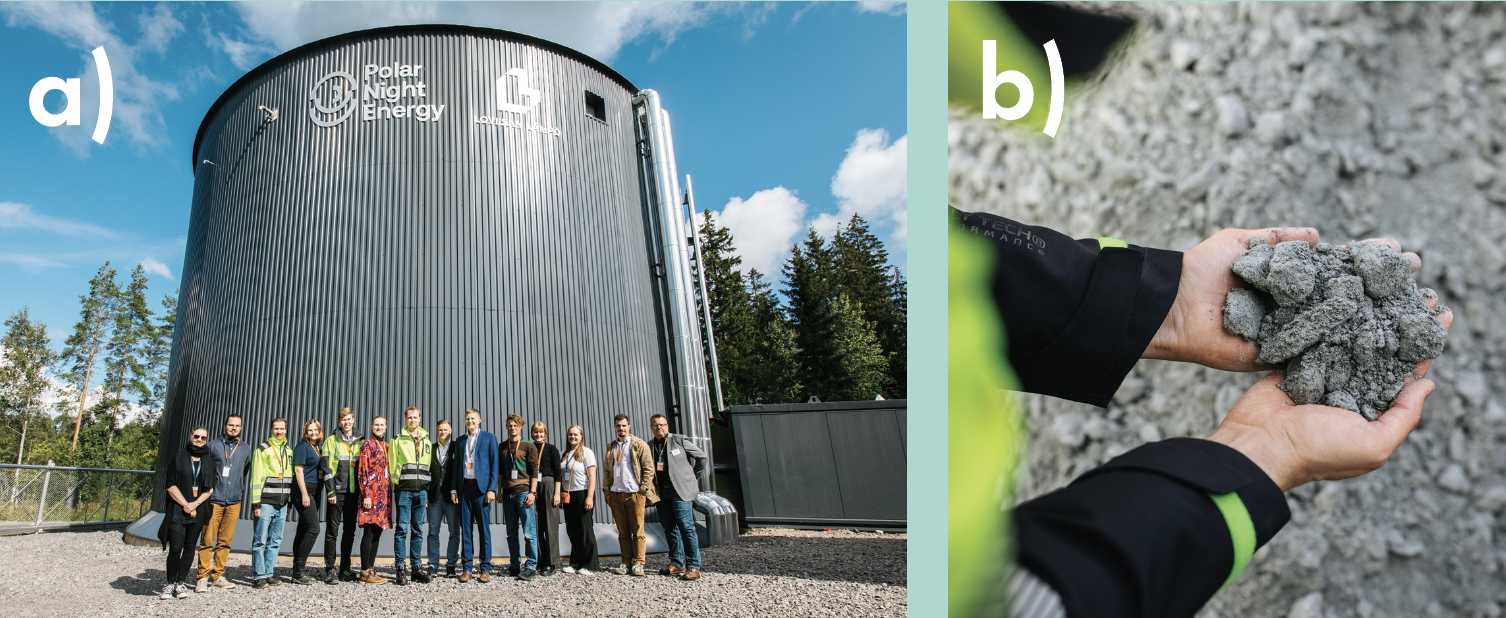
Figure 1. a) Group photo from the Pornainen Sand Battery’s inauguration in August 2025. b) Closeup of the soapstone used as the thermal storage medium in the system. Credit: Polar Night
Kivioja does not anticipate any issues that could affect the repeatability of the first year’s performance. “There we used crushed soapstone instead of sand, but the same thing applies,” he says. “It is going to perform as well in the future as now. There should be no reason for the efficiency or the power capabilities to decrease, so yes, we are expecting the same figures far in the future.”
That future includes plans for expansion, starting in the Baltic region. “From the beginning, we have known that we can scale globally if we just succeed,” Kivioja says. “There is no fundamental barrier that would make it difficult to be in Asia, the U.S., and so on.”
Targeting reduced emissions in concrete slabs
In July 2026, Nordic Innovation announced that it had selected seven projects from 76 responses to its Call for Project Proposals: A Green and Competitive Nordic Region.
The winning proposals included Circular Value Chains for Concrete Slab Reuse in the Nordic Region – RE:SLAB Nordic, which “aims to establish scalable Nordic value chains for reuse of concrete slabs, targeting slab systems that represent a major share of material consumption and embodied greenhouse gas emissions in buildings.”b The project falls under the Innovative Solutions for 2030 program, whose objective is “to promote sustainability and economic resilience in high-emission sectors” through solutions that provide “support for existing businesses in high-emission sectors to adopt green and digital solutions.”c
The project partners proposed focusing on reuse of hollow core slabs, recovered in-situ cast slabs, and other prefabricated slab systems as the means of increasing circularity and reducing emissions in the construction sector. A further goal is strengthening the industry’s Nordic value chains as a means of mitigating global supply chain disruptions.
“A core strength of the project is its emphasis on financial feasibility and robust documentation of the quality and performance of reused concrete slabs,” the award description says.b “The project will activate and connect key actors across the reuse value chain, develop and document practical reuse methods, demonstrate slab reuse in real construction projects, analyse and reduce cost drivers, and establish collaboration models and policy-relevant guidance for large-scale implementation.”
The project lead is Norway’s Sirkulær Ressurssentral AS, and additional partners include Sweden’s KTH–Royal Institute of Technology as well as circrete, Tscherning, and FORCE Technology, all of Denmark.
Return to main article: “Green lands: Nordic countries share knowledge and resources in pursuit of global leadership in sustainable practices“

Related Articles

Market Insights
Digging into the development of uniform global mining standards
Mining standards and regulations have historically varied by region, nation, or locale, making for a patchwork of guidelines and laws for environmental protection, water and emissions management, proper waste disposal, worker rights, and engagement with Indigenous communities. Multinational mining companies, manufacturers, downstream customers, and socially conscious investors have for years…

Market Insights
Rethinking Arctic research: CIFAR report proposes pathways for the Arctic’s future
Although organized, multinational scientific research in the Arctic has taken place since the late 19th century,1 the past two decades have seen a surge in activity alongside the rapid ecosystem changes (Figure 1).2 Yet these scientific studies are increasingly mired in geopolitical tensions and economic interests,3 which means that scientists…

Market Insights
Global markets for lithium and green mining
The electrification and digitization of modern life drive increased demand for certain minerals, but they also drive the need for more environmentally conscious mining practices. Two recent BCC Research reports investigate the global markets for lithium mining and green mining, respectively. This Bulletin content is for ACerS members and registered…