

Even as the COVID-19 pandemic majorly affected industries around the world, the United States government continued researching ways to reduce reliance on foreign sources for critical minerals, as described in the annual United States Geological Survey Mineral Commodity Summaries report.1
The Mineral Commodity Summaries spotlights the events, trends, and issues that took place the previous year in the nonfuel mineral industry. Every August the ACerS Bulletin provides a look at some of the key facts covered in the report, which includes statistics on production, supply, and overall market for more than 90 minerals and raw materials.
In 2020, the estimated total value of nonfuel mineral production in the United States decreased by 2% from 2019 to $82.3 billion. The total value of industrial minerals production decreased as well, by 4% to $54.6 billion. Of this total, $27.0 billion came from construction aggregates production. Crushed stone accounted for the largest share of total U.S. nonfuel mineral production value in 2020 with 22%.
Last year saw decreases in consumption of nonfuel mineral commodities in the commercial construction, oil and gas production, steel production, and automotive and transportation industries due to the financial impacts of the global COVID-19 pandemic. For the metals sector, the aluminum, iron ore, steel, and titanium industries were particularly affected by reduced demand from manufacturing. In general, mines were not subject to COVID-19-related stay-at-home orders because they were deemed critical industries, but decreased demand from downstream industries resulted in reduced production at some operations.
The United States implemented additional import duties in 2020 for certain products that were derivatives of aluminum and steel articles. These duties continued for most countries as a result of the U.S. Department of Commerce findings in 2018 of harm to national security under section 232 of the Trade Expansion Act of 1962. Likewise, the European Union imposed additional duties on approximately $4 billion of imports from the United States while China imposed additional tariffs on approximately $77 billion of U.S. imports.
In February 2020, the U.S. Geological Survey published a new methodology2 to evaluate the global supply of and U.S. demand for 52 mineral commodities for 2007–2016. It identified 23 mineral commodities—including aluminum, antimony, bismuth, cobalt, gallium, germanium, indium, niobium, platinum-group metals, rare-earth elements, tantalum, titanium, and tungsten—as posing the greatest supply risk for the U.S. manufacturing sector. On September 30, Executive Order 13953 was issued to address the national emergency described.3
The U.S. continues to rely on foreign sources for raw and processed mineral materials. In 2020, imports made up more than one-half of the U.S. apparent consumption for 46 nonfuel mineral commodities, and the U.S. was 100% net import reliant for 17 of those. Fourteen of the
17 mineral commodities with 100% net import reliance were listed as critical minerals, and 14 additional critical mineral commodities had a net import reliance greater than 50% of apparent consumption.
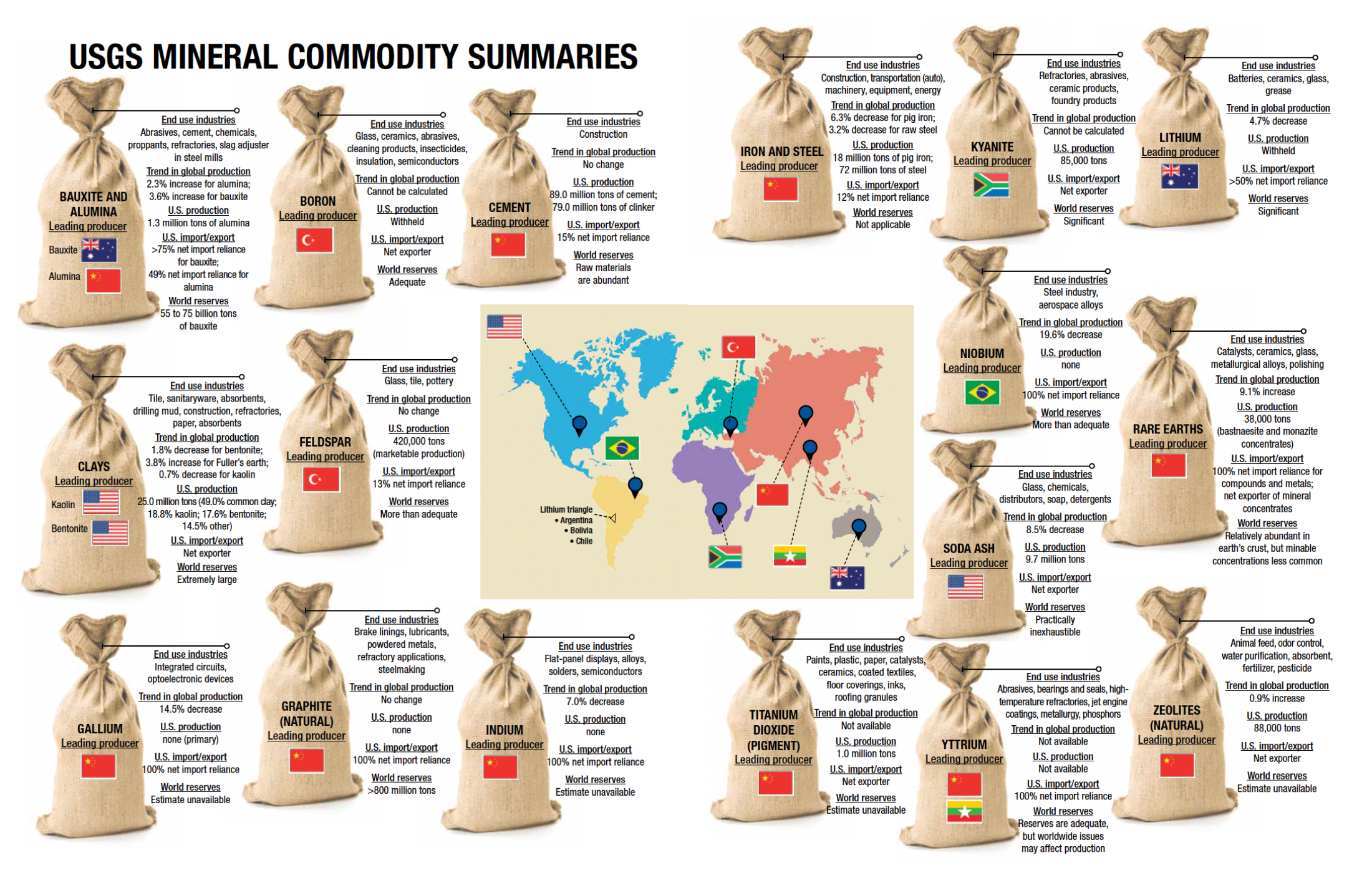
On the next two pages, an infographic summarizes some of the salient statistics and trends for a handful of mineral commodities that are of particular interest in the ceramic and glass industries. Readers are encouraged to access the complete USGS report at https://doi.org/10.3133/mcs2021.
USGS Mineral Commodity Summaries

Related Articles

Market Insights
Next-gen superconducting ceramics could change how we travel and much more
Forty years ago, two physicists from IBM’s research laboratory in Zürich, Switzerland, reported a groundbreaking discovery: Superconductivity, or the quantum mechanical phenomenon in which certain materials exhibit zero electrical resistance when cooled, could be achieved at higher temperatures using ceramics. Superconductivity had been discovered decades before, but its applications had…

Market Insights
Why most AI manufacturing projects fail and how to fix it
Artificial intelligence is reshaping advanced manufacturing, especially processes involving ceramics, glasses, and other hard or brittle materials. But adopting AI is far more difficult than simply buying software and connecting machines. Manufacturers must understand the advantages and limitations of different models, so they can determine where AI fits best within…

Bulletin Features
Radiation effects on rare earth chemistry in molten salts for nuclear applications
Across the nuclear energy sector, molten salts are shaping the next generation of nuclear technologies, from advanced power reactors to used nuclear fuel recycling. In molten salt reactors (MSRs), molten salts uniquely serve as both the primary coolant and fuel medium, a dual role that sets MSRs apart from conventional…