
In recent years, the United States has made significant strides in transforming its mineral supply chains and reliance on foreign mineral sources, as reported in the annual United States Geological Survey Mineral Commodity Summaries.1
The USGS Mineral Commodity Summaries report spotlights events, trends, and issues from the past year in the nonfuel mineral industry. Each August, the ACerS Bulletin shares some of the key facts covered in the report.
In 2025, U.S. nonfuel mineral production reached an estimated $112 billion, a 5.6% increase from 2024. The total value of industrial minerals production was $73.7 billion, which is 2% more than the revised total of 2024. Of this total, an estimated $39.4 billion came from construction aggregates production, including construction sand, gravel, and crushed stone. Crushed stone once again led the U.S. nonfuel mineral commodities list with a production value of $26.8 billion (24% of total value).
The metals sector was a mixed bag of price fluctuations. The production values of cobalt and nickel increased by 80% and 19%, respectively, compared to 2024. In contrast, the production value of lithium decreased by 16%. Meanwhile, the production value of natural aggregates increased by 4%, even though 2025 production volumes decreased by 1% compared to 2024.
The USGS List of Critical Minerals notably expanded from 50 to 60 minerals to help encourage domestic production. The additions are boron, copper, lead, metallurgical coal, phosphate rock, potash, rhenium, silicon, silver, and uranium.
As part of the U.S. government’s ongoing strategy to reduce reliance on foreign supply chains, various investments and congressional acts were implemented aimed at strengthening domestic critical minerals production. For example, the Department of Defense invested $1 billion in the critical minerals sector throughout 2025, including a collaboration with a Korean company on a $7.4 billion smelter project in Clarksville, Tenn.
In April 2025, Executive Order 14272 instructed the Department of Commerce to investigate certain critical minerals for national security purposes, as well as products manufactured from minerals such as batteries, microprocessors, and renewable energy system components.2 A few months later, in July 2025, the One Big Beautiful Bill Act was passed, which provides $2 billion for stockpiling of critical minerals and $5 billion
for the Secretary of Defense to invest in production of niobium, scandium, titanium, and other critical minerals.3
Regarding critical minerals facilities, several projects broke ground, including multiple new facilities producing copper in states such as Arizona, Kentucky, and Georgia. Demand for copper has spiked in recent years as the demand for data centers and electric vehicles has increased.
Despite efforts to strengthen domestic supply chains, the U.S. still relies on foreign sources for certain raw or processed materials. In 2025, the U.S. was 100% net import reliant on 13 of the 60 critical mineral commodities and at least 50% or more net import reliant on 20 others. Recycling served as the only domestic source for antimony, bismuth, chromium, magnesium metal, tin, tungsten, and vanadium.
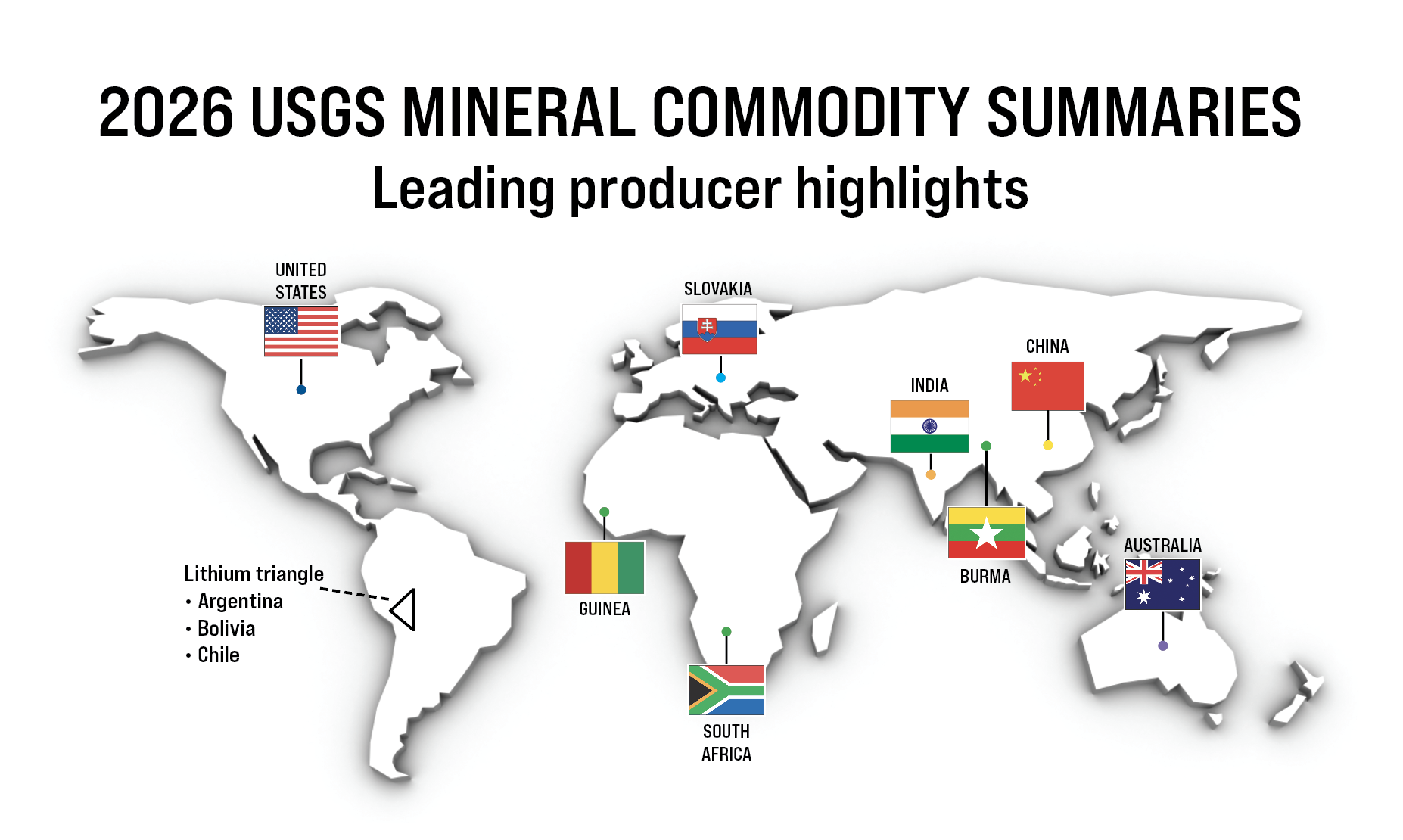
Besides the ongoing trade policy disputes between the U.S. and China in 2025, both countries sought to expand their base of support globally. China formed an International Economic and Trade Cooperation Initiative on Green Mining and Minerals in late 2025,4 while the U.S. launched the Forum on Resource Geostrategic Engagement in early 2026.5
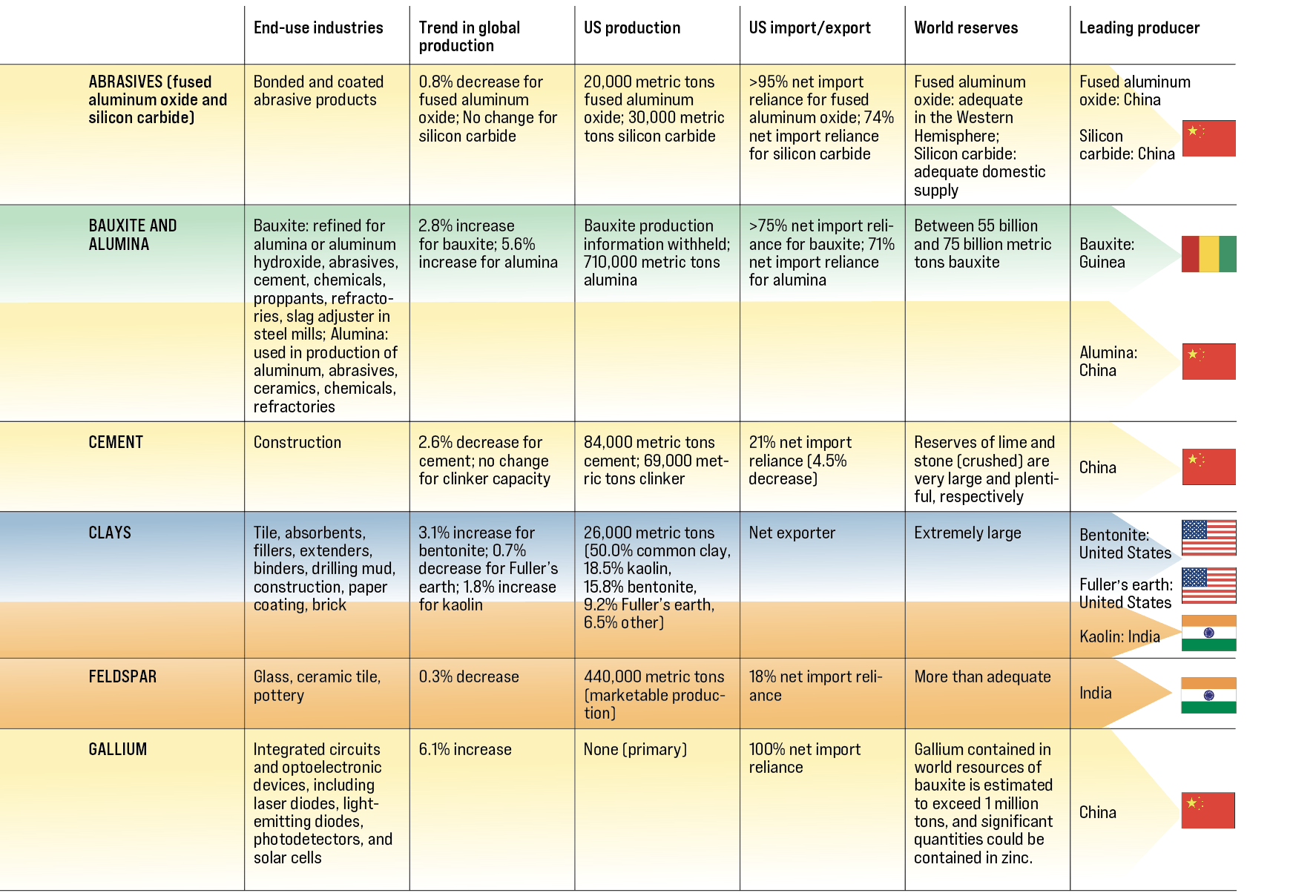
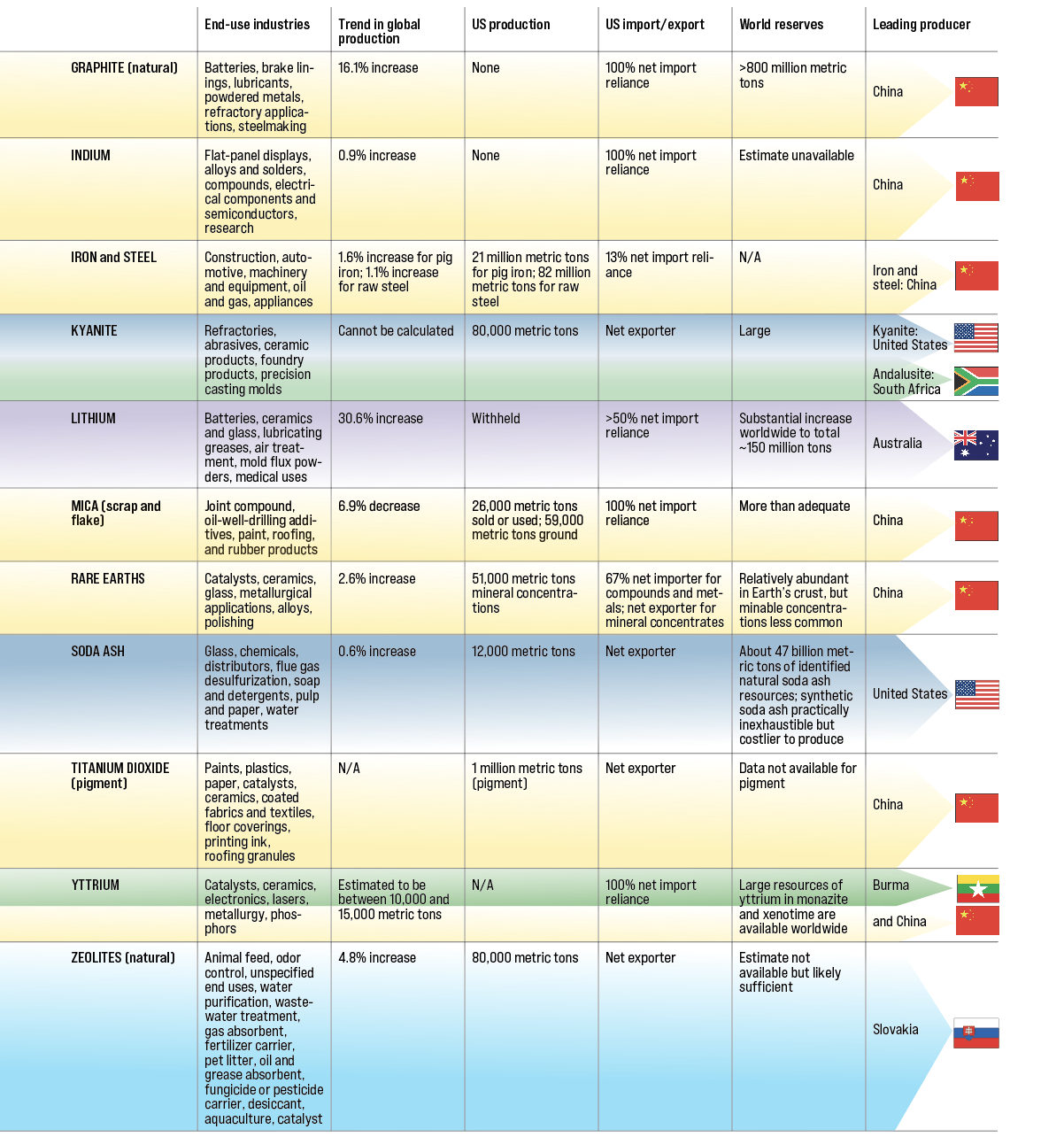
The table below summarizes some of the statistics and trends for a variety of mineral commodities that serve the ceramic and glass industries. Access the complete USGS report at https://pubs.usgs.gov/publication/mcs2026.

Related Articles

Market Insights
Next-gen superconducting ceramics could change how we travel and much more
Forty years ago, two physicists from IBM’s research laboratory in Zürich, Switzerland, reported a groundbreaking discovery: Superconductivity, or the quantum mechanical phenomenon in which certain materials exhibit zero electrical resistance when cooled, could be achieved at higher temperatures using ceramics. Superconductivity had been discovered decades before, but its applications had…

Market Insights
Why most AI manufacturing projects fail and how to fix it
Artificial intelligence is reshaping advanced manufacturing, especially processes involving ceramics, glasses, and other hard or brittle materials. But adopting AI is far more difficult than simply buying software and connecting machines. Manufacturers must understand the advantages and limitations of different models, so they can determine where AI fits best within…

Bulletin Features
Radiation effects on rare earth chemistry in molten salts for nuclear applications
Across the nuclear energy sector, molten salts are shaping the next generation of nuclear technologies, from advanced power reactors to used nuclear fuel recycling. In molten salt reactors (MSRs), molten salts uniquely serve as both the primary coolant and fuel medium, a dual role that sets MSRs apart from conventional…