
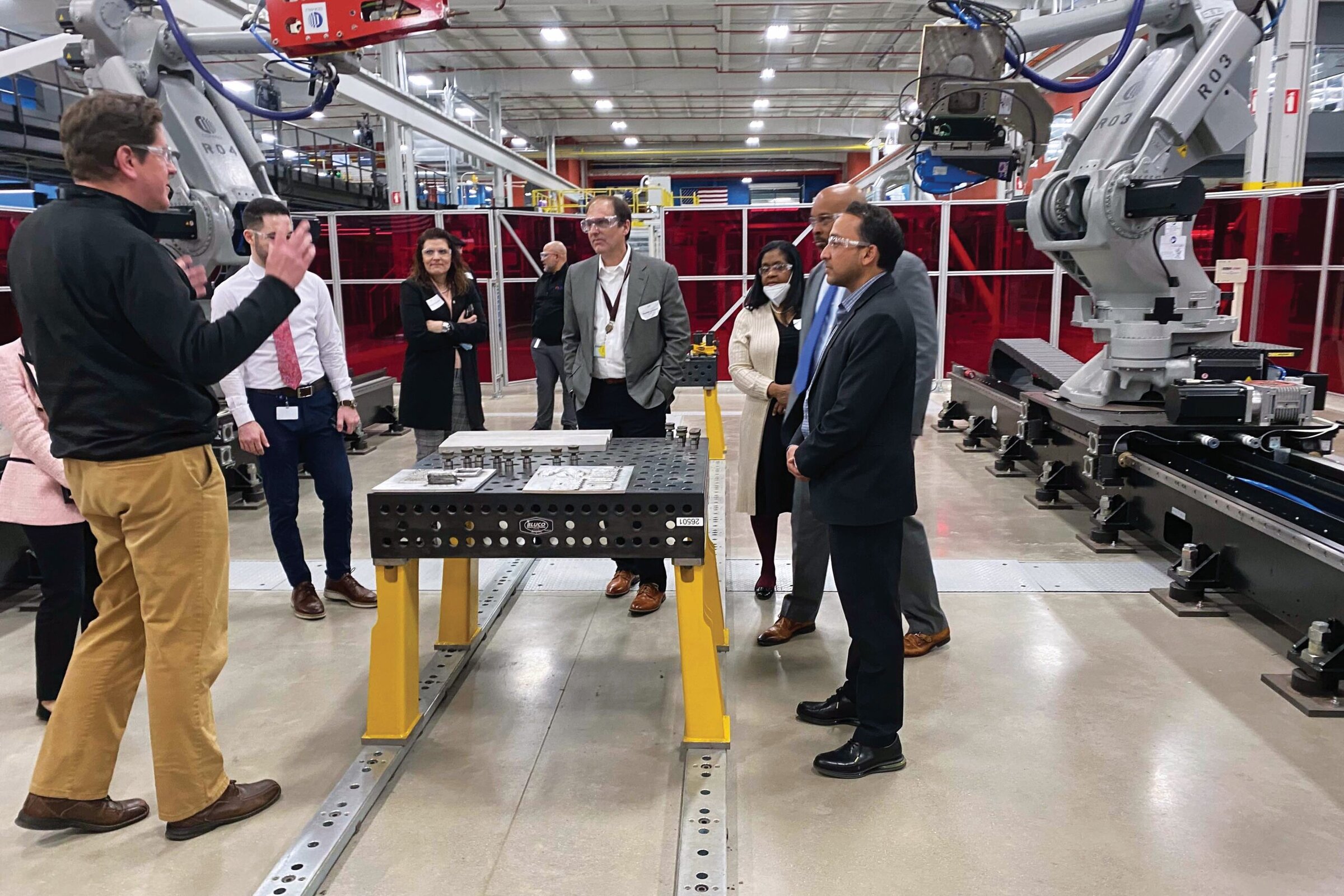
Approaching an era where automation and cognitive computing seamlessly connect to smart factories, supply chains are entering into a fourth industrial revolution known as Industry 4.0. This transformation, through advanced digital technologies across engineering and manufacturing, is set to bring the U.S. manufacturing ecosystem to the forefront of modernization—and with it, a demand for a sustained pipeline of talent and strong domestic manufacturing centers.
“America’s manufacturing ecosystem has been a vital engine of economic growth, innovation, and competitiveness for over 200 years—and has played a critical role in developing and driving the technologies that sustain our national security,” says Bill LaPlante, undersecretary of defense for acquisition and sustainment. “Today, the U.S. is in a technological and economic race to maintain its manufacturing edge, particularly as it concerns critical defense systems, such as satellites, advanced munitions and communications technologies.”
Advanced manufacturing is changing the nature of manufacturing—creating new, technically advanced and higher-paying positions.
Known manufacturing chokepoints across sectors—including skilled labor, machine tools, critical chemicals and a reliance on foreign resources—are impacting operational readiness.
The Defense Department is taking decisive action to combat these challenges to achieve two imperatives: to maintain capability and capacity to sustain legacy systems, and to expand and modernize manufacturing capabilities to build tomorrow’s defense systems. This effort requires significant investment in American workers and infrastructure, including $372 million in the president’s fiscal 2023 budget to strengthen the nation’s supply chains through domestic manufacturing.
The Industrial Base Analysis and Sustainment program within the Department’s Acquisition and Sustainment office is leading multiple projects designed to increase industrial manufacturing capability, supply chain capability and resiliency, and workforce development.
With 64 active and planned projects in key defense industrial base sectors, program efforts assemble a coalition of stakeholders and public–private partnerships designing, building, and producing critical technologies and chemicals to ensure warfighters maintain enduring advantages. Defense-critical sectors at the focus of these efforts include workforce, castings and forgings, microelectronics, batteries, kinetics, and critical chemicals.
Addressing the threat that an aging and shrinking manufacturing workforce poses to U.S. national security, IBAS invested approximately $130 million across 16 unique workforce-related projects since the launch of its National Imperative for Industrial Skills initiative in 2020.
The model’s key principles emphasize identifying industry needs and driving collaboration with education, as well as looking at mutual reliance on like facilities, equipment, and processes driven by relevant industry needs. This approach focuses on developing a deeper and sustained collaboration among all levels of education (K–12, two-year post high school, and four-year post high school) and industry (small and medium manufacturers, large original equipment manufacturers), as well as nonprofit and governmental support activities.
One flagship IBAS effort working to addresses critical machine tool needs in support of defense manufacturing is America’s Cutting Edge program, which launched in March 2020. The effort combines the scientific expertise of the Department of Energy’s Oak Ridge National Laboratory; the research and teaching expertise of the University of Tennessee, Knoxville; and the workforce development leadership of the Institute for Advanced Composites Manufacturing Innovation to revitalize the U.S. machine tool sector through transformative thinking, technology, and training.
Through ACENet, an associated network of regional machine tool innovation and workforce development hubs in Florida, North Carolina, Tennessee, Texas, and West Virginia, the Defense Department is working to increase efficiency of existing machine tools while developing skills and training for next-generation machine tools for composites and metals. These initiatives include establishing efforts to rapidly train the next generation of machine tool designers and operators.
Return to main article: “Breaking down barriers to innovation: How to keep growing in the face of new challenges“

Related Articles

Market Insights
How organizations are overcoming challenges in the glass recycling ecosystem
Driven by the potential for cost savings, energy reductions, and fulfilled sustainability goals, glass manufacturers are increasingly incorporating recycled glass into their products. Glass is theoretically infinitely recyclable, creating a huge potential to use waste glass, or cullet, as raw materials for a variety of glass products, including container glass…

Market Insights
For the love of borates: Carrying the mantle of Steve Feller
Historically and currently, soda lime silicate is the most common type of glass used globally, serving as the windows and bottles surrounding us in everyday life. While alternative glass compositions sometimes made an appearance throughout the centuries,1 the emergence and reliance on specialized glasses did not become prevalent until the…

Market Insights
Green glass manufacturing: Sustainable processing and applications
Glass manufacturing is a carbon-intensive process, and many in the industry are working to reduce the sector’s environmental footprint. Two recent BCC Research reports demonstrate solutions to green glass manufacturing in both the processing and application realms. This Bulletin content is for ACerS members and registered users only. Sign up…