
Here is my theory: Whether it is called rapid prototyping, 3D printing, or additive manufacturing (the preferred ASTM term), this innovation strikes an intuitive chord in the broad ceramic and glass community, including those that mainly consider themselves artists. After all, it is arguable that the very first examples of AM occurred when our ancestors started to make utilitarian pots and vessels by spiraling, shaping, compressing, and firing clay coils.
Early on, those that practiced the clay arts learned that it could be more efficient to add material to construct items with very nearly the desired final shape, size, and features before firing, than to shape the hard and brittle pieces after firing. And, as manufacturing knowledge grew from brick and sanitary ware to semiconductors and medical implants, processes that involved adding material—rather than subtracting and machining away stuff—played an even more prominent role in the ceramic and glass fields.
Based on the generally deserved excitement and recent boggling breakthroughs among contemporary AM pioneers, new additive processes already are rapidly transforming almost every field of materials and manufacturing, including some areas of ceramics. The pace of progress can at times make it very difficult to keep track of emerging innovations and which corporations, consortiums, and governments are placing big bets.
Pioneers and prototyping
If it seems like references to AM suddenly pop up everywhere, you are right. In popular culture, from comedic banter on TV shows like “The Big Bang Theory” to red carpet walkers showing off custom-made accessories, it is a hot and trendy topic. It is a hot topic, too, in the traditional media, including outlets, such as the New York Times, Wall Street Journal, The Economist, and Financial Times, who seem to agree that AM will play out to be one of the biggest historical disruptors in manufacturing—one that will upset major business models, supply chains, and, perhaps, global influence.
How did we get to the explosive “Age of AM?” Although the fundamentals may be millennia old, a fuse with many strands was lit in the mid-1990s and quietly burned for decades—fanned by pockets of materials researchers, manufacturers, and even artists. Some of the major strands included materials and layering R&D from the printed circuit boards and semiconductors industries, stereolithography, advanced robotics, data processing, computer-aided design and computer numerical control, advance joining, and, of course, materials research and design.
Here and there, dedicated AM systems started to pop up. Expensive, yes, but the pioneering equipment could be justified in certain situations where, for example, time was the bottom line consideration (rapid prototyping), the cost or health effects of raw materials or complex machining was prohibitive (beryllium parts), or the design was impossible to build otherwise (tissue scaffolds and some art designs).
Most, but not all, of these early systems were based on working with various waxes, polymers, plastics, and metals. Interest in “printed” ceramics existed early on, but faced unique challenges, such as postprocessing densification and finding slurry compositions, including binders, that could be adapted to the few existing 3D printing machines.
Nevertheless, there were significant ceramic 3D pioneers in the 1990s. Initially, researchers used the term “freeform” to describe their work. Great interest emerged in continuous ink-jet printing through a moving fine nozzle, such as the 1999 work by investigators at Drexel University to create prototype Ti3SiC2 carbide components.
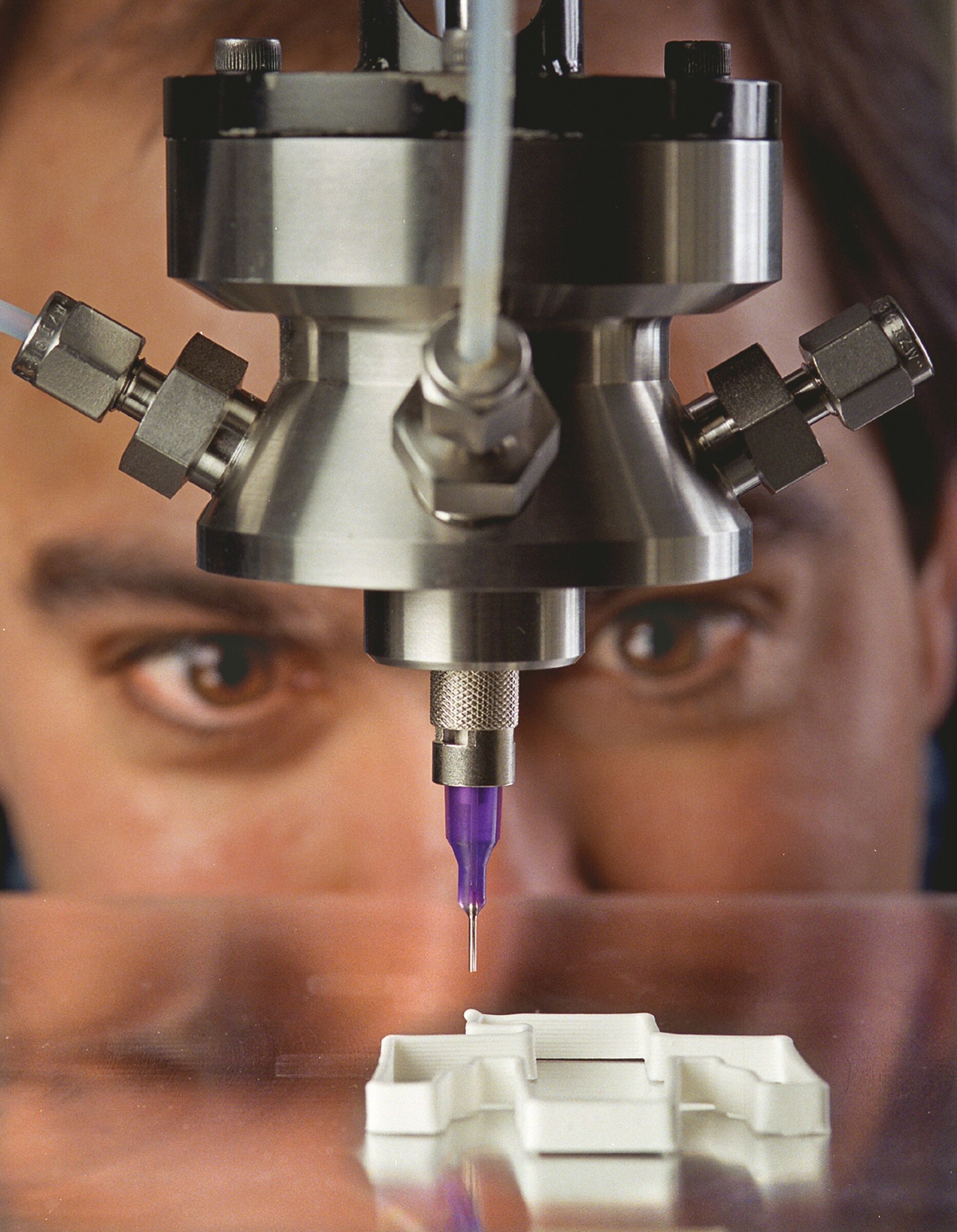
Figure 1. Robocasting deposits ceramic-loaded slurry through a syringe according to a computer-controlled pattern under the watchful eye of Joseph Cesarano. (Credit: Randy Montoya; Sandia National Laboratory.)
In the mid-1990s, Sandia National Laboratories’ Joseph Cesarano and University of Arizona’s Paul Calvert demonstrated “robocasting” based originally on a moveable platform instead of a moving print head (Figure 1). A 1999 news release from SNL explained that robocasting “relies on robotics for computer-controlled deposition of ceramic slurries—mixtures of ceramic powder, water, and trace amounts of chemical modifiers—through a syringe. The material, which flows like a milkshake even though the water content is only about 15 percent, is deposited in thin sequential layers onto a heated base.” Said Cesarano, “The robot squeezes the slurry out of the syringe, almost like a cake decorator, following a pattern prescribed by computer software.” New ceramic materials also began to find use in AM foundry work, where successful business models for rapid prototyping, casting, and tooling were established.
Although optimism abounded, the early period of AM was one where available systems were relatively rare, typically expensive, and accessible only to a lucky few. It was a time of major spade work, and several proven categories of AM systems emerged (see ‘ASTM’ sidebar) as well as several system manufacturers.
Through the 2000s, AM grew at a slow but steady pace, still something of an “gee-whiz” oddity to the public. It was, at best, a niche solution or, at worst, an expensive indulgence to manufacturers. But the fuse kept burning.
3D goes ‘boom’
According to a 2013 report from the Royal Academy of Engineering, the explosion in AM occurred around 2009, when a key patent for an AM system expired. The patent covered fuse deposition modeling, which involves the extrusion of a filament that forms the finished piece plus an additional material that serves as a removable support structure. In one notable example, the patent expiration allowed companies, such as MakerBot (well-known today in the small-scale “hobbyist” world), to slash the prices of their 3D printing systems by as much as 90 percent. At the consumer level, this development unleashed an open-source AM printing marketplace and movement. Likewise, it was a wakeup call to a broad swath of manufacturers and investors that they needed to reckon with AM and the accompanying opportunities, challenges, and threats. Aerospace, automotive, and even architecture applications suddenly were being sized up for AM opportunities.
Thus, compared with the years where AM was rare and expensive, 2014 is a sharp contrast. It is not much of an exaggeration to say that almost anyone can access AM systems that can make parts of nearly any shape imaginable, layer by layer, from a stable of materials that includes some ceramics. Furthermore, the current capabilities allow for almost any production volume—from small scale and one-off supercustomized products (not just parts) to high-volume manufacturing of units that must perform in critical applications.
What the future holds and who will end up as the AM winners and losers is unclear. Despite the decades of early work, AM remains generally an immature field. Even the best-informed prognosticators hedge as to what industrial sectors are most likely to benefit, what companies will emerge as AM business leaders, and what geopolitical regions will dominate in the near term.
However, that does not mean that we have to fly blindly into the future of AM. To appreciate the growth arc of AM, there is value in examining a “snapshot” of the field just as a business’ balance sheet shows a snapshot of the enterprise. For AM snapshots, there is only one place to start: the annual “Wohlers Report” from Wohlers Associates (www.wohlersassociates.com).
Plenty of different numbers get thrown around when it comes to measuring current spending on AM-related activities, but founder Terrence Wohlers has been around AM for 27 years and has produced 18 editions of the yearly publication that bills itself as AM’s “Worldwide Progress Report.” These reports have evolved into the field’s most reputable reference, tracking spending, trends, opportunities, collaborations, research, and emerging technologies.
According to Wohlers’ most recent report (November 2013), worldwide AM products and services grew at a hefty compounded annual growth rate of 28.6 percent in 2012, which translated as a market worth $2.204 billion. This compares with growth during 2011, when the market had reached $1.714 million. Wohlers’ best guess is that by 2021 the AM market will be more than $10 billion. To put this trend in perspective, a Wohlers’ news release notes, “It took the 3D printing industry 20 years to reach $1 billion in size. In five additional years, the industry generated its second $1 billion. It is expected to double again, to $4 billion in 2015.” That is just the direct impact of AM. McKinsey Global Institute research suggests the impact of AM on world GDP could reach $550 billion per year by 2025.
Printers here, there, everywhere
Another metric Wohlers follows is the number of AM units sold. Almost 8,000 industrial-use systems (those that sell for more than $5,000) were sold in 2012.
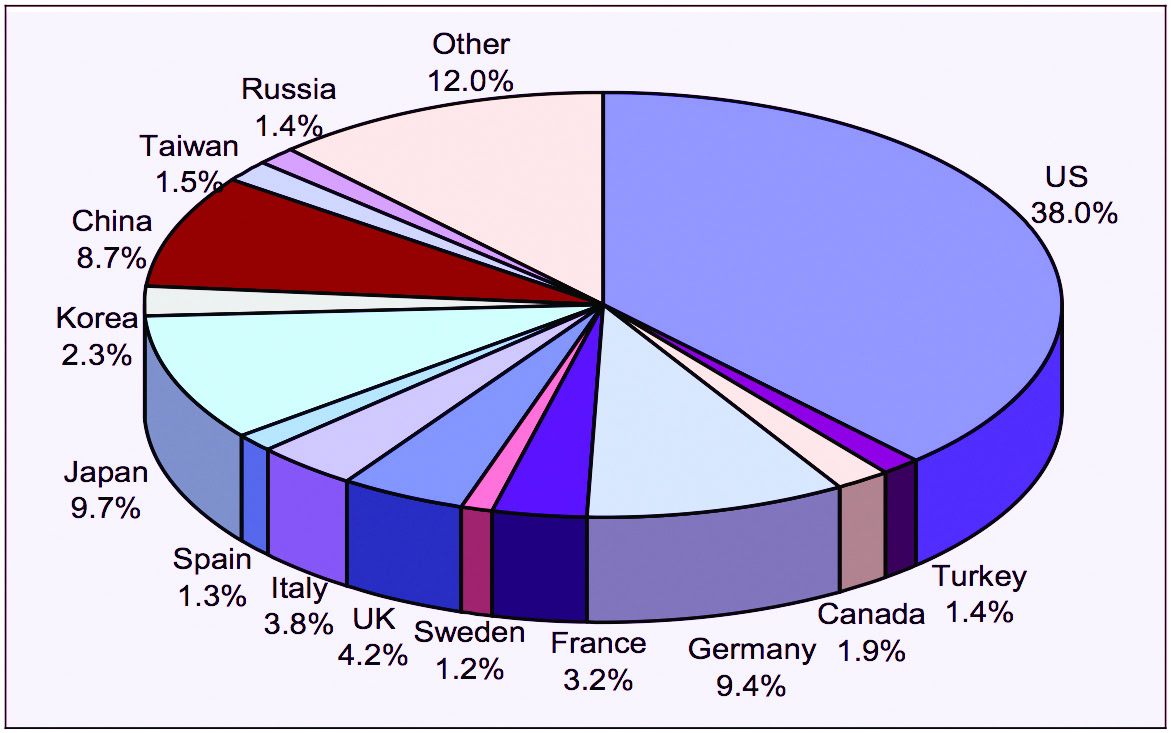
Figure 2. Cumulative international distribution of industrial additive manufacturing systems installed through 2012. (Credit: Wohlers Report 2013.)
The state of the global industry is uneven, as Figure 2 shows. Wohlers reports that the United States has a huge installation lead, having accumulated 38 percent of industrial systems. Japan, Germany, and China also have accumulated a sizable number of units. Some of the leading systems makers include the US’ 3D Systems and ExOne, Israel’s Stratasys, Sweden’s Arcam, and Germany’s EOS and Voxeljet. Many of these are publicly traded companies, and 3D Systems, for example, has a market value approaching $8 billion. But, as in other tech sectors, change occurs rapidly. Wohlers warns:
As of May 2013, 16 companies in Europe, seven in China, five in the US, and two in Japan were manufacturing and selling AM systems. This is a dramatic change from a decade ago when the mix consisted of 10 in the US, seven in Europe, seven in Japan, and three in China. What’s more, all of the metal powder bed fusion systems are manufactured outside of the US. Seven manufacturers of these systems are in Europe and two are in China.
The US maintains a strategic goal of remaining an AM leader, and the topic even earned a mention in President Obama’s 2013 State of the Union address when he said, “[AM] has the potential to revolutionize the way we make almost everything.” Just months later, the Obama administration launched AmericaMakes (originally titled and often still referred to as the National Additive Manufacturing Innovation Institute) to serve as a supportive and collaborative hub for the nation’s AM industry.
Beyond industrial installations, some experts argue that an equally significant measure is the surge in number of small AM units sold, in large part because of the patent expiration. About 35,000 of the under-$5,000 systems were sold in 2012, some to hobbyists and do-it-yourselfers. Many small units also are purchased by educational institutions and engineering students, a trend that has positive implications for innovation and for preparing a workforce for AM manufacturers. Although small AM system sales are a long, long way from those for personal computer sales, it is increasingly common to find them on campuses and secondary schools, and being demonstrated and offered for sale in a variety of retail outlets.
This changes everything’
The do-it-yourself movement, the launch of AmericaMakes, and Obama’s speech provided plenty of fodder for reporters and commentators in 2013. But the biggest AM news story in 2013 was an April announcement from General Electric signaling a high commitment to AM. In essence, GE said it was prepared to manufacture a relatively large volume of a critical aircraft mechanism using a metal-powder additive technology, direct metal laser melting (DMLM).
The company said it had orders for thousands of its new LEAP jet engines for the Airbus Group’s A320 planes and that each engine would have 19 fuel nozzles printed from a fine cobalt–chromium powder via DMLM (Figure 3). Further, GE said it was capable of producing at least 25,000 nozzles per year. Although that number of parts is considerably less than quantities found in consumer manufacturing, the quantity was an eye-opener to many in the business community and put them on notice that AM was entering the mainstream.
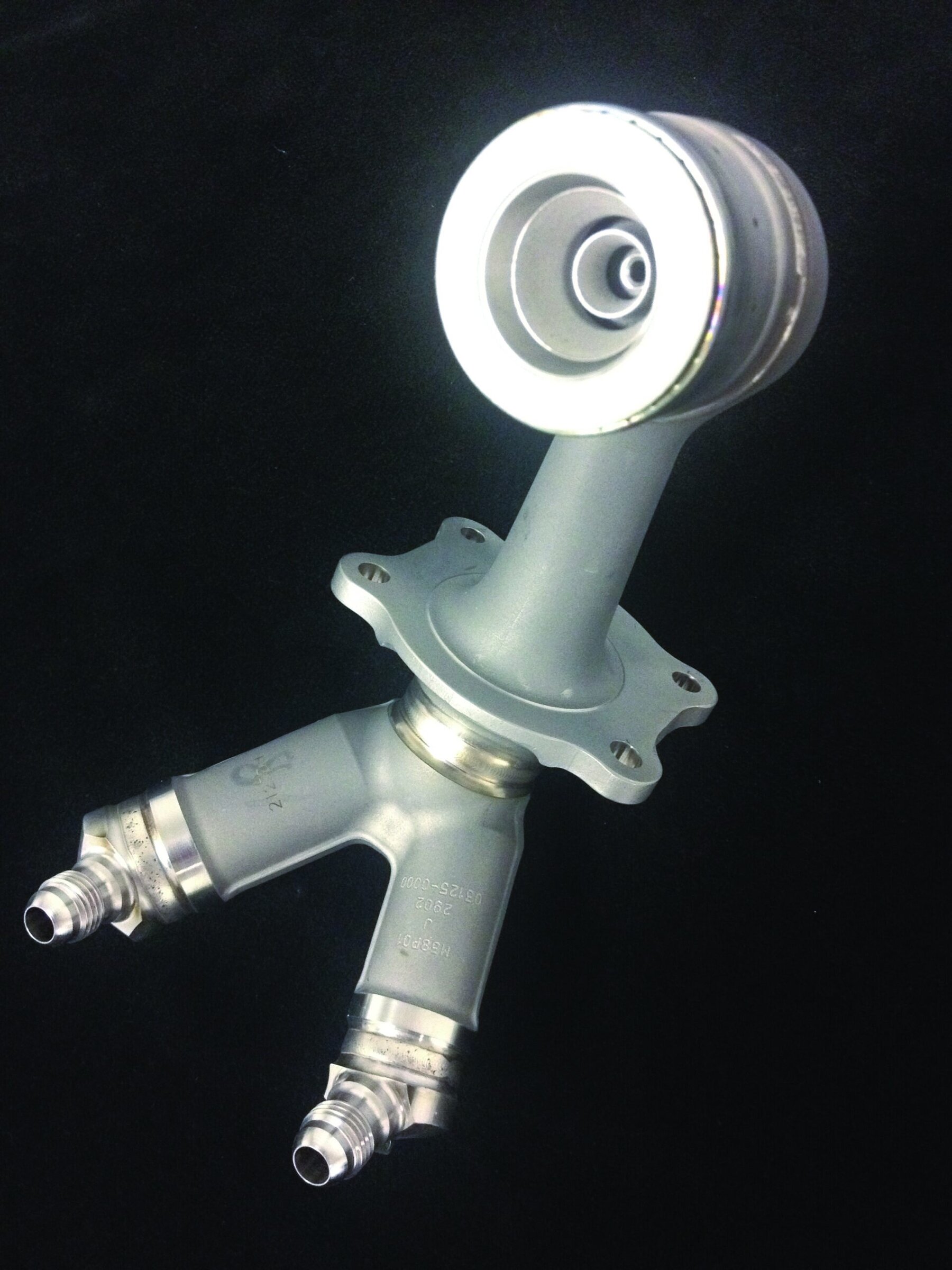
Figure 3. Cobalt–chromium fuel nozzle for GE‘s LEAP engine. (Credit: GE Aviation.)
The GE announcement probably did not catch Wohlers by surprise. He was aware that in 2012 GE had hosted a “summit” on AM and that it had purchased Morris Technologies, then an innovative AM company specializing in metals, and hired CEO Greg Morris to be GE Aviation’s business development leader for additive manufacturing. He also knew that the use of AM for final production parts had grown from almost nothing in 2003 to 28 percent of AM product and service revenues (Figure 4).
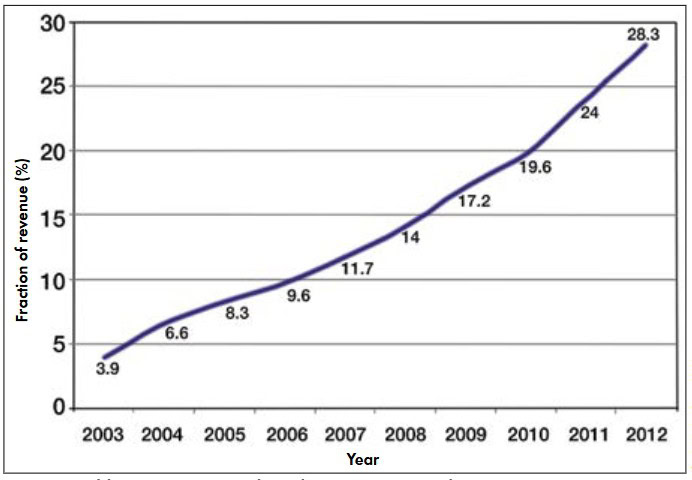
Figure 4. Additive manufactured production parts contribute an increasing fraction of overall revenues of AM products and services. (Credit: Wohlers Report 2013.)
Still, GE’s move snagged Wohlers’ attention. In an interview with the Bloomberg News Service, he said, “[GE’s] investment changes everything, and it’s also unprecedented. They see a big need and a lot of demand, but the supply is not there.”
In truth, other aerospace and turbine companies, such as Lockheed Martin, Boeing, and Siemens, also had been looking into AM. For example, United Technologies Corp. helped establish the collaborative Pratt & Whitney Additive Manufacturing Innovation Center at the University of Connecticut. Airbus Group itself, through its EADS Innovation Works in partnership with AM systems manufacture EOS, had been redesigning a nacelle hinge bracket (part of the engine housing), also for the A320.
However, GE garnered most of the attention, and Greg Morris tells the ACerS Bulletin,
It is important to understand what GE did and didn’t do. We didn’t set out to see if we could print an existing nozzle and see if it could match what was made by traditional methods, which required forming, machining, and joining about 20 pieces but also generates a lot of waste. Despite the generation of expensive waste, GE had a lot of experience with making nozzles the traditional subtractive way… The point is that for GE—and for any manufacturer—it is nearly impossible to make a good business case for simply switching from traditional methods to 3D.
Instead, GE started over and used a ‘design-to-process approach.’ That is, we altered our CAD designs to optimally exploit the benefits of DMLM. We had the opportunity to actually make a better product by allowing more complexity to enter the design. With AM, the complexity is no longer an issue, and the ability to print very complex designs allows us to make improvements that lead to weight reductions, materials and labor reductions while improving performance. We built in the cost and technical advantage, and at the same time moved from a 20-piece unit to a one-piece nozzle.
Morris says although the printed pieces approach the shape of the final product, they must undergo some postprocessing to obtain, for example, optimized surface finishes for critical gas flow passages.
AM manufacturing can create data management and storage issues. Morris says, “If you are monitoring a lot of processes, you generate a lot of data, and, ideally, you have a real-time feedback loop that allows you to adjust as you go. We have the ability to monitor every voxel in every part, but the question is, what do you do with this data and how long do you keep it? It’s a practical concern, but not something that can’t be solved.”
Does Morris agree that AM is going to disrupt manufacturing? “It is hard not to believe it is not already being disruptive,” he says. “A disruptive technology is one that is big enough that it changes the course of how certain industries behave and how certain parts perform. AM fits these categories.”
Morris predicts the disruption will play out in many ways, including the value of intellectual property. “For example, a company may have a traditional process wrapped up in a lot of IP. But, the same company may wake up one day in the near future and suddenly find that additive manufacturing gets around its IP, and then they have to catch up,” says Morris.
“The advantages to AM are broad and, if exploited correctly, can quickly add up,” he continues. “I think AM will blossom into a market in the tens of billions of dollars in the not distant future.”
How far can GE go with AM? At least one company staffer had predicted that within his lifetime, half of all jet engine parts will be printed through an AM method. When asked to confirm this, Morris didn’t back down. He says, “It depends somewhat on how you define engine parts. We probably aren’t going to print the nuts and bolts and some of the other relatively simple parts. But, I think it is reasonable that we could be printing half of the parts in the next 20 to 30 years. As the technology gets better, faster, and more efficient, and as we learn how to have better surface finishes and hold better tolerances, I think there is a compelling case that it could happen. It is a bold statement, but one that I can stand behind.”
The remaining challenges are substantial. Morris asks, “For example, how do we print parts in larger sizes, and how do we obtain better throughput? To an extent, we currently limit the amount of AM-made parts because of the costs. But, as more entrants get into producing AM machines, we are going to see costs come down. Another big concern is how to efficiently inspect these very complex parts when they are printed. How do we set standards for the raw materials and monitor the quality of components and consistently deliver every part at the same quality? As mentioned earlier, these parts often have critical surfaces in complex internal passages, and they also have to mate up with something or have critical tolerances in some areas.”
Christine Furstoss, GE Global Research’s Technical Director of Manufacturing & Materials Technologies, expands on this point in an excellent 2013 video conference of AM experts (available on the company’s website). She says a big interest now is how to wed additive and subtractive approaches. “The need for subtractive doesn’t go away, and it is probably highlighted even more. If we design for AM, we have to design for its abilities as well as its limitations.”
Furstoss also explains that AM can shake up the traditional manufacturing supply chain in less than obvious ways. “[Now with AM] you can think about a lot of models for distributed manufacturing, because you can now make parts without as much infrastructure.” But, she warns, “The need for good quality control, qualification, repeatability, and inspection doesn’t go away, and we also have to get those technologies distributed.”
Furstoss also says GE does not plan on going it alone and wants to encourage the growth of AM networks and sharing, and, like others in this field, she often thinks in terms of an “AM ecosystem.” For example, she notes, “We’d love it if more people were engaged on the materials side. … The more people we can get engaged in thinking about the challenges, if they are a materials company, if their materials work for AM-type technologies, that’s what is really going to spur the growth of this ecosystem.”
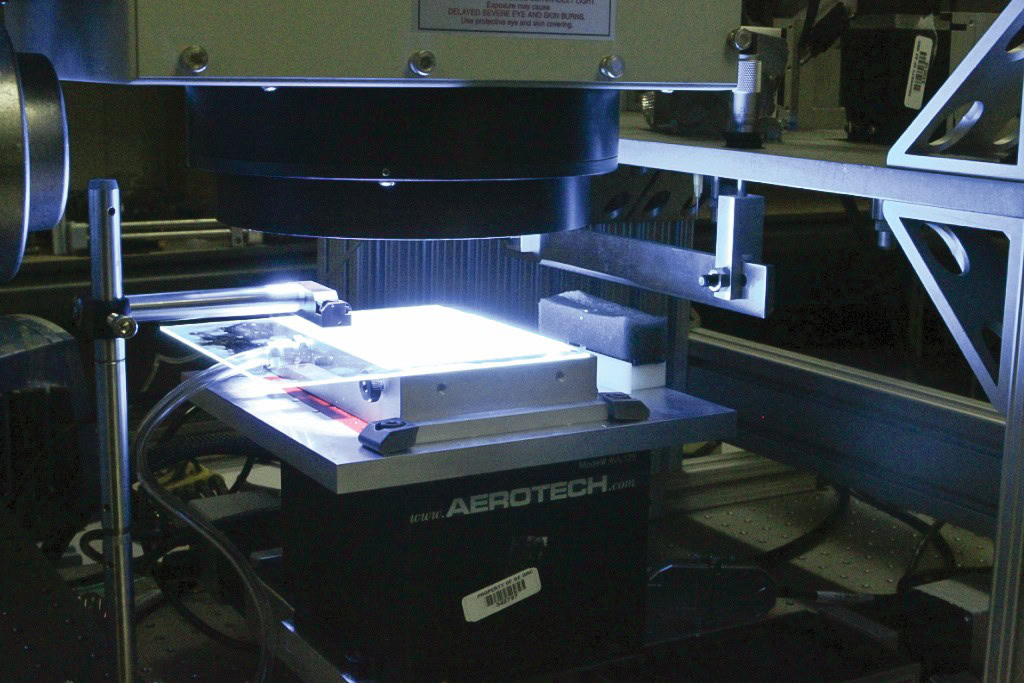
This additive manufacturing machine at GE Global Research Center makes ultrasonic
transducers by depositing a thin, uniform layer of ceramic slurry that is exposed to patterned ultraviolet light. Credit: GE Global Research.
The views of some key players and thought leaders on how large the distributed manufacturing business will get covers a wide spectrum that includes narrow and multimaterial, multifunctional 3D manufacturing. Although GE is taking something of a wait-and-see approach, Avi Reichental paints a radically different picture of the evolution of AM manufacturing. As president and CEO of 3D Systems, Reichental is hardly a disinterested party, but he says AM will fundamentally disrupt distributed manufacturing models and carry some political overtones. In the GE video, he says, “I personally believe the ability to empower startups to make goods previously on a scale that was available only to deep-pocketed companies is a game changer. It is fundamentally going to shift how we look at starting businesses.”
Reichental says that AM will be a bridge that connects “virtual” with the “actual” and bring about democratic access to true craftsmanship. “And at the heart of this,” he says, “is the democratization of not just the devices—I am on the record as saying capable, multimaterial, highly functional 3D printers will soon cross the $1,000 barrier, and, in a few years, we will see them at the $500 level—I see that also happening with content creation and ‘gamification’ of CAD and other design tools, and reverse engineering, scanning tools, and inspection tools. [This will] bring responsible desktop manufacturing not just for the benefit of the makers but also for the benefit of entrepreneurs and startups and hobbyists in a way that makes it accessible, scalable, and also completes the design-to-manufacturing process, including built-in inspection, at price points that make it affordable for everybody to participate in.”
“It’s inevitable, it’s imminent, the train has left the station, and I think there is a great deal of community movement and ecosystem to suggest that the innovation is not going to just come from large companies but also from individuals and universities and [AmericaMakes] and other organizations. None of us can do it alone,” says Reichental.
What is ahead?
As if the qualitative developments in the AM world mentioned above were not enough, the sun is just dawning on the age of multimaterial, multifunctional 3D printing, particularly for biological–medical and functional electronic products. Systems devised with multiple print heads and hundreds of nozzles can deliver multiple materials—polymers, metals, glasses, ceramics, carbon fiber, composites, organics—at multiple resolutions.
At one extreme is the California-based Organovo, which designs and creates functional human tissues with bioprinting. The goal of this company is to make “reproducible 3D tissues that accurately represent human biology” for pharmaceutical testing, to serve as platforms for medical application trials, and for tissue implants. Although it declined to publish details, the publicly traded Organovo announced that it delivered its first 3D liver tissue “to a laboratory outside of the company to a key opinion leader for experimentation, and marks the achievement of a milestone along the pathway to commercial launch of its 3D liver tissue product.” The company says it combines multicellular “bio-inks” with bio-inert hydrogels, which serve as supports and act as fillers to create channels.
Another multimaterial, multifunctional 3D pioneer is University of Texas at El Paso’s Ryan Wicker. Wicker is the director and founder of UTEP’s WM Keck Center for 3D Innovation. Wicker thinks in terms of “dynamic” AM, where multiple systems and processes run concurrently. In the previously mentioned GE video, Wicker says, “My research is in building these multifunctional components, and we are moving toward building moving, dynamic systems.”
Wicker speaks in terms of creating multimaterial, multifunctional products on a desktop printer. To prove his point, the Keck Center’s website offers a video of a complete dc brushless motor being printed. “It still requires embedding some magnets, and inserting bearings and controllers, but you can see an entire electromechanical component being fully printed, where, when we are completed, you break it off the support structure,” says Wicker. “The rotor moves, you can spin the motor and plug it in and it works! In terms of materials characterization, even in single materials systems, we have a lot of research that needs to be done to look at the performance of these materials, but we are moving forward in printing these dynamic systems.”
However complex Wicker’s ideas may seem, that sort of thinking is the whole point. Outside of rapid prototyping or maintaining “virtual inventories” of rarely used parts, the conversion from proven traditional manufacturing to AM probably does not make sense unless it exploits the macro and micro complexities that AM make possible. It has become something of a cliché, but AM practitioners repeatedly point out that “complexity is free.”
Building on the concepts Wicker outlines, some believe the direct printing of high-volume, heterogenous consumer electronics, i.e., smartphones, is possible in the not distant future. Naturally, this would require the mixed use of several materials and would have to leverage the processing techniques of the respective materials fields. Although work in this area is still immature, the concepts are taken seriously, and these systems are expected to evolve from the normal AM embryonic stage of rapid prototyping and gradually mature from prototyping to small-lot and large-lot production.
The ability to have flexible robotic 3D manufacturing systems may erase the feast-and-famine problems that plague some large electronics manufacturers who get trapped with equipment that cannot be easily and quickly reoriented for a different product. On the other hand, the appearance of superflexible AM systems could open opportunities for distributed manufacturing and entrepreneurs who can survive on printing a dozen or so phones a day.
The emerging variables offered by AM are beginning to allow designers to exploit complex internal and external structures. “Topology optimization” is an important buzzword and AM goal that generally refers to maximizing performance while minimizing factors such as weight, material, and energy consumption. This topology optimization is at the heart of GE’s AM announcement and future plans.
3D printing also allows “cellular” designs that can optimize products by adding strength and durability through mimicking the natural hierarchy of nanostructures that have evolved in bone tissues.
When thinking about the future, another topic that resurfaces is patent expirations. As mentioned at the beginning of this article, the price of FDM printers dropped rapidly when the patent expired. In February, a patent on another popular and robust AM process, selective laser sintering (SLS), expired. Although it is unknown whether this expiration will trigger a similar dramatic discounting of SLS systems, Wohlers thinks a change will come. He predicts on his blog (www.wohlersassociates.com/blog) that in 2014 low-cost SLS systems will be available and, “At least one Chinese manufacturer will test the waters by selling laser sintering products internationally.”
Whether one thinks of it in terms of an ecosystem or community or subcommunities, there is also excitement about how collaborations will spur AM’s future. AmericaMakes (www.americamakes.us) is positioned to serve as an umbrella and roadmapping effort that already is funneling resources to industry-identified innovation goals and ensure international competitiveness.
Another key group is the standards community, which will be providing standardization of processes, terms and definitions, process chains, test procedures, quality parameters, etc. ASTM International has established the F42 Committee to focus on AM, and there is a parallel and complimentary effort, the ISO/TC 261 Committee (see more under “Standardization in additive manufacturing” below). These broad-based efforts will help accelerate adoption of AM and lessen the burden of individual companies bearing the cost and burden of qualifying AM process and materials.
Knowing the unknowable
AM easily lends itself to much speculation about intriguing futures.
When Avi Reichental was asked in the GE video what notable developments he expected from AM in the next 50 years, he mentioned, not unexpectedly, bioprinting and lots of consumer-oriented products.
Surprisingly, he also firmly forecasted a rarely referenced topic in additive manufacturing—food! As it turns out, Reichental’s prediction may happen sooner than he or anyone else expected: In February, a research group at the London South Bank University demonstrated the “food of the future” made with a 3D printer and insect “flour.”
However, when it was Wohlers’ turn to forecast, he may have had the most accurate crystal ball. He initially suggested that in a half century we would see smart integrated electronics, human organs, and parts printed in space.
Yet, despite his deep insights and nearly three decades in the field, Wohlers quickly followed with a verbal shrug about the future. He said, “Honestly, I don’t think we know. Not long ago, no one was able to forecast there would be a full-length movie inside our phone, because you couldn’t get a VHS tape inside a phone. Additive manufacturing is really about what we don’t know.”
Standardization in additive manufacturing
ASTM International’s F42 Committee and the ISO/TC261 Committee are working together to develop a common set of standards for the worldwide AM field. They held their first joint meeting in June 2013.
Their plan is to have a hierarchy of AM standards, including the following three levels:
- General standards: standards that specify general concepts, common requirements, or are generally applicable to most types of AM materials, processes, and applications;
- Category standards: standards that specify requirements that are specific to a material category or process category; and
- Specialized standards: standards that specify requirements that are specific to a material, process, or application.
The two groups have formed a consensus list of high-priority candidates for potential joint AM standards development, as follows:
- Qualification and certification methods;
- Design guidelines;
- Test methods for characteristics of raw materials;
- Test methods for mechanical properties of finished AM parts;
- Material recycling (re-use) guidelines;
- Standard protocols for round robin testing;
- Standard test artifacts;
- Requirements for purchased AM parts; and
- Harmonization of existing ISO 17296-1 and ASTM 52912 AM terminology standards.
Source: “AM Standards Development Plan,”
(www.astm.org/COMMIT/AM_Standards_Development_Plan_v2.docx)
3D printer instead of a toybox?

Bike helmet 3D printed in a single job. (Credit: Stratasys)
3D printers are starting to pop up in nonmanufacturing locales, including Staples, Office Depot, and UPS storefronts. Some investors even have speculated that Radio Shack might be reinventing itself to take advantage of its background in electronics and do-it-yourself projects.
Even your local bicycle shop might have talented printers, too. In January, Stratasys demonstrated a new color, multimaterial printing system to produce functional prototypes of bicycle parts, helmets, and even sunglasses with translucent lenses in one print job.
3D printers may even find their way into the average household through a powerful and lucrative market: toys. As this was being written, Reichental’s 3D Systems announced a cooperative venture with toymaker Hasbro and the acquisition of Digital Playspace (DPS). Hasbro is known for its brand of Transformers, My Little Pony, and Play-Doh products. DPS is an AM-based platform for making doll house-sized structures that are described in a company news release as “a vivid 3D create-and-make experience for children and parents.”
Skeptics cite durability and safety issues about these toy product business concepts, but, if those issues can be resolved, it is easy to imagine how marketing campaigns for, say, the next “Transformers” movie could tie into home AM units.
ASTM International F42 Committee—Additive manufacturing process categories
- Material extrusion—material is selectively dispensed through a nozzle or orifice.
- Material jetting—droplets of build material are selectively deposited.
- Binder jetting—a liquid bonding agent is selectively deposited to join powder materials.
- Sheet lamination—sheets of material are bonded to form an object.
- Vat photopolymerization—liquid photopolymer in a vat is selectively cured by light-activated polymerization.
- Powder bed fusion—thermal energy selectively fuses regions of a powder bed.
- Directed energy deposition—focused thermal energy fuses materials by melting as the material is deposited.

Related Articles

Market Insights
Next-gen superconducting ceramics could change how we travel and much more
Forty years ago, two physicists from IBM’s research laboratory in Zürich, Switzerland, reported a groundbreaking discovery: Superconductivity, or the quantum mechanical phenomenon in which certain materials exhibit zero electrical resistance when cooled, could be achieved at higher temperatures using ceramics. Superconductivity had been discovered decades before, but its applications had…

Market Insights
Why most AI manufacturing projects fail and how to fix it
Artificial intelligence is reshaping advanced manufacturing, especially processes involving ceramics, glasses, and other hard or brittle materials. But adopting AI is far more difficult than simply buying software and connecting machines. Manufacturers must understand the advantages and limitations of different models, so they can determine where AI fits best within…

Bulletin Features
Radiation effects on rare earth chemistry in molten salts for nuclear applications
Across the nuclear energy sector, molten salts are shaping the next generation of nuclear technologies, from advanced power reactors to used nuclear fuel recycling. In molten salt reactors (MSRs), molten salts uniquely serve as both the primary coolant and fuel medium, a dual role that sets MSRs apart from conventional…