
Continued tariffs, new trade agreements, increased production values—this year brought different successes and challenges for the nonfuel mineral industry, all of which are captured in the annual United States Geological Survey Mineral Commodity Summaries report.1
The Mineral Commodity Summaries spotlights the events, trends, and issues that took place the previous year in the nonfuel mineral industry. And because raw materials are what make our high-tech world possible, every August the ACerS Bulletin provides a look at some of the key facts covered in the report, including statistics on production, supply, and overall market for more than 90 minerals and raw materials.
The estimated value of total nonfuel mineral production in 2019 increased by 3% from 2018 to $86.3 billion. The total value of industrial minerals production increased by 3% as well, to $58.2 billion. Of this total, $27.7 billion came from construction aggregates production. Crushed stone accounted for the largest share of total U.S. nonfuel mineral production value in 2019 with 22%.
Trade wars started in 2018 continued in 2019, with various import duties being either newly levied, continued, or removed. In May, the U.S., Canada, and Mexico reached an agreement on trade terms, resulting in the removal of the ad valorem duties for aluminum and steel imports on Canada and Mexico. Also in May, the U.S. and China failed to reach an agreement, which resulted in the U.S. increasing tariffs for List 3 items to 25% and China imposing additional import duties for certain items. In December, a phase one trade agreement was reached between the U.S. and China, which reduced some tariff rates and resulted in additional tariffs not being implemented.
Since Executive Order 13817 was issued in December 2017, the federal government has made several steps toward ensuring secure and reliable supplies of critical minerals in the U.S. In May 2018, a final list of critical minerals was published in the Federal Register, which included 35 minerals or mineral material groups. In June 2019, the U.S. Department of Commerce issued a report2 containing six calls to action, 24 goals, and 61 recommendations that describe specific steps the U.S. government will take to achieve objectives outlined in the executive order.
The U.S. continues to rely on foreign sources for raw and processed mineral materials. In 2019, imports made up more than one-half of the U.S. apparent consumption for 46 nonfuel mineral commodities, and the U.S. was 100% net import reliant for 17 of those. In terms of critical minerals, these minerals comprised 14 of the 17 mineral commodities with 100% net import reliance and comprised 17 of the 29 remaining mineral commodities with imports greater than 50% of annual consumption. In line with previous years, China and Canada supplied the largest and second largest number of nonfuel mineral commodities, respectively.
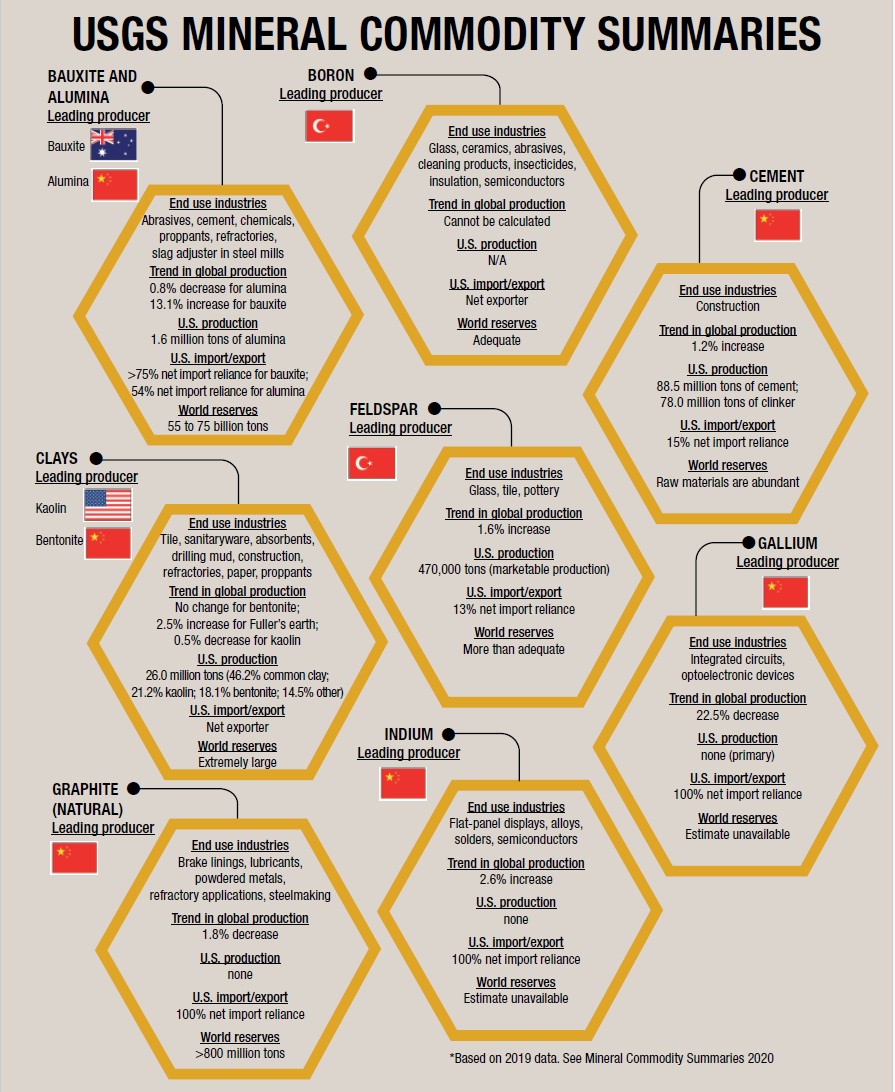
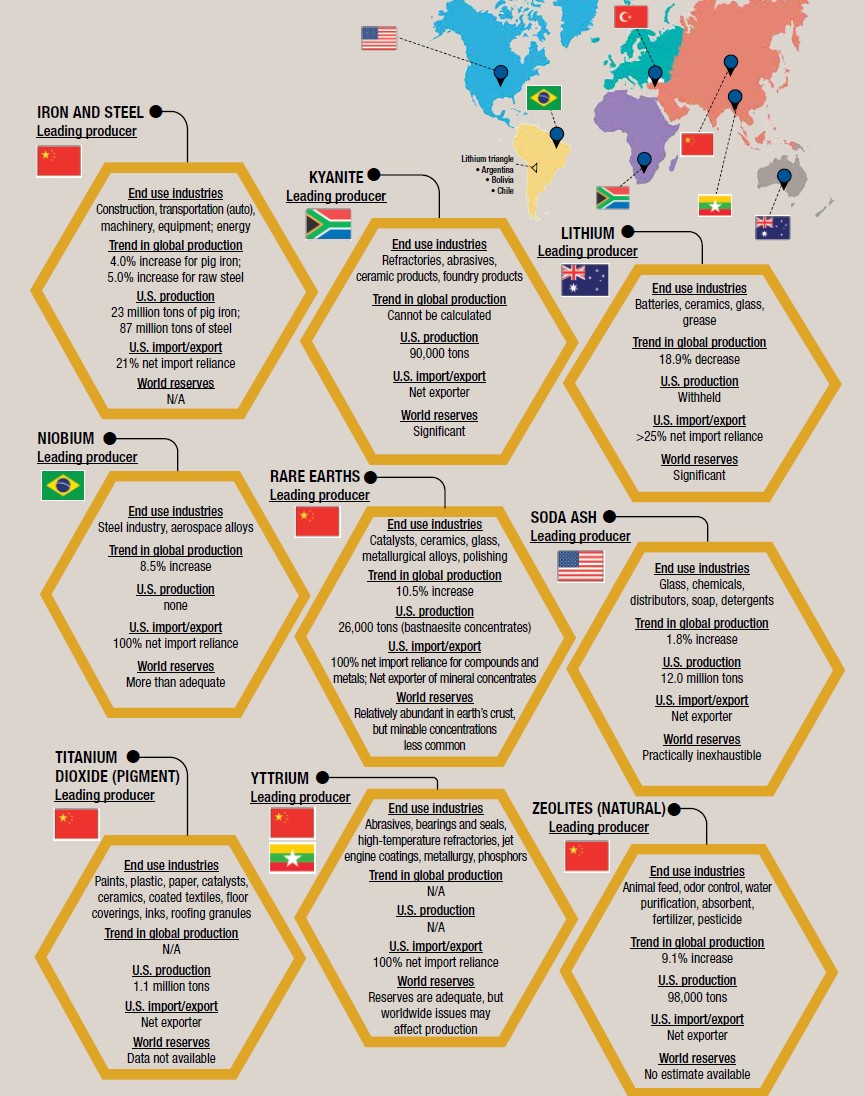
Below, an infographic summarizes some of the salient statistics and trends for a handful of mineral commodities that are of particular interest in the ceramic and glass industries. Readers are encouraged to access the complete USGS report at https://doi.org/10.3133/mcs2020.

Related Articles

Market Insights
Next-gen superconducting ceramics could change how we travel and much more
Forty years ago, two physicists from IBM’s research laboratory in Zürich, Switzerland, reported a groundbreaking discovery: Superconductivity, or the quantum mechanical phenomenon in which certain materials exhibit zero electrical resistance when cooled, could be achieved at higher temperatures using ceramics. Superconductivity had been discovered decades before, but its applications had…

Market Insights
Why most AI manufacturing projects fail and how to fix it
Artificial intelligence is reshaping advanced manufacturing, especially processes involving ceramics, glasses, and other hard or brittle materials. But adopting AI is far more difficult than simply buying software and connecting machines. Manufacturers must understand the advantages and limitations of different models, so they can determine where AI fits best within…

Bulletin Features
Radiation effects on rare earth chemistry in molten salts for nuclear applications
Across the nuclear energy sector, molten salts are shaping the next generation of nuclear technologies, from advanced power reactors to used nuclear fuel recycling. In molten salt reactors (MSRs), molten salts uniquely serve as both the primary coolant and fuel medium, a dual role that sets MSRs apart from conventional…