
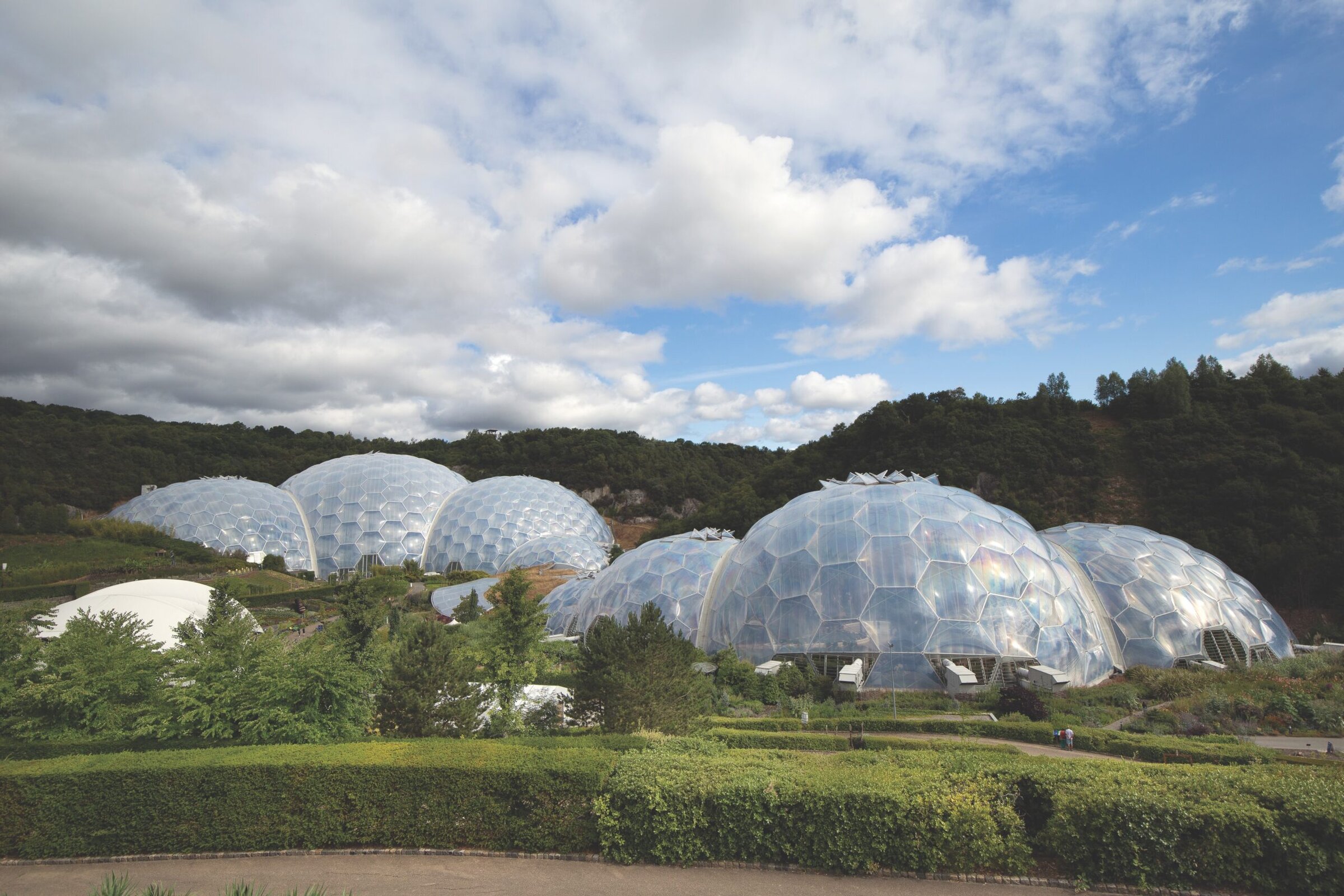
The greatest research and development lab on Earth is the planet itself.
Nature provides countless examples of effective engineering practices, from the tough brick-and-mortar structure of natural nacre to the ingenious vascular systems that regulate temperature in some animals’ ears. By modeling these biological entities and processes, humans can develop more efficient and economical approaches to addressing climate challenges.
As companies embrace emerging ideas designed to benefit the environment and the bottom line, biomimicry is gaining recognition as a design strategy across diverse industries. In a 2023 Biomimetics paper titled “Biomimicry industry and patent trends,” Haejin Bae of Korea’s National Institute of Ecology reports on a patent analysis of biomimicry-inspired solutions to technological problems that resulted in awards of 940 patents in Korea, the U.S., Japan, and Europe between 1975 and 2021.
“Based on the results of the patent analysis,” she writes, “it was found that biomimicry technology is in a growth phase that is expected to continue in the future and that Korea and the United States are leading the development of this technology.”
A global community for collaboration
One of the most exciting trends in biomimicry is the emergence of organizations and tools that facilitate research and development across sectors, borders—and even languages.
The Biomimicry Institute, headquartered in Bozeman, Mont., is a nonprofit organization founded in 2005 “to enable a nature-positive, inclusive, and regenerative world inspired and guided by nature’s genius.” Since 2008, the Institute has hosted AskNature.org, “an open-source database of deep biological knowledge, presented in accessible language.” It includes case studies of “successful cutting-edge projects informed by biomimicry” as well as an essay collection for more in-depth exploration of biomimicry themes, trends, and patterns.
During Climate Week in September 2025, the Institute launched the beta version of its new AI-powered AskNature Chat. This tool is designed “for people of all ages, education levels, professions, and languages to support the practice and study of biomimicry,” the organization says in a press release. The launch advances the Institute’s 10-year strategy, announced during Climate Week 2024 as part of the organization’s 20th anniversary, which supports its mission “to elevate biomimicry as a transformative solution to climate change, biodiversity loss, and the disconnection between people and nature.”
The Institute also serves as an accelerator through an annual six-month program that provides funding and in-kind services to 10 “high-impact nature-inspired startups.” To date, the Institute counts more than 40 “thriving companies” in its portfolio. The 2025 cohort includes
- Emboa Medical, Inc., a Purdue University-licensed startup in West Lafayette, Ind., that invented “a boa constrictor fang-inspired” catheter tip that reduces procedure time in the removal of blood clots from narrow vessels; and
- OptionV Energy, a Boston, Mass. outgrowth of technology R&D conducted at the University of Massachusetts Lowell that “mimics the selective metal-binding biology of Amanita mushrooms to recover high-purity vanadium from industrial waste cleanly, efficiently, and at low temperatures, enabling affordable long-duration energy storage and resilient critical mineral supply chains.”
Learn more about the accelerator program and the 2025 cohort at https://biomimicry.org/innovation/accelerator.
Biomimicry research centers worldwide
Research centers and institutes around the world are contributing to the global expansion and adoption of bio-inspired design.
United States
The Biomimicry Center in the Arizona State University School for Complex Adaptive Systems, part of the College of Global Futures, is a joint effort between the university and Montana-based consulting and professional training company Biomimicry 3.8 that is “aligned with the Global Futures Laboratory vision of creating conditions for a thriving life on a healthy planet.”
The Biomimicry Research and Innovation Center at the University of Akron, Ohio, “is dedicated to connecting artists, businesspeople, designers, engineers, and scientists to catalyze biomimicry-based innovation” in areas such as “permanent/reversible adhesives, building construction techniques, color-producing additives/structures, robotic actuators/control systems, thermal management systems, water harvesting/repellent materials, and more.”
The Center for Biologically Inspired Design at Georgia Institute of Technology is dedicated “to improving the ability of scientists, engineers, and other professionals to translate biological knowledge into innovative products and processes,” which is accomplished “through fundamental research, novel interdisciplinary training and education, academic–industrial collaborations at all levels, and public outreach.”
Europe
Biomimicry Europa is a Belgium-based international nonprofit association whose activities include promoting biomimicry at exhibitions and conferences and collaborating with institutions and local authorities on research projects, studies, and reports conducted at the national or European level. The nonprofit founded Ceebios, “a center for studies and expertise in biomimicry” in Senlis, France, to collaborate with academics, businesses, and communities on the development of “a framework (tools, methods & resources) to catalyze biomimetic innovation” and “to integrate biomimicry into industrial and territorial innovation.”
The Max Planck Institute for Intelligent Systems in Germany seeks “to mimic the elegance of natural designs, propelling the development of energy-efficient, untethered, and easily controllable autonomous machines.” Its Biomimetic Materials and Machines Group conducts research within three areas of focus: manufacturing functional materials, sustainable systems, and untethered machines.
The Biomimetics-Innovation-Centre at Bremen University of Applied Sciences “supports technology transfer from science to industry, especially concerning the national and international networking of different actors in the environment of Biomimetics.”
Degree programs in biomimicry
As interest in and demand for biomimicry-based innovation grows, degree programs have emerged to prepare professionals and students for careers in this field. For example:
Master of Science in Biomimicry (Arizona State University, est. 2015): Encompasses studies in biology, design thinking, chemistry, and sustainability, with an emphasis on interdisciplinary learning and practical application. Language of instruction: English.
International Bachelor’s in Biomimetics and Biomimetics Master’s: Mobile Systems (Bremen University of Applied Sciences, est. 2003): Combines biological and engineering content to prepare students for the development of innovative technological solutions. Language of instruction: German.
Biomimetics coursework is also gaining a higher profile within degree programs for sustainability professionals. For example, the Minneapolis College of Art and Design offers a Master of Arts in Sustainable Design, and the curriculum includes the course Systems Thinking Biomimetic. The University of Akron offers the undergraduate courses Biomimicry Foundations and Biodesign, among others. Students can earn a certificate in biomimicry by taking these and other courses.
For middle and high school students interested in biomimicry, the Biomimicry Youth Design Challenge competition “is a free, hands-on, project-based learning experience that provides classroom and informal educators with a framework for introducing biomimicry and an interdisciplinary approach to science and environmental literacy.” Winning 2024 projects can be found at this link.
Biomimicry education begins during preschool at Green School Bali in Indonesia. The private school’s curriculum adheres to the Green Literacies Framework “to prepare learners not only for the world as it is, but for the world they have the power to shape.” Additional Green Schools have been opened in New Zealand (2020) and South Africa (2021).


Related Articles

Bulletin Features
The nonferrous metals market: Supply and regulatory pressures inspire strategies for a resilient future
Nonferrous metals serve foundational roles in the electrification, renewable energy, and digital transformation. Nonferrous metals are metals that do not contain iron in significant amounts. These metals typically are nonmagnetic, corrosion resistant, electrically and thermally conductive, and lightweight, making them ideal for applications in the emerging markets mentioned above. Even…

Market Insights
Industrial digitalization: ‘Smart’ operations can improve worker safety and well-being in high-temperature environments
Heavy industry is the backbone of economies around the world, critical to automotive production, construction, the energy sector, and everything in between. But many heavy industries are facing worker shortages. There are more than 400,000 open manufacturing jobs in the United States, according to the Bureau of Labor Statistics.1 With…

Market Insights
‘Fail fast’ manufacturing: How disciplined experimentation strengthens, not threatens, quality
In manufacturing, few phrases raise eyebrows faster than “fail fast.” In the startup world, this business strategy is celebrated as a sign of agility. On a ceramic manufacturing floor, it can sound careless or even dangerous. In manufacturing, few phrases raise eyebrows faster than “fail fast.” In the startup world,…