
Archeologists define vitrified forts as stony fortifications in which a dry-wall structure has been bound by molten or calcined materials.5
Over the past 60 years, scientists have produced three theories of how hillforts were vitrified: incidental, or resulting from cooking-hearth fires, forges, or even lightning; constructive, meaning materials were purposefully selected and melted to fortify dry-wall structures; and destructive, meaning walls surrounded by organic matter, such as timber, that was set on fire either by accident or during an attack.6
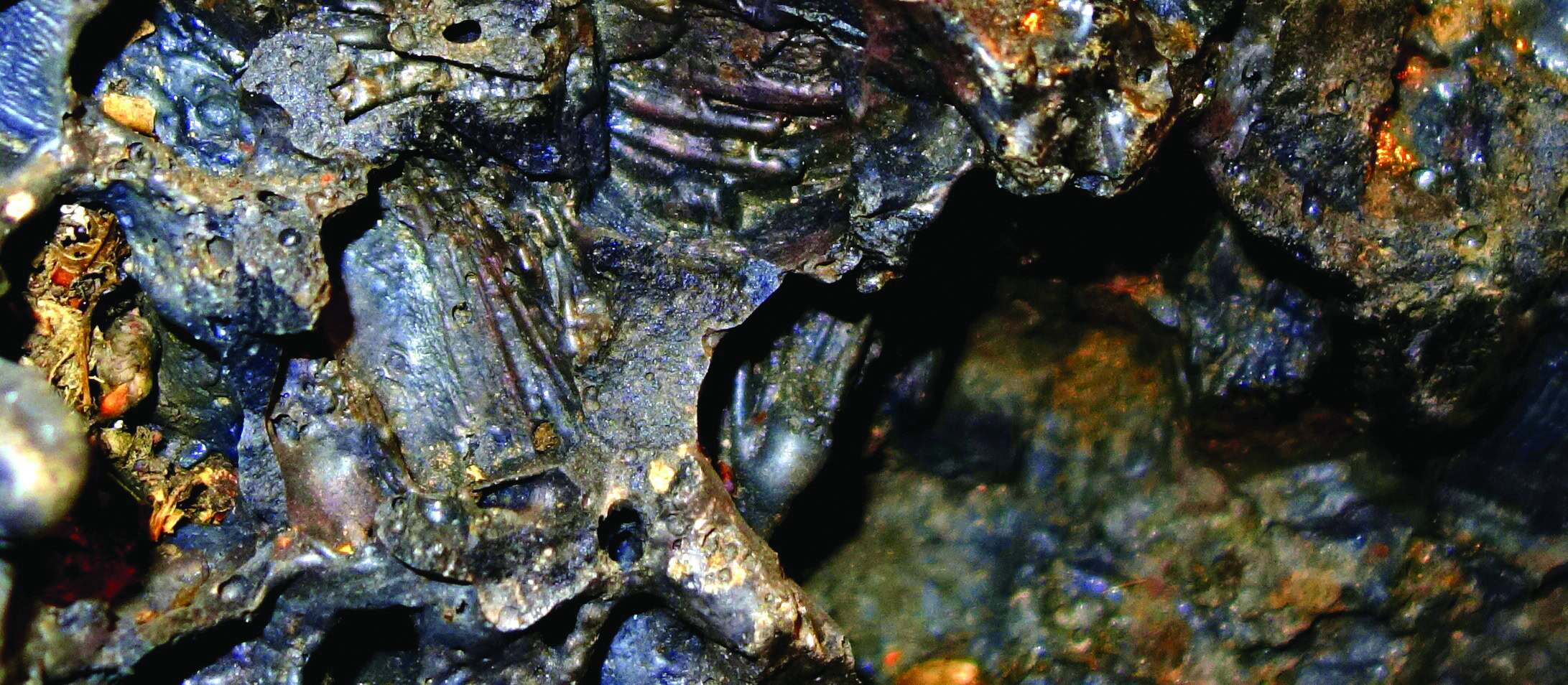
Close-up of a molten section from a hillfort, showing impressions of the charcoal used to vitrify the materials, despite ~1,000 years of weathering. Credit: John McCloy
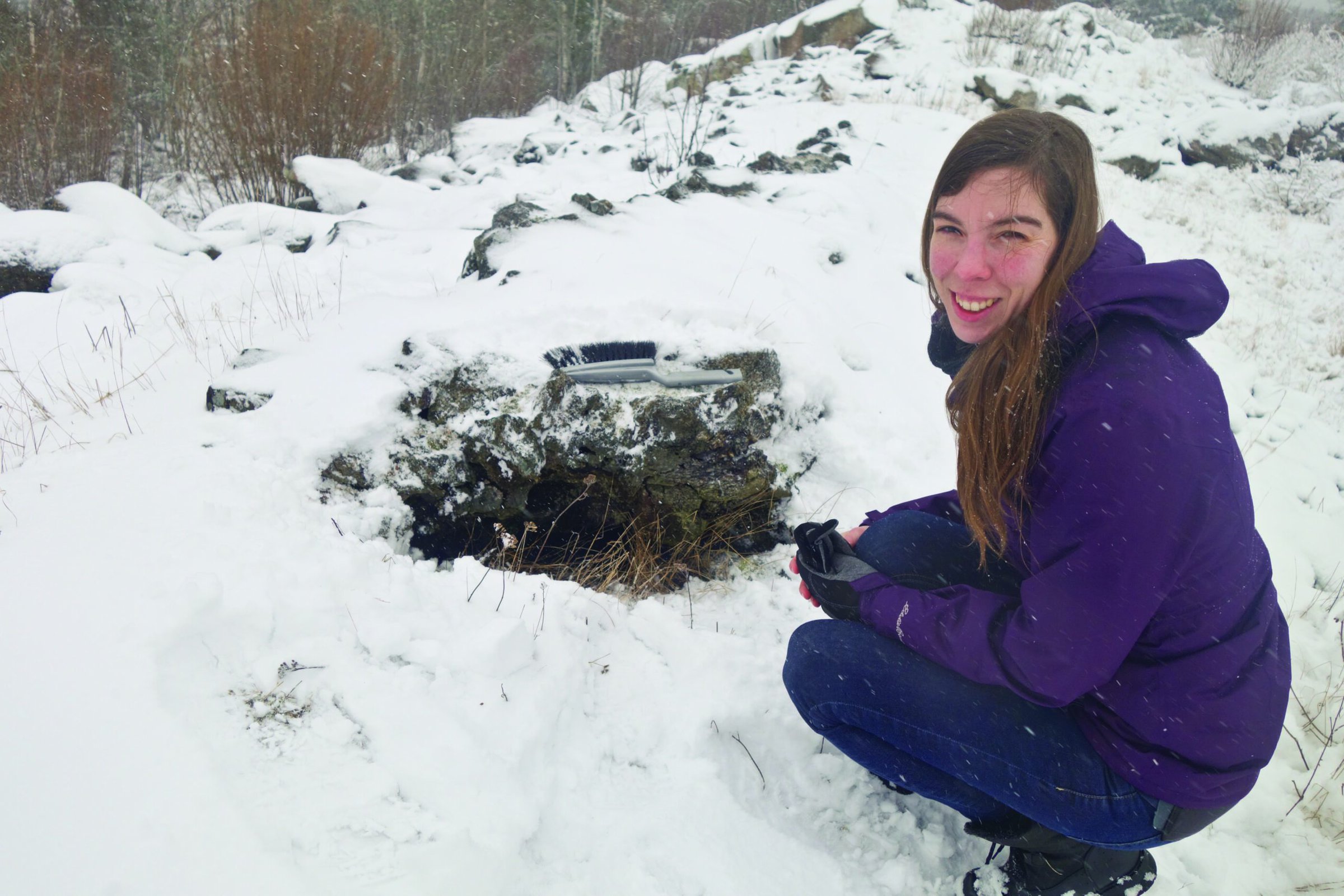
In the case of the Broborg hillfort, located near Uppsala, Sweden, scientists believe that vitrification was intentional, and its construction was completed around 500 CE during the Migration Period (prior to the Viking age). Several excavations of the site have resulted in evidence of house foundations, suggesting that at one point it held a permanent settlement. Walking along the edge of the partially vitrified wall at the site, a casual observer will find it initially difficult to discern rock from vitrified material. However, Peter Kresten—a geologist who has spent most of his professional career investigating vitrified forts—can provide guidance that makes differences between the two materials apparent. Atop and between about one-third of the well-weathered black-and-white-speckled granite and gneiss boulders lie smooth sections of amphibolite melt. With further survey of the site, one can see that the areas where the boulders were not covered and fused with vitrified matter are more heavily eroded than their fortified counterparts. When the dust is lightly swept away from vitrified sections, one discovers a slightly cloudy material that ranges in colors from dark brown to almost clear and, in some areas, still bears marks of the charcoal used in its firing.
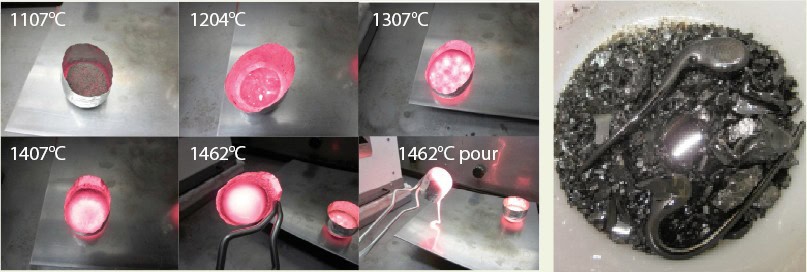
Melt series based on chemistry of melted amphibolite composition from the Broborg site. Melting in atmosphere and without the use of bellows required heating the material to temperatures > 1,400˚C, which is not likely to be reached in ancient times. (Left) Final glass produced from the melting study. (Right) Credit: Jose Marcial and Joseph Osborn
Amphibolite appears to have played an important role in the construction of Broborg and has led researchers at Washington State University and Pacific Northwest National Laboratory to dig into the geology of this region of Sweden. The amphibolite used at the site is metamorphic doleritic rock formed at high water pressure and contains mainly hornblende and feldspars. Studies of the amphibolite left at the site have uncovered evidence of a wide range of localized melting and moisture evolution, from slight heating to complete liquefaction. WSU scientists have found that temperatures >1,400˚C are needed to create a molten material if the melting is completed in air without the aid of bellows. Other studies have found that amphibolite collected from the site could be melted only with the help of a forced draft and a furnace hearth covered with turf.7 These results suggest that to create vitrified portions of the wall, ancient people most likely had to control redox condition and water content of the melt—a technology they most likely developed based on their experiences with iron smelting. Understanding how these melts were made could inform their chemistry, which is invaluable in determination of the long-term durability of Broborg glasses.
Return to main article: “Ensuring longevity: Ancient glasses help predict durability of vitrified nuclear waste“

Related Articles

Bulletin Features
Emerging Professionals: Science for Society & Future Focus
Science for Society articles: Rishabh Kundu and Ryan C. Eaton: “One small tweak to the lens of materials research, one giant leap for mankind” Grace Dunham: “Microwave firing: Inspiring young scientists through rapid ceramic demos” Hossein Libre: “Shaping materials science through policy engagement” Future Focus articles: Kartik Nemani: “Hope and…

Bulletin Features
Emerging Professionals: Research Articles
Experiential learning: Developing the next generation of engineers By Ryan Eaton When a measure becomes a target, it ceases to be a good measure. Goodhart’s law, coined in reference to monetary policy, is readily applicable to engineering education. When students begin optimizing their study habits to pass an exam rather…

Bulletin Features
Durable and programmable metasurfaces enabled by phase change materials
Controlling light with high spatial precision enables technologies ranging from imaging and sensing to communications. Traditionally, optical components such as lenses and filters rely on bulk materials and fixed geometries, which limit their ability to adapt dynamically. Metasurfaces offer a fundamentally different approach. These materials consist of planar arrays of…