

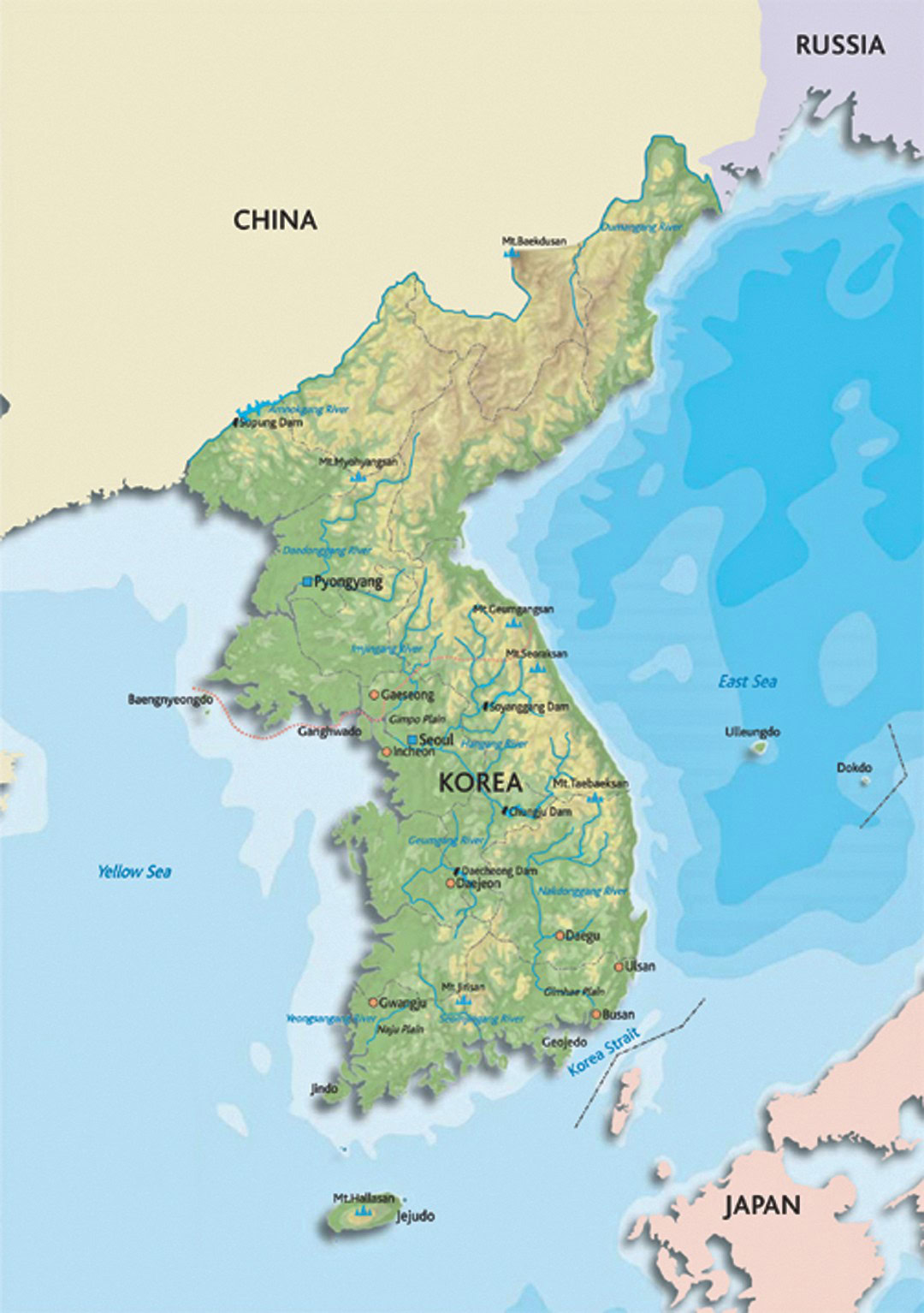
The Republic of Korea’s 38,502 square miles of territory—an area slightly smaller than Pennsylvania and slightly larger than Indiana—is home to 49.12 million people, 82.5% of whom live in urban areas. The labor force numbers 26.27 million, and unemployment stood at 3.5% in 2014.
From 2013 to 2014, the country’s GDP (purchasing power parity) rose 3.3% to $1.781 trillion, or $35,400 per capita, and the country recorded a budget surplus equal to 0.9% of GDP. Its economic position is particularly noteworthy given how radically it has changed in just a few decades. “In the 1960s, GDP per capita was comparable with levels in the poorer countries of Africa and Asia,” the CIA World Factbook notes. “In 2004, South Korea joined the trillion-dollar club of world economies.”
Services generate 59.4% of Korea’s GDP, followed by industry (38.3%) and agriculture (2.3%). The three sectors employ, respectively, 70.4%, 24%, and 5.7% of the labor force. Leading industries include electronics, telecommunications, automobile production, chemicals, shipbuilding, and steel. Industrial production rates remained flat from 2013 to 2014.
Credit: Republic of Korea; Flickr CC BY-SA 2.0
Korea maintains a positive trade balance: 2014 exports reached $572.7 billion, up from $559.6 billion in 2013, while 2014 imports were $525.5 billion, up from $515.6 billion in 2013. Leading export commodities include semiconductors, petrochemicals, automobiles and automobile parts, ships, wireless communication equipment, flat screen displays, steel, electronics, plastics, and computers. The country’s chief export markets are China (26.1%), the United States (11.1%), Japan (6.2%), and Hong Kong 5%.
According to the CIA World Factbook, the country needs to foster greater equilibrium between exports and domestic sectors, such as services. Although heavy reliance on exports is a particular concern, its long-term challenges also include a rapidly aging population, an inflexible labor market, and the dominance of large conglomerates known as chaebols.
Leading import commodities include crude oil and petroleum products, semiconductors, natural gas, coal, steel, computers, wireless communication equipment, automobiles, fine chemicals, and textiles. Top trading partners for imported goods include China (16.1%), Japan (11.6%), U.S. (8.1%), Saudi Arabia (7.3%), Qatar (5%), and Australia (4%).
Almost 80% of U.S. consumer and industrial products exported to Korea became duty free under the U.S.–Korea Free Trade Agreement, which went into effect on March 15, 2012. The Office of the U.S. Trade Representative notes that under the trade treaty, “nearly 95% of bilateral trade in consumer and industrial products will become duty free within five years of that date.” When the agreement went into effect, the U.S. International Trade Commission estimated that “the reduction of Korean tariffs and tariff-rate quotas on goods alone” would add $10–$12 billion to the U.S. GDP annually “and around $10 billion to annual merchandise exports to Korea.”
For further details and export support, see “Tools to Help Utilize the U.S.–Korea FTA” at ustr.gov/trade-agreements/free-trade-agreements/korus-fta/tools-to-help-utilize. Information about trade or joint venture opportunities in Korea can be obtained from the U.S.–Korea Business Council, the American Chamber of Commerce in Korea, or resources on the website of the U.S. Embassy in Seoul. In addition, the U.S. Commercial Service maintains an online library of resources (export.gov/southkorea/index.asp) related to doing business in Korea.
Return to main article: “Korea’s core competencies“

Related Articles

Bulletin Features
Emerging Professionals: Science for Society & Future Focus
Science for Society articles: Rishabh Kundu and Ryan C. Eaton: “One small tweak to the lens of materials research, one giant leap for mankind” Grace Dunham: “Microwave firing: Inspiring young scientists through rapid ceramic demos” Hossein Libre: “Shaping materials science through policy engagement” Future Focus articles: Kartik Nemani: “Hope and…

Bulletin Features
Emerging Professionals: Research Articles
Experiential learning: Developing the next generation of engineers By Ryan Eaton When a measure becomes a target, it ceases to be a good measure. Goodhart’s law, coined in reference to monetary policy, is readily applicable to engineering education. When students begin optimizing their study habits to pass an exam rather…

Bulletin Features
Durable and programmable metasurfaces enabled by phase change materials
Controlling light with high spatial precision enables technologies ranging from imaging and sensing to communications. Traditionally, optical components such as lenses and filters rely on bulk materials and fixed geometries, which limit their ability to adapt dynamically. Metasurfaces offer a fundamentally different approach. These materials consist of planar arrays of…