
In the 1960s the popular comic strip Dick Tracy featured a 1950’s-style detective who maintained communication with his headquarters via a wristwatch that also served as a two-way radio. It was highly futuristic and far-fetched for the time and made compelling reading for at least one particular eight-year-old boy. Today, seemingly without our noticing or taking time to marvel, similar devices have proliferated and can be purchased for a few dollars at any convenience store. And they can reach not only local police headquarters, but any police headquarters around the world! Also, consider this—only a dozen generations ago the chief occupation of our ancestors was meeting daily needs of food and shelter. This began to change in the late 1800s with the industrial revolution. Today, a day’s nutrition costs only a few dollars to purchase at a conveniently located grocery store.
These advancements share a common characteristic: Innovation in farming and communications has advanced the state of the art with respect to cost, productivity, and performance. Indeed, human innovation has been at work since before the first lithic tools were chipped out of flint. In this article I review some of the factors that drive innovation in a medium-sized company and how innovation provides a steady stream of more effective and useful products to the marketplace. I will illustrate this with a few brief case studies from the Unifrax product development files.
Creating value through innovation
Companies engage in product development for new growth opportunities in a strong economy and to sustain the business during economic downturns. The effect on company value is twofold: Sales and bottom-line profits of the company increase; and the future expectations of earnings are enhanced. A company with a consistent history of growth through new product development and a pipeline of new products typically garners a higher value, increases its staff, and creates a better work environment overall.
For new products to add ongoing value to a company, the commercialization process must be sustained over time. New products have a finite life cycle and a predictable value and profitability trajectory over that cycle. When first introduced, a new product offers tangible benefits to the end user, such as higher performance, efficiency, cost savings, or regulatory compliance. Initially, this value is relatively large and represents a potential shared profitability between the product developer and the customer or end user. This is commonly considered in product pricing: The developer can charge a premium for the new product, and a customer typically is willing to pay the premium, provided the customer receives a satisfactory benefit in return. (My business school colleagues will recognize this as “value pricing.”)
The dynamics of the marketplace dictate that this advantage is transient. Inevitably, competitors enter the market with similar products, claiming their share of the value pool. As time passes, competition between suppliers exerts downward pressure on product prices, driving them lower and encouraging more cost-effective production to maintain profitability. Over time margins erode and the once-new product becomes less profitable and may ultimately become a commodity, competing for customers in a broad field of equivalent products, with customers selecting vendors based solely on lowest price or convenience.
Although the main driver for product innovation is profit, corporate investment in product innovation provides a significant benefit to society as a whole (along the lines of the communications and farm examples). Companies seeking higher profitability invest in product innovation. Society benefits from better, more effective products, and the innovator benefits from increased revenues.
Innovation can consume large amounts of cash and human resources. Companies must manage product development activities to ensure maximum return on investment, similar to any investment portfolio.
Unifrax strives to maintain a portfolio of new products totaling or exceeding 20 percent of revenues. We manage our development portfolio through “design control,” a stage–gate process encompassing all aspects of activity and decision making from project identification and product conception to product launch and market support. This process brings clarity and visibility to all stages of the new product development process, ensuring that resources are leveraged effectively.

A felt-like fibrous refractory mat holds automotive catalytic converter substrates in place during use. Credit: Unifrax
Project identification and justification
Identification of potential new products can occur through a variety of channels. Most new product needs become apparent when a customer’s application evolves and current products cease to meet performance requirements. This was the case in the late 1990s when new auto designs called for the catalytic converter to be moved closer to the exhaust manifold to allow more rapid heat-up and catalyst activation to reduce startup emissions. At that time, Unifrax refractory fiber mat wrapped catalytic converter substrates in automotive emission control system piping to cushion and hold it in place. When existing products failed in new designs because of higher temperatures, Unifrax worked with OEMs to develop CC-Max, a product with higher temperature performance specifically designed for the so-called close-coupled application.
Government codes and regulations provide another source of new product needs. This has been a major driver in Unifrax’s passive fire protection business, for example. Unifrax fiber has the twin properties of being a superior thermal insulator and being fully stable under fire conditions, allowing it to be used as a barrier to prevent the spread of fire in building, maritime, and aerospace applications. When regulations were instituted for improved fire protection in passenger compartments of ships, new products were developed that stretched the performance envelope to allow the maximum insulation in the smallest space at the lightest weight. In 2003 a new regulation required the installation of a fire-barrier on the underside of the fuselage in new commercial passenger aircraft produced after 2006. Unifrax worked with the end user to define the requirements for the product and ultimately developed and introduced a novel, lightweight barrier capable of holding off an external fire for up to four minutes, adding additional life-saving minutes for passengers to escape in the event of a fire.
Occasionally, products may be developed in anticipation of a market need without an identified customer. In such cases, “market pull” is traded for “market push.” Other development drivers might include a response to a competitor’s product introduction, product cost-reduction initiatives, or a quality improvement effort on an existing product.
Unifrax collects new product ideas from employees at all levels in a central database for periodic review and evaluation. The marketing department estimates sales from a prospective new product. Before committing resources, it is imperative to verify that the return on the project justifies the investment and that there are no higher-potential projects to which the resources would be better applied. Candidates projecting an acceptable potential return are assessed for technical risk and overall “likelihood of success.” At this time, other “fuzzy” evaluations are made, such as likely competitor response, barriers to entry, and ability to protect the technology. After a candidate passes all screening criteria, senior management formally accepts the project, and it enters the “pilot development” phase.

Aluminosilicate fibers are useable up to 1400°C and provide the basis for Unifrax’s ‘Fiberfrax’ line of products. Credit: Unifrax
Pilot development
Once approved, a project team begins development work on the new product. In our experience, cross-functional teams have proved particularly useful. Teams typically include a development engineer, who assumes the function of team leader during the pilot development phase, and staff from quality, marketing, and manufacturing. Other departments, such as purchasing, health and safety, or project and process engineering, participate as-needed. In this way, all functions with a stake in the new product exert influence throughout the development process, ensuring that all interests (including the customer’s, via marketing) are represented throughout the development effort.
During pilot design, the team defines the physical and performance requirements for the product and develops the process and formulation needed to meet those requirements. Product performance requirements are researched and formally documented via a “failure mode and effects analysis,” or FMEA. In this analysis, the product is viewed through the eyes of the customer and the end user, and all its necessary functionality is described. Properties considered may include density, strength, thermal stability, thermal conductivity, color, tactile characteristics, potential for smoke generation, or other user-specified characteristics. Tests are defined to objectively measure these characteristics, and the team (likely in conjunction with the customer) sets numerical targets for each property. These values are assembled into a “design specification” that encompasses the full performance requirements of the product under development. The development team reviews the specification for completeness and accuracy. Throughout the development process, testing against this specification comprises the pass/fail criterion for all prototype product designs. After the team has established the specification, the fun part of product development can begin!
With its homework complete, the development team begins formulating the product. In most cases, product design evolves, that is, minor adjustments stretch existing technology in a given direction—rarely does the team start from scratch. But this is not to understate the challenge—the performance envelope of existing products often represents the real physical limitations of melting points, viscosity values, tensile strengths, or chemical reactions. Pushing behavior beyond existing values requires controlling and manipulating the parameters driving the behavior. Resource constraints (that is, staff, time, money) force strategy decisions regarding approaches. For example, it is a luxury to be able to evaluate properties at a mechanistic level, but this also can be highly effective.
Where expertise exists within the company, it is certainly brought to bear on development challenges. (Unifrax is fortunate to have good employee retention—a pool of seasoned engineers is available to speak to such problems.) If the challenge can be adequately defined, it also is possible to look for help outside the company. Unifrax has had good results using outside consultants as problem-solving resources as well as university relationships that have given us access to specialized measurement equipment to develop product understanding.
Where understanding ends, hard work begins. A prototype product must be fabricated and tested. Even when performance mechanisms are known (or at least estimated), experimentation is necessary. Designing simple, effective experiments that give rapid, definitive information on prototype performance controls costs and development time.
The Unifrax development laboratory is equipped with a full range of pilot and test equipment to fabricate quickly any product form needed and measure all key physical and performance parameters. In this way, an idea can be tested quickly. Experiment protocols range from simple ladders that vary a single parameter to complex, statistically driven experiment designs that test multiple variables simultaneously and delineate their individual and interactive impact on the product. Failed prototypes are common—and frequent—until a formulation succeeds.
Developing a workable product is the goal of the “pilot design” phase. At this point, the team, exercising caution, pessimism, and suspicion, repeats the successful formulation to ensure the results are reproducible. Also, the team wants to understand the robustness of the solution:
- Can it tolerate the normal variations of a manufacturing environment?
- Is it capable of surviving conditions beyond those expected?
Once a suitable formulation is established, senior management reviews all aspects of product development—performance targets, raw materials, safety, formulation, specifications, manufacturability, cost, and product performance. At this time, the original market assumptions are reviewed to ensure they continue to be relevant. If all assumptions are valid and the work has been thorough and produced a robust outcome, the new product is approved and advances to the next stage of the commercialization process, “manufacturing design.”
Manufacturing design
Costs for a project escalate significantly in the manufacturing design phase, where the formulation must be scaled-up and proved. Whereas the pilot phase used a few grams to a pound of raw materials, manufacturing development requires quantities of hundreds or thousands of pounds. Scale-up involves demonstrating manufacture on production equipment and requires time at the manufacturing plant. Often, production schedules prevent time from being immediately available or, worse yet, sometimes trial runs interrupt production.
The production environment can reveal a number of complex and potentially unexpected influences, and successful execution requires dedicated attention from someone familiar with the product under development and the manufacturing system. Typically, the manufacturing engineer assumes leadership of this critical phase. Immense detail goes into planning, and every available operating parameter must be tracked frequently to document all potential influences on the product. The product is measured and tested at frequent intervals even during stable production runs to ensure there are no unexpected deviations. Plant trials benefit from an attitude of “constructive paranoia.” Product developers need to think “three steps ahead and four layers down” to ensure success.
The specific development path of a new product in the manufacturing design phase is impossible to chart—it may be direct and efficient or laden with unexpected problems. In case of the latter, standard problem-solving methods apply. Sometimes, the best option is to return to the pilot design phase and rework a product to address problems identified in the manufacturing design phase.
Eventually, diligent effort prevails and achieves a successful and stable production run. The products made during plant trials also undergo full characterization and qualification against the established performance targets, and, if all is well, samples are provided to the customer for qualification and acceptance testing. Along the way, other team members will have developed a product introduction plan, written descriptive product data sheets and safety data sheets, selected and qualified raw materials and vendors, ordered packaging, and developed production operating procedures. Senior management meets for a final review, which may include examining all supporting documentation of the project including product design, performance characteristics, and customer feedback. Once again, the marketing and performance assumptions that were made at the outset are given a reality check, cost and price are checked, and the marketing plan is reviewed. Provided all items are in order, the managers of each corporate function grant approval, and the new product is born.
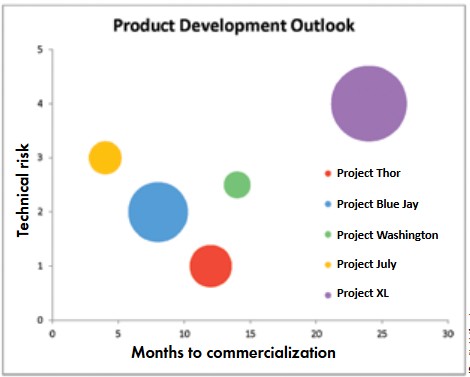
“Bubble chart” for managing product development priorities based on development time, technical risk, and market size. Credit: Unifrax
Benefits of design control
Unifrax has codified “design control” procedures into a collection of documents called the “Product Introduction Checklist.” Standard forms, which are collected, stored, and readily accessible through a shared database, document each step. Standardizing procedures and actions into a formalized workflow gives all team members a clear view of the project’s history, status, and next steps. This helps align priorities and minimizes lost productivity.
Design control has the added benefit of making project status immediately visible to management, which, in turn, makes the development portfolio easier to track and manage. Periodic portfolio “bubble chart” reviews are very helpful in this regard.
As Unifrax has grown from a hundred-million dollar enterprise in 1996 to a half-billion dollar worldwide manufacturer, the philosophy of aggressive growth through new products has remained a constant tenet of its strategic mission. Since 1996, the stakes have become higher and the need to “get it right the first time” has grown.
Aggressive and well-executed product development benefits not only the developer but society as a whole. New products developed by Unifrax are deployed worldwide in diverse applications, such as automotive emission control, industrial thermal management, and critical life-safety applications involving passive fire protection. As a direct result of Unifrax product development and introduction, thermal processes are more efficient, reduce fuel consumption, and prevent tons of greenhouse gas from entering the atmosphere. Automobile-related pollution is reduced by hundreds of tons per year and buildings, airplanes, and ships have improved fire protection systems, with added safety for life and property.

Related Articles

Market Insights
Next-gen superconducting ceramics could change how we travel and much more
Forty years ago, two physicists from IBM’s research laboratory in Zürich, Switzerland, reported a groundbreaking discovery: Superconductivity, or the quantum mechanical phenomenon in which certain materials exhibit zero electrical resistance when cooled, could be achieved at higher temperatures using ceramics. Superconductivity had been discovered decades before, but its applications had…

Market Insights
Why most AI manufacturing projects fail and how to fix it
Artificial intelligence is reshaping advanced manufacturing, especially processes involving ceramics, glasses, and other hard or brittle materials. But adopting AI is far more difficult than simply buying software and connecting machines. Manufacturers must understand the advantages and limitations of different models, so they can determine where AI fits best within…

Bulletin Features
Radiation effects on rare earth chemistry in molten salts for nuclear applications
Across the nuclear energy sector, molten salts are shaping the next generation of nuclear technologies, from advanced power reactors to used nuclear fuel recycling. In molten salt reactors (MSRs), molten salts uniquely serve as both the primary coolant and fuel medium, a dual role that sets MSRs apart from conventional…