

The National Science Foundation is an independent federal agency that serves as a funding source for basic research conducted at America’s colleges and universities.
NSF is divided into seven science and engineering research and education directorates. The Mathematical and Physical Sciences Directorate is home to the Division of Materials Research, which includes the Ceramics Program.
The Ceramics Program supports fundamental scientific research in ceramics (e.g., oxides, carbides, nitrides, and borides), glass-ceramics, inorganic glasses, ceramic-based composites, and inorganic carbon-based materials. The objective of the program is to increase fundamental understanding and to develop predictive capabilities for relating synthesis, processing, and microstructure of these materials to their properties and ultimate performance in various environments and applications. Research to enhance or enable the discovery or creation of new ceramic materials is welcome. Development of new experimental techniques or novel approaches to conduct projects is encouraged.
During fiscal year (FY) 2015, the Ceramics Program provided support for 36 new or renewal awards, 14 supplemental awards, and cofunding for several grants managed by other programs. New or renewal awards are listed in Table I, but more information on any NSF award is available by searching the NSF awards database or by adding the seven-digit award number to the end of www.nsf.gov/awardsearch/showAward?AWD_ID=. At any given time, one can generate a map or list of active awards from the Ceramics Program homepage at 1.usa.gov/1Ylk9RH. Although FY 2016 began in October 2015, the first awards probably will appear in spring of 2016.
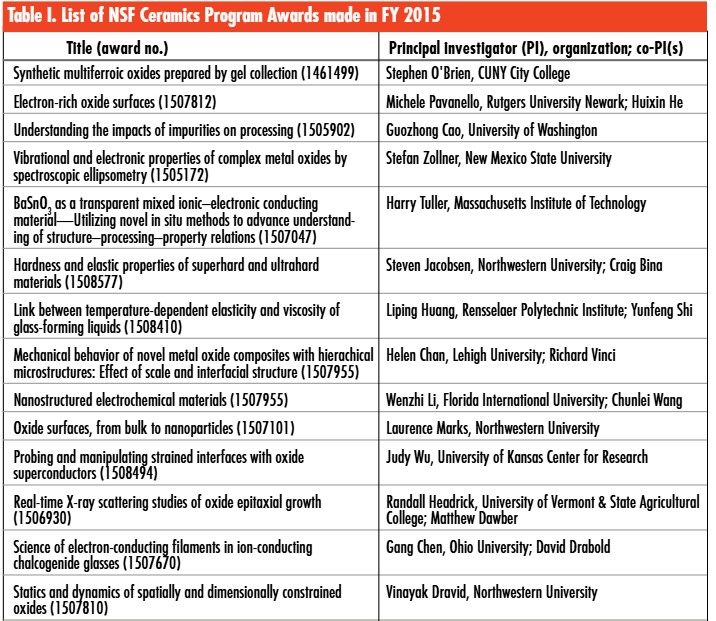
Credit: Data from National Science Foundation; table formatted by ACerS
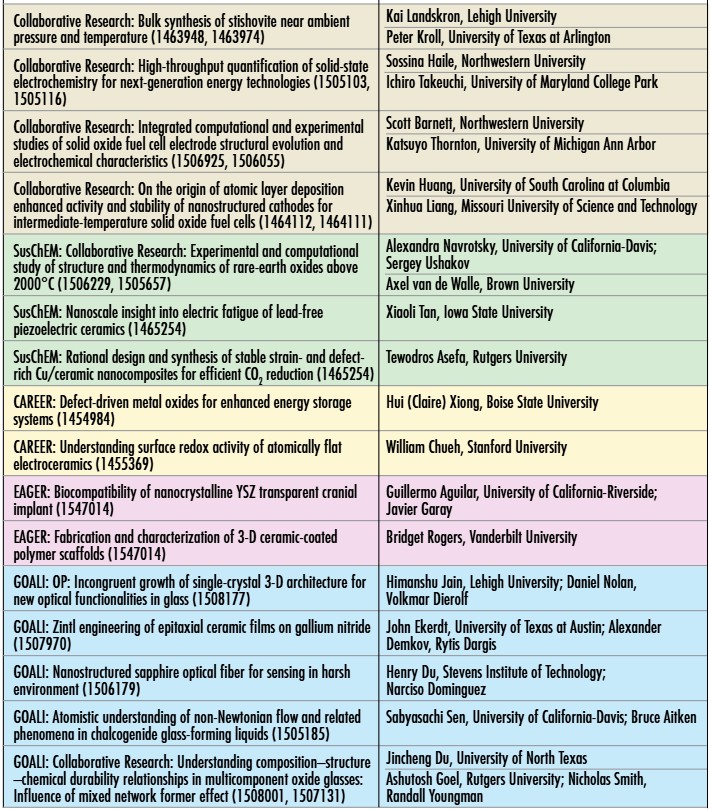
Credit: Data from National Science Foundation; table formatted by ACerS
Collaborative Research
Collaboration research can include more than one investigator at the same institution or at multiple institutions. For multiple institutions, there can be one proposal with a subaward to the other institution(s), or multiple coordinated proposals can be submitted as a joint project. See NSF’s Grant Proposal Guide (1.usa.gov/1OyPUfv) for further details, including responsibilities.
Sustainable Chemistry, Engineering, and Materials (SusChEM)
The SusChEM initiative (1.usa.gov/1lTJ79P) addresses interrelated challenges of sustainable supply, engineering, production, and use of chemicals and materials.
Faculty Early Career Development Program (CAREER)
The CAREER (1.usa.gov/1E4FrZn) solicitation is restricted to single investigators who are assistant professors. The two awards made in FY 2015 are detailed in the ACerS Bulletin.1
EArly-concept Grants for Exploratory Research (EAGER)
“The EAGER funding mechanism may be used to support exploratory work in its early stages on untested, but potentially transformative, research ideas or approaches.” Full details are provided in the Grant Proposal Guide (1.usa.gov/1TSnOQu).
Grant Opportunities for Academic Liaison with Industry (GOALI)
GOALI (1.usa.gov/1mpWVsv) promotes university–industry partnerships by making project funds or fellowships and traineeships available to support universities working with industry. One of these Ceramics Program projects also was funded under the Optics and Photonics area of interest (1.usa.gov/1Pb9ymt). Companies engaged in the 2015 Ceramics Program projects are Corning Inc., Translucent Inc., and Fiberguide Industries Inc.
Related Articles

Market Insights
Next-gen superconducting ceramics could change how we travel and much more
Forty years ago, two physicists from IBM’s research laboratory in Zürich, Switzerland, reported a groundbreaking discovery: Superconductivity, or the quantum mechanical phenomenon in which certain materials exhibit zero electrical resistance when cooled, could be achieved at higher temperatures using ceramics. Superconductivity had been discovered decades before, but its applications had…

Market Insights
Why most AI manufacturing projects fail and how to fix it
Artificial intelligence is reshaping advanced manufacturing, especially processes involving ceramics, glasses, and other hard or brittle materials. But adopting AI is far more difficult than simply buying software and connecting machines. Manufacturers must understand the advantages and limitations of different models, so they can determine where AI fits best within…
Bulletin Features
Radiation effects on rare earth chemistry in molten salts for nuclear applications
Across the nuclear energy sector, molten salts are shaping the next generation of nuclear technologies, from advanced power reactors to used nuclear fuel recycling. In molten salt reactors (MSRs), molten salts uniquely serve as both the primary coolant and fuel medium, a dual role that sets MSRs apart from conventional…