
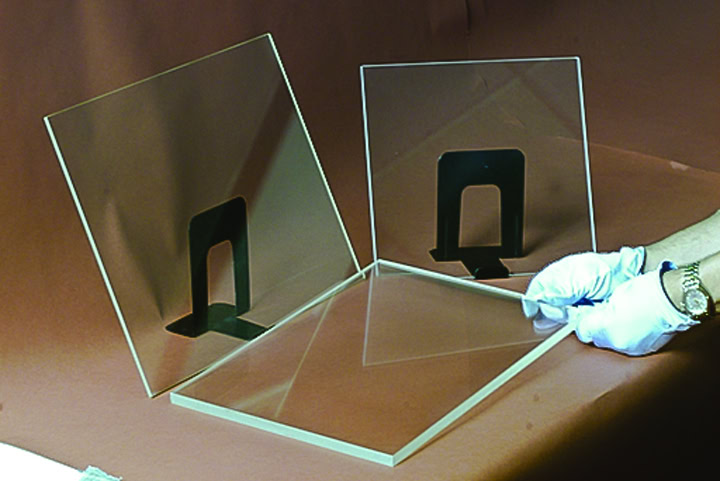
The first reported work on transparent polycrystalline ceramics goes back to the 1950s. For example, some of the literature on materials discussed in this article, magnesium aluminate spinel and aluminum oxynitride spinels, traces back to late 1950s and early 1960s.1–3 The advantages of these materials over current state-of-the-art materials include
- Ease of manufacturing;
- Superior mechanical properties, such as modulus, hardness, and strength;
- Performance at high-temperature environments; and
- Chemical durability.
Candidate polycrystalline transparent ceramic compositions include yttrium aluminum garnet and yttria, but aluminum oxynitride (γ-AlON )and magnesium aluminate spinels seem to have established themselves as leading candidates in multiple market segments, such as the military, aerospace, and lasers, mainly because of their durability, availability in large sizes, and cost.
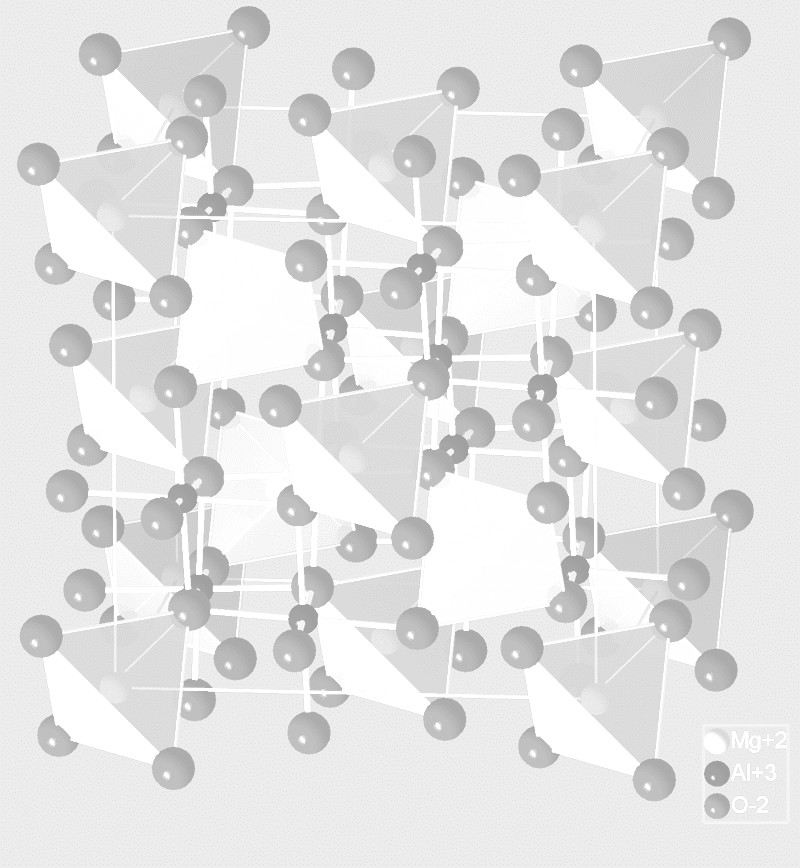
Spinel crystal structure. Credit: Surmet.
Today, γ-AlON and magnesium-spinel are manufactured in large sizes and in large volumes. However, high cost remains a barrier to their deployment as replacements for glasses and some opaque ceramics. Growing demand in current and emerging markets position these materials at the cusp of new commercialization opportunities in terms of volumes and costs. This article reviews the unique properties of these materials that make solving the production challenges a worthwhile endeavor.
Optical properties
Properties drive applications, and, obviously, optical properties are among the most important for transparent polycrystalline ceramics. However, the combination of mechanical properties (and, for some applications,4 other properties, too) makes these spinel materials uniquely suitable for a range of applications in defense and aerospace systems.
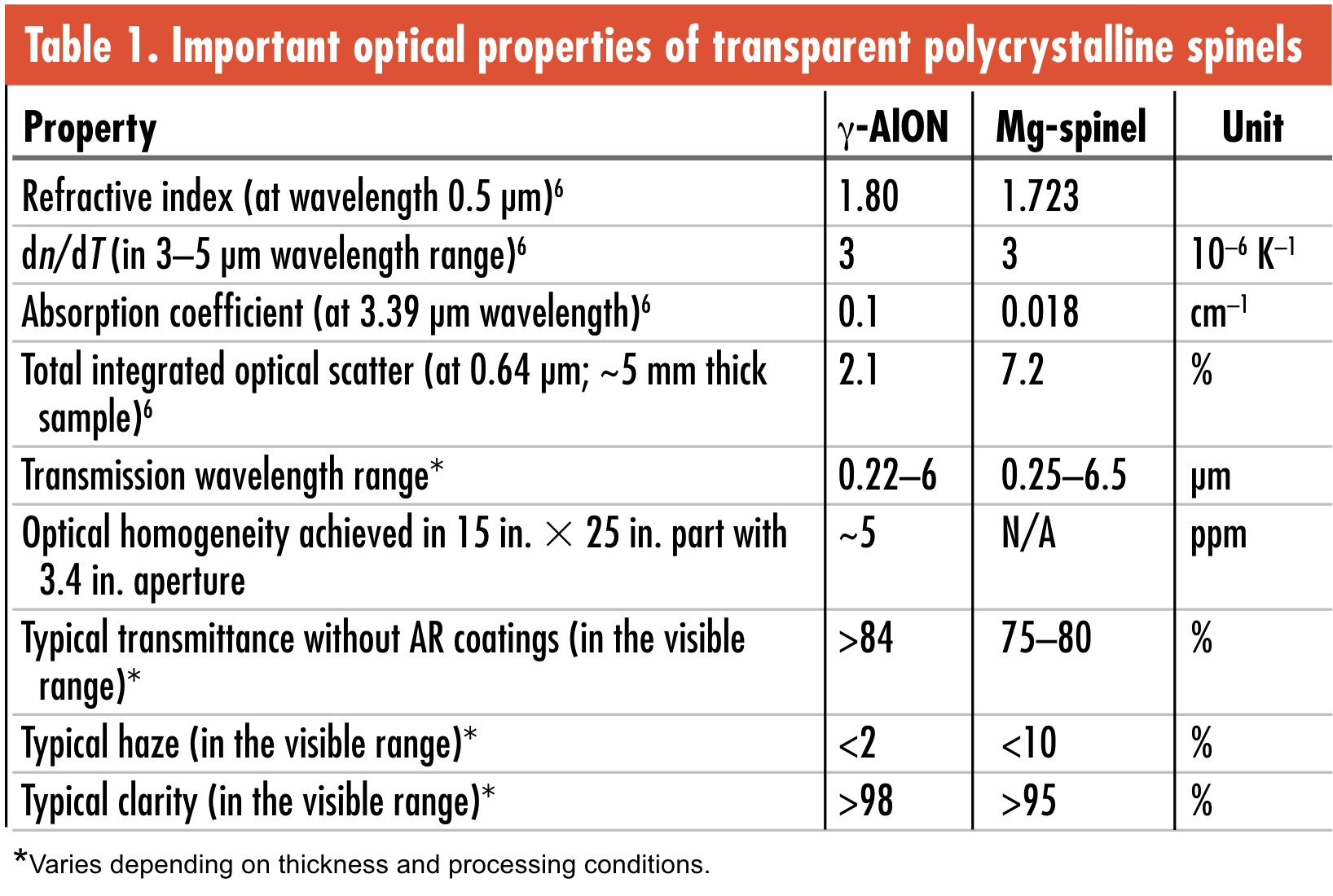
Many defense and aerospace applications require materials that are transparent in the ultraviolet, visible, and through the mid-infrared wavelength ranges. High transparency means low scattering losses, low reflectance, and low absorption. For cubic spinel polycrystalline materials, several factors determine optical quality. Cubic materials are isotropic, so they have no inherent birefringence. However, secondary phases, such as pores, impurities, and inclusions, typically lead to low transmittance. Controlling material purity and processing conditions minimizes defects, and increases transparency up to theoretical limits. In the absence of absorption and scatter, reflection losses from the material’s inherent refractive index determine transmittance. Consequently, transmittance can be increased significantly via antireflection coatings.
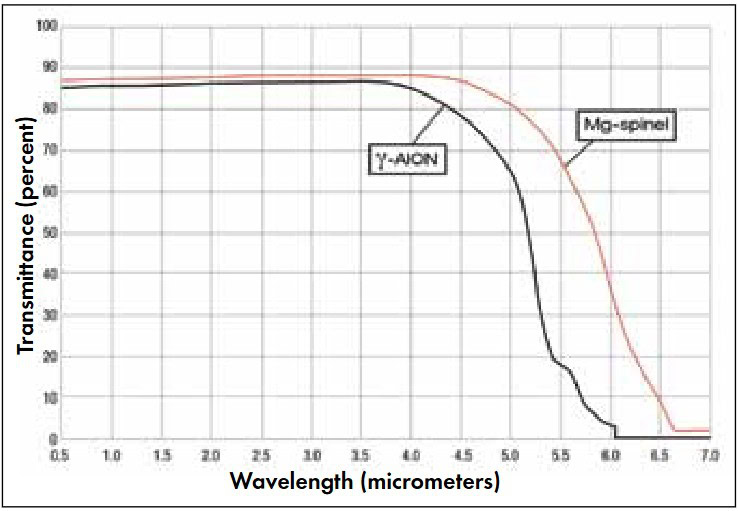
Figure 1. Calculated transmittance of γ-AlON and magnesium-spinel (at 2 millimeter thickness). The calculation includes Fresnel reflective losses that can be eliminated through use of an antireflection coating. Credit: Surmet.
Figure 1 shows transmittance of γ-AlON and magnesium-spinel optical ceramics. Even though it is polycrystalline, γ-AlON is one of the best currently available materials in terms of optical quality. The transmittance of γ-AlON approaches its theoretical values in the near-UV, visible through mid-IR wavelengths, but starts dropping around 4.5 micrometers and cuts off at mid-IR range wavelengths of about 6 micrometers because of intrinsic (phonon) absorption. Additionally, it drops to zero at about 0.22 micrometers in the short wavelength range. In comparison, magnesium-spinel transmits further in the mid-IR range—transmittance starts dropping around 5 micrometers and stops at 6.5 micrometers wavelength. The transmittance of magnesium-spinel also drops to zero at about 0.2 micrometers. This is an advantage for spinel applications that require high transmission in the 4.5–5 micrometer range.
In addition to excellent transmittance, commercial γ-AlON products have exceptional optical clarity (exceeding 98 percent) and very low haze (less than 2 percent) in the visible wavelengths. (Optical clarity relates to the amount of light scattered at small angles. In contrast, haze relates to the amount of light scattered at large angles.)
Pores, secondary phases, inclusions, defects, and inhomogeneous grain boundaries greatly affect the clarity and haze properties of transparent polycrystalline ceramic materials. High clarity and low haze requires nearly 100 percent density and no secondary phases, which are very challenging from a processing perspective. In addition, impurities can impart a tint to the final component, whereas less than full density causes haze. Thus, the production of high-quality transparent ceramics demands both careful powder synthesis and close control during densification.
Another important optical property is the refractive index. In γ-AlON, it varies between 1.81 and 1.67 over the 0.4–5.0 micrometer wavelength range, with normal dispersion as shown in Figure 2. (Dispersion is the change in refractive index with wavelength for a material and is denoted by the dimensionless “Abbe number.”) A typical Abbe value for γ-AlON and magnesium-spinel is about 60, which means that the dispersion is much lower than some of the glasses with similar refractive indices, making the spinels strong candidate materials for lenses with low chromatic aberration.
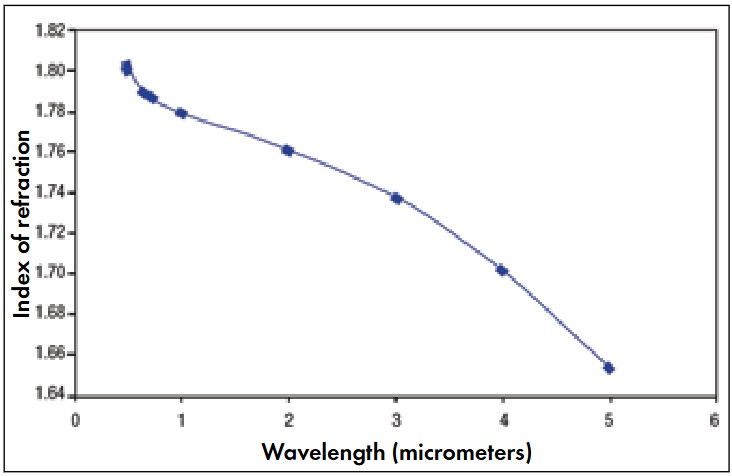
Figure 2. Measured dispersion of γ-AlON optical ceramic over a range of wavelengths. Credit: Surmet.
Also, the cubic spinel phase of aluminum oxynitride exists across a wide composition range. Therefore, properties, such as refractive index, can be tailored without losing transparency. Components like graded refractive index lenses (GRIN) are fabricated, for example, by controlling composition or by adding dopants. Unlike many glasses, which are transparent only in visible wavelengths, γ-AlON GRIN lenses are transparent in the visible through mid-IR range. Certain GRIN lenses can have flat surfaces, because the “lens curve” is built into the material via the refractive index gradient. Also, grading the composition can eliminate the aberration associated with spherical lenses. Additionally, GRIN lenses can reduce significantly the size, weight, and complexity of the optical train for defense applications, such as image systems for laser range finders, night vision goggles, and unmanned aerial vehicles.
Night vision technologies improve visibility (transmission) in low light conditions. Most night vision devices (NVD) are for military applications, but some are used in the civilian arena. NVDs require transmission in the 0.4–0.92 micrometer range. In this range, γ-AlON and magnesium-spinel transmit better than glasses. As Figure 3 shows, γ-AlON-based armor offers significantly more night vision capability (about 40–50 percent more transmission) over glass laminates in low-light conditions. More transmission means a higher signal-to-noise ratio and higher-resolution imaging, which improve awareness for the warfighter in low-light situations.
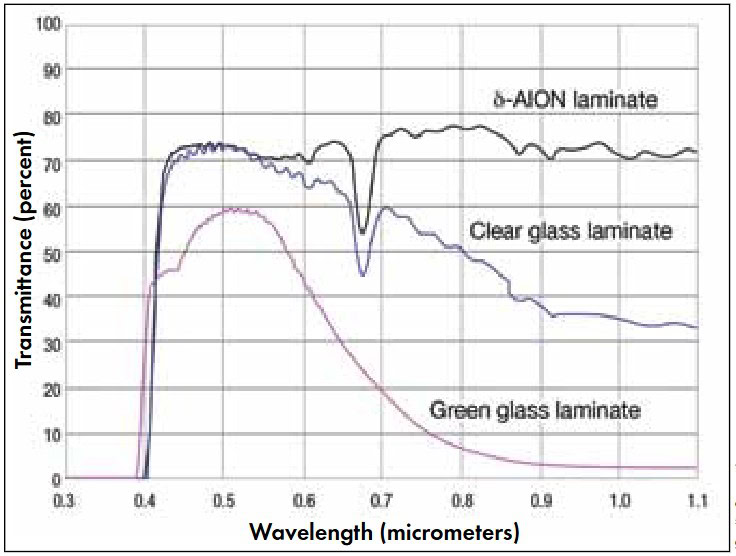
Figure 3. Comparison of night vision performance of γ-AlON laminate to glass laminates. Credit: Surmet.
Mechanical properties
Transparency alone is not enough for warfare situations. These materials must endure stresses encountered in manufacturing, transport to theater, deployment in service, or ultimately, under ballistic conditions. Ballistic properties and environmental durability are critically important properties in the military context.
Although γ-AlON and magnesium-spinel are cubic spinel lattices, their bonding and bond strength differences make γ-AlON mechanically superior to magnesium-spinel, giving it a higher hardness and elastic modulus than magnesium-spinel. In fact, the hardness of γ-AlON approaches that of single-crystal sapphire, making it the hardest polycrystalline transparent material currently available commercially. The combination of high hardness and elastic modulus makes γ-AlON a leading candidate material for transparent armor applications, followed by magnesium-spinel and single-crystal sapphire. Table 2 compares the important mechanical properties of the two transparent polycrystalline materials as well as some of their thermal properties.
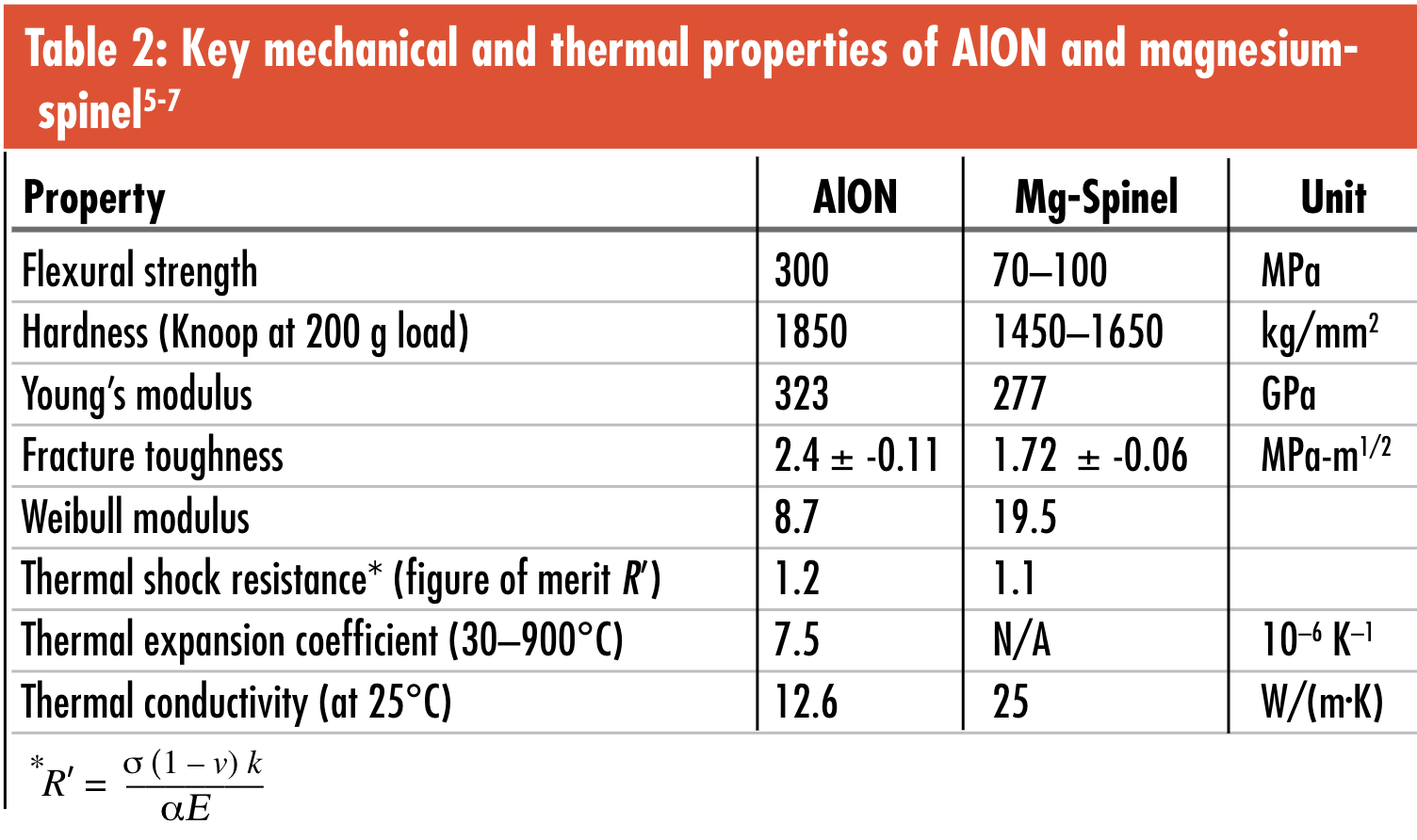
Although lower elastic modulus and hardness values of magnesium-spinel compared with those of γ-AlON are related to structure and bonding, the lower flexure strength is also strongly affected by processing influences. Lithium fluoride sintering aids are added to magnesium-spinel during the hot press/HIP process (uniaxial hot pressing followed by hot isostatic pressing). However, the grain-boundary phase formed during liquid-phase sintering is weaker than the bulk and can lead to intergranular fracture, as shown in Figure 4. Use of a sinter/HIP process eliminates sintering aids and yields a stronger microstructure, however, inclusions are more likely.
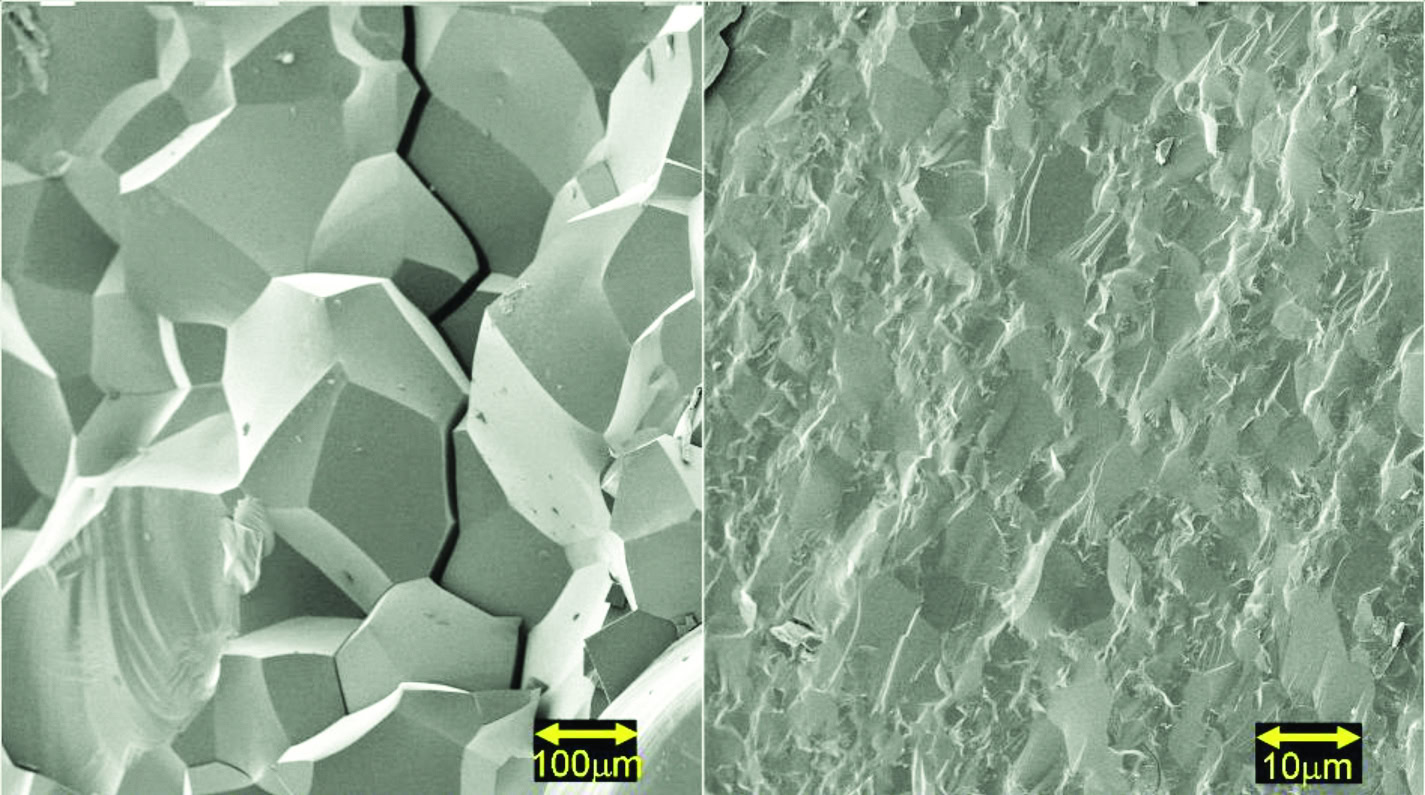
Figure 4. Comparison of hot-pressed sintered microstructure with sinter/HIP process. Credit: Surmet.
The sinter/HIP process can produce inclusion-free, optical quality γ-AlON parts, provided that the starting powders are high quality. The hot pressing/HIP process offers no advantage when high-quality starting powders are used.
Ballistics: Projectiles and explosives
Any transparent armor system must defeat ballistic threats and be optically transparent. Glass-based transparent armor systems can meet these requirements, but there are drawbacks. Glasses and polymers are usually less hard than armor piercing (AP) core materials, so laminates are made thick (heavy) to stop penetration. Spinels, however, are two- to three- times harder than glasses, and the laminates are less bulky.
Lightweight, high-performance, transparent armor is a system of materials that includes ceramics, glass, and polymers. Usually, the design consists of multiple layers separated by thin polymeric sheets. Typically, the front layer is made of hard ceramic (known as the front face) and is capable of destroying the projectile on impact.
Transparent ceramics, such as γ-AlON, magnesium-spinel, and sapphire, are much harder than AP core materials (typically steel, tungsten carbide, or tungsten). When the AP core of the projectile hits the strike-face of a hard ceramic material, it erodes and disintegrates during penetration.8 The fractured and eroded core debris is then stopped efficiently by a polymeric layer on the back face of the laminate. Moreover, ceramic armor achieves protection levels similar to glass laminates at smaller armor thicknesses, leading to lower areal densities and lighter weights, as shown in Figure 5.
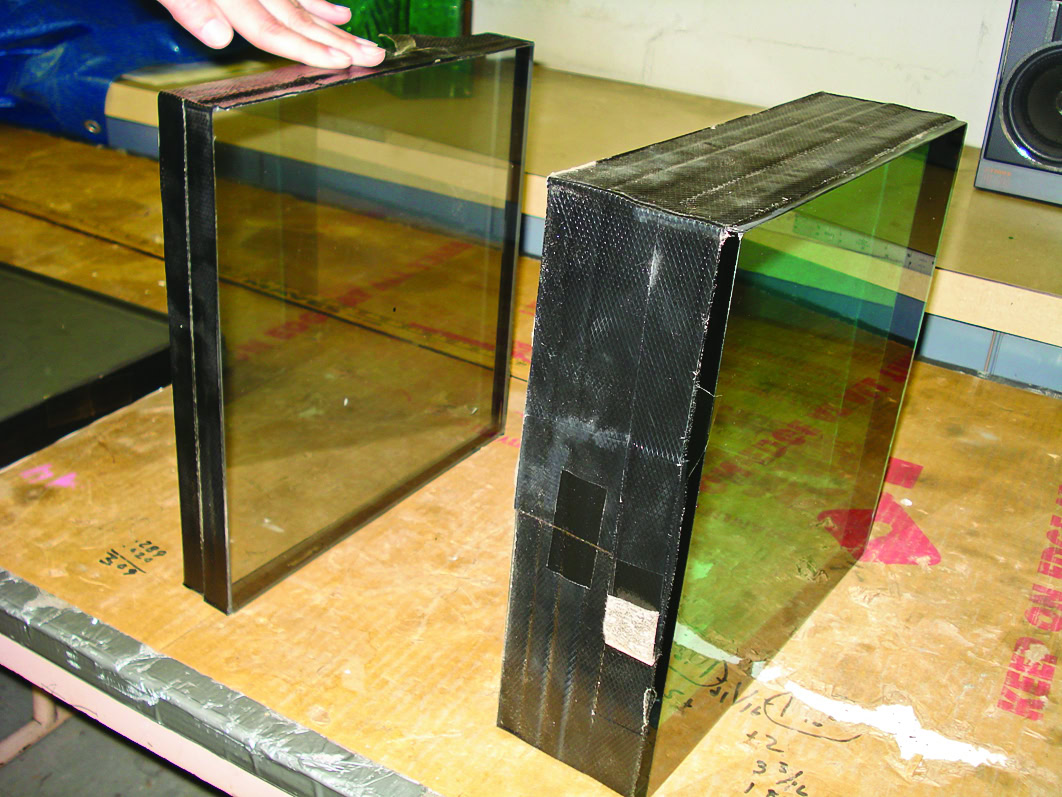
Figure 5. Dimension and weight comparison of armor laminates with similar ballistic protection. Left: γ-AlON laminate, 1.6 inches thick and density of 18.9 pounds per cubic foot. Right: Glass laminate, 3.6 inches thick and density of 43 pounds per cubic foot. Credit: Surmet.
Ballistic tests conducted at the Army Research Laboratory (ARL) in Aberdeen, Md., compared current glass-based transparent armor with three transparent ceramic armor materials: γ-AlON, magnesium-spinel, and single-crystal sapphire. Details for this work are classified and unavailable for publication. However, ARL tests showed that γ-AlON ceramic armor resisted penetration 10 percent better than magnesium-spinel armor, 20 percent better than sapphire armor, and 150 percent better than conventional glass-based laminate armor. In separate tests conducted by Surmet, γ-AlON transparent armor successfully withstood single-hit and multihit projectile threats, including 30 caliber and 50 caliber AP threats. It outperformed glass armor with less than half the thickness and reduced weight by about 60 percent.
Environment: Rocks and weather
In addition to ballistic threats, materials for defense applications must resist environmental damage threats in the field. For example, tank windows must resist abrasion from airborne dust and sand. Similarly, electromagnetic windows must resist abrasion and wear resistance, as well as chemical stability erosion.
Sand erosion and rock strikes
In the field, glass-based armors suffer severe loss of transparency from erosion by wind-swept sand, dust storms, and scratches from rock strikes. In simulated environmental sand erosion tests, the optical transmission of glass-based armor fell by 23 percent, whereas the optical transmission of γ-AlON transparent armor remained unchanged under the same test conditions. Similar performance also can be extrapolated to γ-AlON used in sensor and electromagnetic window applications.
Laboratory rock strike tests show similar differences between γ-AlON and armor glass tiles. Figure 6 shows what happens when a granite projectile is fired at two monolithic window targets—γ-AlON and N-BK7 optical glass—at a speed exceeding 270 miles per hour. (These are not laminates. The test simulates field conditions for sensor and electromagnetic windows, where laminates cannot be used.) The top series shows a rock impacting a γ-AlON window, pulverizing, and leaving behind an intact window. The bottom series shows a rock impacting a glass window: The rock also pulverizes, but the damage to the glass window is severe.
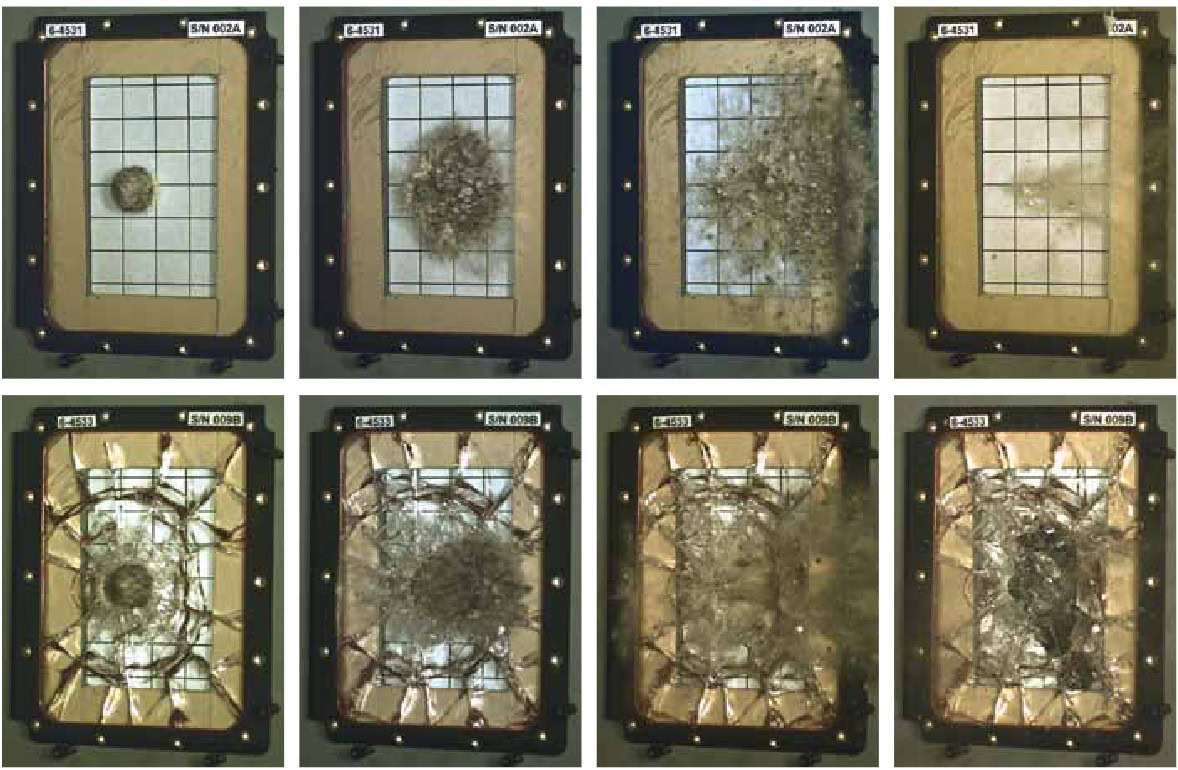
Figure 6. Performance of γ-AlON (upper) and glass (lower) in a simulated rock strike test. The glass tiles experience severe cracking, whereas the γ-AlON remains intact. Credit: Surmet.
Delamination
Delamination brought on by high interlaminar residual stresses and thermal cycling stresses is a significant source of nonballistic failure of transparent armor. Tests show that γ-AlON-based transparent armor delaminates less during thermal cycling tests owing to thinner laminate sections and less thermal expansion mismatch with both the glass and polycarbonate sections. Thus, γ-AlON transparent armor delaminates less than glass-based armor under thermal cycling in field conditions.
Extreme environments
Beyond ballistic properties, γ-AlON transparent armor tolerates vibration, mechanical shock, g-loading, and sudden pressure release. Also, it endures extreme environmental stresses, such as solar radiation, humidity, temperature ranges from –67°F to +185°F, and thermal cycling. A recent study even considered the material for spacecraft windows.4
Table 3 lists other useful properties of transparent polycrystalline spinels that could add to their utility as armor or lead to new applications.
Military applications for transparent ceramics
Military and civilian security forces use transparent armor extensively for ground vehicle protection. Examples of ground vehicles equipped with transparent armor include high-mobility multipurpose wheeled vehicles (“Humvees”) and mine-resistant ambush-protected (MRAP and M-ATV) vehicles and trucks. Although most systems currently use glass-based armor, γ-AlON-based transparent armor is under evaluation for future vehicles because it weighs up to 65 percent less, can sustain multiple strikes, offers increased field-of-view to the driver (less weight means larger windows can be installed), and larger cabin volume (because of thinner panels). In addition, vehicle designers can incorporate γ-AlON’s other properties into systems, such as night vision capability and laser protection.
Some military aircraft need armoring, and for these applications, weight, mechanical integrity, and transparency are of paramount importance. Typical aviation applications include windshields, blast shields, windows for sensor protection, and armored “look-down” windows for helicopters, combat aircraft, and other airborne systems. Most of the property requirements for these applications are similar to those of ground vehicles. However, the optical specifications require a minimum of 70-80 percent transmission and less than 4 percent haze. Transparent γ-AlON-based armor windows that have successfully completed qualification testing and obtained FAA certification are starting to be installed in production commercial armored aircraft and helicopters. More applications are under evaluation, and some applications of polycrystalline transparent ceramics are in the early stages of adoption, such as helicopter, aircraft, and ground vehicle windows.
Several other military optical applications require windows, however, most or these applications are domes or lenses. An important advantage of polycrystalline ceramics over single crystals is that the shapes can be made standard powder-processing techniques, such as pressing, injection molding, slip casting, and cold isostatic pressing.
Optics applications include
- Domes IR-guided missile systems use IR-transparent domes. For example, one of the Joint Air-to-Ground Missile system designs uses tri-mode seeker domes (near IR, MWIR or LWIR, and millimeter wave). Optical-quality γ-AlON and magnesium-spinel ceramics are being evaluated. Designs for an electro-optic defense system under development, the Common Infrared Counter-Measures, also may include mid-IR transparent ceramic hyper-hemispherical domes.
- Reconnaissance and sensor windows Reconnaissance systems with imaging capabilities for surveying and sensing field conditions, such as terrain or heat, have stringent optical requirements. A typical specification for transmitted wavefront uniformity allows less than one-tenth of a wavelength of error over the size of the sensor aperture. Some helicopter-based sensors and aircraft-based targeting pods now have γ-AlON windows installed.
- Night vision systems The current technology NV systems, Generation III, sense signals over wavelength range of 0.4–0.92 micrometers. Transparent γ-AlON-based armor has a high transmission over this wavelength range and has shown 40–50 percent improvement in NV transmittance performance compared with glass armor designed for the same ballistic threat (Figure 2). NV performance is expected to be increasingly important for next-generation systems.
- GRIN optics This new and highly advanced application area for transparent ceramics is still in the development stage. This technology reduces the number, weight, and complexity of optical train components in military systems, such as image systems for laser range finders, NV goggles, and unmanned aerial vehicles.
- Windows for laser communications Transparent windows or domes protect laser systems from the outside world for many airborne laser-based systems, such as laser data links, Counter Manpads (shoulder launched missiles), laser rangefinders, laser target designators, and laser radars. Military optics systems must meet the optical specification for transmitting laser light with high efficiency, low absorption and scatter, and minimal distortion. The extremely high hardness that makes γ-AlON good for ballistic protection also provides field durability for optical components.
- Laser igniter windows At present, high-current electrical pulses ignite the propellant of small- and medium-caliber cannons, but the technology is fraught with problems, such as premature ignition from stray electromagnetic fields and hazardous compositions. Laser ignition may solve some of these issues, and initial tests show that γ-AlON maintains optical and mechanical stability during the high pressures and temperatures experienced with multiple firings.
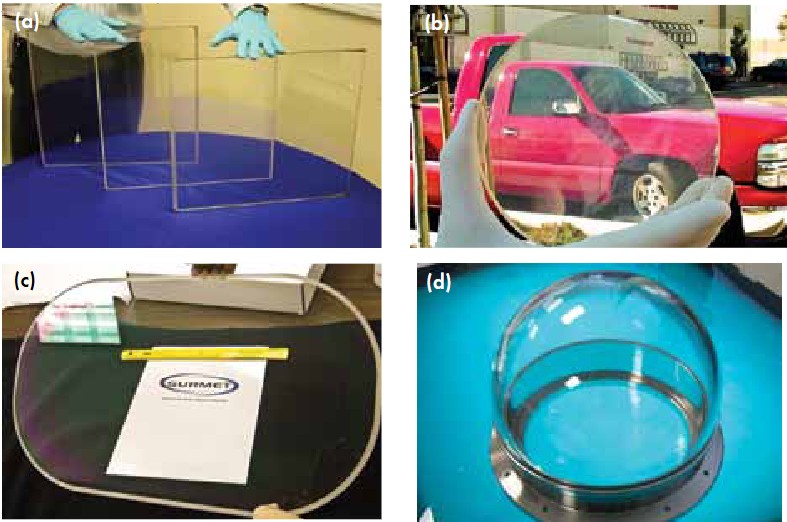
Figure 7. Example transparent polycrystalline ceramics components: (a) γ-AlON panel for armor laminate; (b) magnesium-spinel lens for sensor pod systems; (c) γ-AlON reconnaissance window for aircraft; (d) γ-AlON hyper-hemispherical dome for IR countermeasure systems. Credit: Surmet.
Beyond defense: Nonmilitary applications
Just as defense applications exploit the optical and mechanical properties of γ-AlON and magnesium-spinel, these materials also could solve many nondefense and industrial-materials-related problems. For example, there are energy-related applications for oil and gas drilling, phosphors, LED technology, solid-state lasers, and lamp envelopes. In the medical arena, they can be used for prostheses, scintillator hosts, and medical equipment sensors in the mid-IR transmission range.
Acknowledgement
Sreeram Balasubramanian contributed to this article.
Manufacturing transparent ceramics and components at Surmet
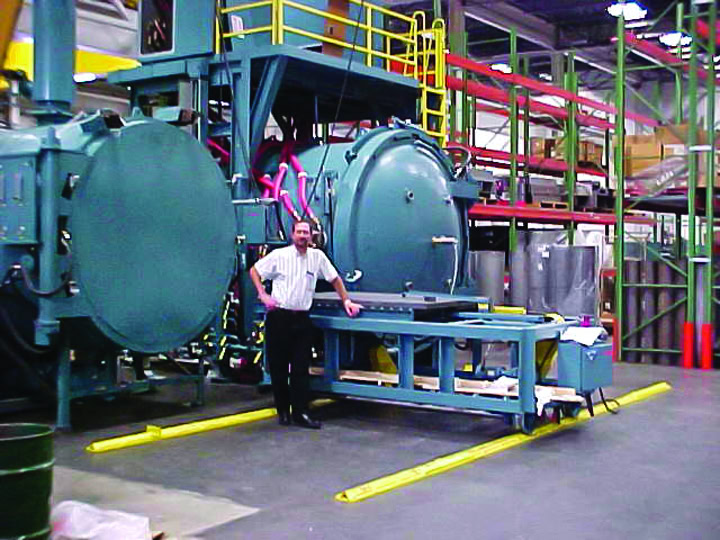
Lee Goldman in front of AlON heat treating furnaces. Credit: Surmet
Surmet was founded in 1982 and entered the advanced ceramics business in 2002 when it licensed and subsequently bought the γ-AlON technology from Raytheon Co. Here are a few of the company’s accomplishments since its founding:
- Powder synthesis. Powder synthesis requires high-temperature furnaces capable of reaching close to 2,000ºC, with atmosphere control and uniform temperature control. Careful blending, crushing, and milling processes all play a role in powder preparation. Over the past 10 years, Surmet has developed processes for manufacturing γ-AlON powders in tonnage quantities.
- Fabrication. Parts larger than about 4 inches by 4 inches are susceptible to fracturing during forming and densification because of considerable shrinkage during sintering. Through careful control of processing protocols, Surmet fabricates parts with areas of several square feet.
- Components. Highlight achievements for Surmet components for military applications include
- Qualified and FAA certified transparent γ-AlON-based armor windows installed in production commercial armored aircraft and helicopter systems;
- γ-AlON windows measuring approximately 14 inches by 25 inches for reconnaissance pods; and
- γ-AlON GRIN lenses with the required gradients (in development with DARPA support). Further work will increase magnitude and size of gradients using materials and processes compatible with large-volume manufacturing.

Related Articles

Market Insights
Next-gen superconducting ceramics could change how we travel and much more
Forty years ago, two physicists from IBM’s research laboratory in Zürich, Switzerland, reported a groundbreaking discovery: Superconductivity, or the quantum mechanical phenomenon in which certain materials exhibit zero electrical resistance when cooled, could be achieved at higher temperatures using ceramics. Superconductivity had been discovered decades before, but its applications had…

Market Insights
Why most AI manufacturing projects fail and how to fix it
Artificial intelligence is reshaping advanced manufacturing, especially processes involving ceramics, glasses, and other hard or brittle materials. But adopting AI is far more difficult than simply buying software and connecting machines. Manufacturers must understand the advantages and limitations of different models, so they can determine where AI fits best within…

Bulletin Features
Radiation effects on rare earth chemistry in molten salts for nuclear applications
Across the nuclear energy sector, molten salts are shaping the next generation of nuclear technologies, from advanced power reactors to used nuclear fuel recycling. In molten salt reactors (MSRs), molten salts uniquely serve as both the primary coolant and fuel medium, a dual role that sets MSRs apart from conventional…