
Today, a dormant volcano in Norway is making its own headlines as the source of Europe’s biggest stash of rare earths. Not to be outdone, Finland has become the first European country with lithium mining capabilities across the entire production cycle. Nordic newsmakers are once again causing global disruption, but this time with advances in mining, energy, construction, and sustainability.
These developments have attracted attention and joint venture partners to the region. In 2024, the Corning Scientific Center relocated to Helsinki to tap into the Finnish capital’s “collaborative business ecosystem, top-tier talent, and strategic fit for R&D.”1 In 2025, Heidelberg Materials launched Brevik CCS, “the world’s first industrial-scale carbon capture and storage facility in the cement industry,” in Norway.2 And on the conference circuit, international participants flocked to Helsinki for the Nordic Forum on Raw Materials3 and the Global Mining Guidelines Group Forum4 earlier in 2026.
The world is discovering that innovation is on brand throughout the Nordic region, and that brand identity is being managed by a consortium of government bodies.
The Nordic Council of Ministers, headquartered in Copenhagen, is the “official body for inter-governmental co-operation” in the region and “seeks common solutions wherever and whenever the countries can achieve more together than by working on their own.” Its vision statement says, “We in the Nordic countries—Denmark, Finland, Iceland, Norway, Sweden, the Faroe Islands, Greenland, and Åland—are determined to lead the way and find good solutions for the future…Our vision is that the Nordic Region will become the most sustainable and integrated region in the world by 2030.”5
A grant program for gamechangers
The Council formed Nordic Innovation to make the region a pioneer in sustainable growth “by promoting entrepreneurship, innovation and competitiveness in Nordic businesses,” according to the organization’s website.6 It oversees three programs in support of its mission: Innovative Solutions for 2030; Nordic Forward: Resilience and Competitiveness for 2050; and Nordic Growth and Capital Attraction.
In July 2026, Nordic Innovation announced funding awards granted to seven projects (from a total applicant pool of 76).7 Among these projects is “Circular Value Chains for Concrete Slab Reuse in the Nordic Region,” which is featured in the “Project Spotlights” bonus content article.
The Nordic Additive Manufacturing Alliance (NAMA) also received a funding award. NAMA is being organized to reduce reliance on global supply chains and ensure that the region develops the additive manufacturing capacity necessary to “secure critical production, respond to disruptions, and scale innovation when it is most needed” and to “create the structures, governance, and shared understanding needed to act collectively rather than nationally.”8
NAMA is a joint venture of Finland’s DIMECC Ltd., which serves as project lead, and the Research Institutes of Sweden, Norwegian Additive Manufacturing Cluster, and Danish AM Hub. NAMA delegates leadership responsibilities based on each country’s national strengths: Sweden in materials and powder production, Finland in industrial implementation and digital design, Denmark in circular business models and innovation hubs, and Norway in maritime and energy applications.
The remaining funding grants can be read about in detail at https://www.nordicinnovation.org/programs. See the directory in the issue PDF for more information about research funding organizations in the Nordic region.
Finland: The home of atomic layer deposition
Atomic layer deposition (ALD), one of the most important thin film growth techniques used today, enables advanced manufacturing of semiconductors, microelectronics, and nanotechnology. Few may realize that this technique was developed by Finnish physicist Tuomo Suntola, an alumnus of Helsinki University of Technology in Espoo, Finland.
Today, researchers at Aalto University (the successor to Helsinki University) continue to push the bounds of ALD usage and development. For example, a team led by Assistant Professor Ville Miikkulainen is dedicated to “improving ALD processes and understanding their chemical reactions—essential for producing energy materials needed for the green transition.”a
References
aJ. Mäntykivi, “Invisible triumph: how a Finnish invention powers modern microelectronics,” Aalto University. Published 22 Sept. 2025.
An EU-wide imperative: Circularity in mining
Across borders and across all industries, emerging solutions must comply with regulations and adhere to sustainability standards established by the European Union, which funds research and innovation through Horizon Europe.
Horizon Europe’s 2021–2027 budget of €93.5 billion (US$106.8 billion) supports projects that address climate change, contribute to achieving the United Nations Sustainable Development Goals, and heighten the EU’s competitiveness and growth. The program’s proposed budget for 2028–2034 is €175 billion (US$199.9 billion).
Sustainable mining strategies (with an emphasis on circularity) are a hot topic in the current round of funding. The subject has attracted so much attention that the second International Circular Hydrometallurgy Symposium was held in Belgium from Sept. 2–4, 2026 (the first was held in 2024). Nordic thinking at the symposium was represented by a trio of speakers.
- Norway: Oluf Bøckman of Glencore Nikkelverk, “Circular chemistry, with hydrometallurgy in the center”
- Finland: Mårten Eriksson of Umicore Battery Materials Finland, “Toward zero-waste pCAM: Circular hydrometallurgy in action”
- Finland: Peik Ekman of Fortum, “On-site electrochemical production of key chemicals for hydrochemical processing of EoW Li-ion batteries”
Below are three examples of Horizon EU projects aiming to transition the mining sector to sustainable, circular practices.
- CICERO, founded to “develop a sustainable and cost-effective processing and refining model for nickel, cobalt, and manganese, and their downstream conversion into ‘made-in-Europe’ NMC materials for Li-ion batteries.”
- EXCEED, whose “multi-metal/mineral, zero-waste mining-and-refining approach adopts a mineral-centric, integrated methodology via the application of a first-of-its-kind predictive and forensic geometallurgy, supported by enhanced in-line characterisation tools and the development of digital twins.”
- LITHOS, which “triggers innovations along the value chain … making it possible to deal with different levels and types of impurities in non-spodumene lithium minerals.” In addition, “LITHOS gives specific attention to closed-loop water systems in the mineral processing (KPI: 90% less water consumption). The overall CO2 emissions of the LITHOS flowsheet will be 50% lower than today’s benchmark.”
Each project is run by a consortium of partners and beneficiaries located throughout Europe. VTT Technical Research Centre of Finland, a self-described “state-owned research, development, and innovation partner for companies and society” headquartered in Espoo, is coordinating the EXCEED and LITHOS projects and is a partner in CICERO.
Inka Orko, VTT’s head of business development in the Materials and Energy business area, says in an ACerS interview that these projects share the objective of developing technologies that remove bottlenecks to implementation of the circular economy. In the case of LITHOS, an equal priority is building “full lithium value chains in Europe, because we have come to realize that we really need to build our resilience in that sense.”
Capitalizing on research to compete globally
In August 2026, VTT announced its new strategic outlook. Its objective is “to start and sustain chain reactions of positive impact,” the enterprise says on its website.9 “We create technology that turns into new products, solutions, startups, and even entire industries. Commercialisation is a way to ensure that research creates real value.”
To promote industrial and national growth, VTT focuses on three pillars. It has identified startups as the heart of its strategy for creating “new international business through innovation.” The second pillar is renewal of established businesses, which VTT says helps “open new directions for growth, accelerate product development, and take technologies from research towards use.”9 Finally, it sees innovation as a means of strengthening Finland’s resilience in areas such as defense, dual-use technologies, and energy systems.
The organization’s work in mining, minerals, and metals encompasses battery technologies, computational material design, industrial 3D printing, industrial circular economy, metals and materials recovery, and powder piloting (Figure 1). In addition, it is the parent organization of Finland’s national metrology institute and national standards laboratory.
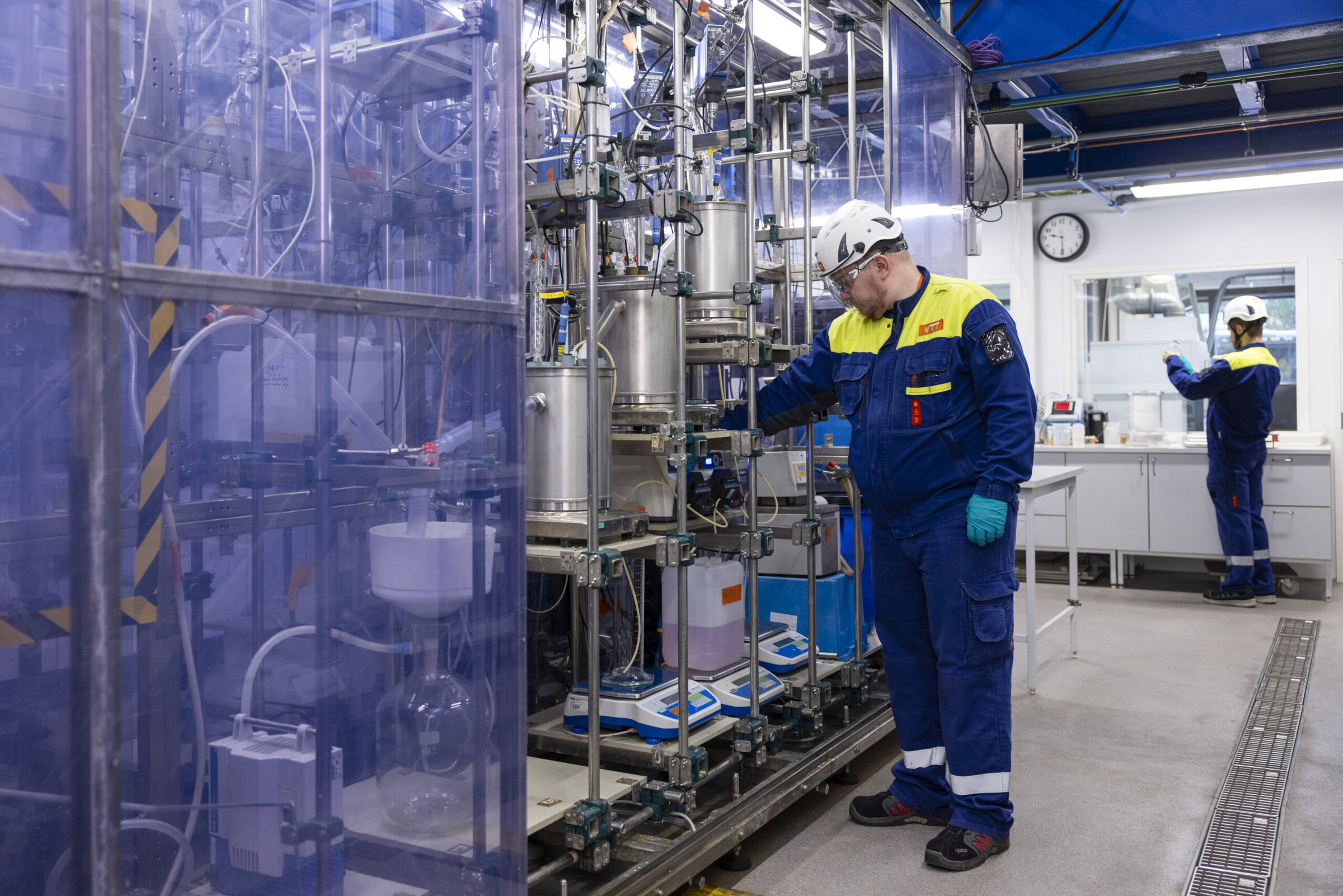
Figure 1. Picture of the VTT Flexmet, a highly customizable piece of equipment for piloting continuous recovery of metals from ores. It is located at VTT’s Bioruukki pilot center in Espoo, Finland. Credit: VTT
VTT’s “beyond the obvious” motto reflects a culture in which teams are not afraid to take chances in research. “You need to experiment with things that are not likely to happen or likely to succeed. There needs to be some risk level,” Orko says. “We also have people who are really meticulous about particular detail. So it’s a big crowd for different kinds of personalities and different mindsets, and I think we need all of that.”
In keeping with national and regional sustainability priorities, VTT focuses on the circular economy. “Recycling is part of the equation. However, we think that recycling alone is not enough because it’s still linear processing,” Orko says. To move beyond that, the enterprise is looking at data-based whole system design that makes it possible to minimize waste and side streams, account for energy use throughout the value chain, and factor in the maintenance and repair cycle. VTT relies on data, modeling, and predictive technologies as tools for extending the useful life of its clients’ products and equipment.
At the same time, it works to integrate circularity into customers’ business models and operations. “Otherwise, we’re just doing academic work, and it’s never going to become mainstream,” Orko says. “To really make the transition, companies need to adopt the technologies but also understand how to utilize the technologies for the benefit of the business.”
Mining Greenland’s untapped resources
The Skaergaard Intrusion is “an iconic, strata-bound PGM-Au-Cu deposit in Southeast Greenland emplaced 56 million years ago during the continental break-up and the opening of the North Atlantic Ocean,” Nasdaq-listed Greenland Mines explains on its website.
Greenland Mines oversees the Skaergaard Project, which holds one of the world’s largest undeveloped deposits of gold, palladium, and platinum. The website notes, “Through a new drilling and development program, Greenland Mines aims to double its resource to ~50 million contained ounces of Au, Pd, and Pt, as well as adding vanadium and gallium to its raw critical metals portfolio.”
On May 20, 2026, the company announced it had signed an acquisition agreement for “the Sarfartoq Project, a carbonatite-hosted rare earths deposit in southwest Greenland with approximately 27 million kg of neodymium oxide and 8 million kg of praseodymium oxide at the ST1 Zone, and a Nd–Pr ratio of 25–40% of total rare earth oxides, among the highest reported globally.” The company closed the acquisition on Sept. 1, 2026.
For more information, visit https://greenlandmines.com.
Making extractives more environmentally friendly
In its work with the metals and minerals sector, VTT pursues strategies for increased efficiency in metals and chemicals recovery along with the development of materials and manufacturing techniques that ensure supply meets industrial demand. Its areas of focus include developing closed-loop material cycles, more efficient processes, new raw materials, and purpose-built materials. The website touts VTT’s R&D support of sustainable mining via 24/7 continuous hydrometallurgy piloting, closed water loops, value from side stream and waste, autonomous and zero-emission mining machinery, and sensing solutions from exploration to processing.
The “social” element of sustainable development in mining is another priority. It can take more than a decade to progress from the exploration phase to the start of mining operations. Orko notes that gaining local community support is key to preserving the project timeline and ensuring that the community feels its concerns about environmental impacts are addressed.
Modeling strategies and circularity objectives also play roles in VTT’s approach to powder piloting, an area that draws on VTT’s three decades of materials research and development. “We do modeling and feed it in into the platform,” Orko says. “Then when we get the processing conditions and different output from the process, we also feed it back into the model. We’re able to have this loop operational because we combine the modeling capabilities and the experimental capabilities.”
The enterprise also looks for opportunities to create products from side stream material. Orko cites the example of using mine tailings in ceramic materials. “We discovered that the strength properties were better in the ceramic material when we were using the mine tailings as raw material, compared to the material that was manufactured from the primary source,” she says. “So, secondary or circular raw material is not necessarily inferior to primary materials.”
Although it operates as an independent technology development organization, VTT also serves as an incubator for spin-off companies formed in response to new patent awards. Orko estimates that 25 such startups have formed in the past decade, and VTT typically retains 10% ownership in those offshoots.
“Hopefully they are able to upscale the technology and become world leaders in their thing,” Orko says. “As a governmental company, our job is to produce those companies, have them change the world, and have them make the big thing out there. Our job is to move on to the next one. We are not a venture capitalist company at all. We are creating the spin-offs for the benefit of Finland, for the benefit of Europe, and for the benefit globally.”
Foreign market intelligence: Data resources to support exploration of cross-border collaboration
In February 2026, the Central Intelligence Agency announced that it had ceased publication of its annual World Factbook after more than 60 years. Companies looking for market opportunities, joint venture partners, or vendors abroad must now find alternatives to this one-stop shop for data and details on a country’s history, geography, people, government, and economy. Here, we offer an overview of available resources.The Federal Reserve Bank of St. Louis created the FRED app, which provides “full access to over 840,000 economic data series from 124 regional, national, and international sources.”
The U.S. Census Bureau maintains an International Trade portal that is “the official source for U.S. export and import statistics.” Resources include the interactive, customizable tool Time Series/Trend Charts.
The U.S. International Trade Administration publishes Country Commercial Guides, which now include Global Digital Economy Reporting.
The World Bank’s annual Business Ready report replaces the “Doing Business In” project, which was discontinued in 2021. The new resource “reflects a more balanced and transparent approach toward evaluating an economy’s business and investment climate” and provides “a quantitative assessment of the business environment.”
The World Trade Organization maintains a Trade Profiles site for access to “key indicators on trade in goods and services for over 190 economies, highlighting the major exports and imports for each economy as well as their main trading partners.”
Read more: “Glaciers and glazes: Iceland’s environment inspires its ceramic arts“
Read more: “Project spotlights: From rare earths to sand batteries to circular concrete, novel Nordic ideas move the needle on sustainability“
Related Articles

Market Insights
Digging into the development of uniform global mining standards
Mining standards and regulations have historically varied by region, nation, or locale, making for a patchwork of guidelines and laws for environmental protection, water and emissions management, proper waste disposal, worker rights, and engagement with Indigenous communities. Multinational mining companies, manufacturers, downstream customers, and socially conscious investors have for years…

Market Insights
Rethinking Arctic research: CIFAR report proposes pathways for the Arctic’s future
Although organized, multinational scientific research in the Arctic has taken place since the late 19th century,1 the past two decades have seen a surge in activity alongside the rapid ecosystem changes (Figure 1).2 Yet these scientific studies are increasingly mired in geopolitical tensions and economic interests,3 which means that scientists…

Market Insights
Global markets for lithium and green mining
The electrification and digitization of modern life drive increased demand for certain minerals, but they also drive the need for more environmentally conscious mining practices. Two recent BCC Research reports investigate the global markets for lithium mining and green mining, respectively. This Bulletin content is for ACerS members and registered…