

The ubiquitous use of smartphones, tablets, bank ATMs, and other touchscreens has increased scientific and public concerns associated with bacteria on the surfaces of these devices. Engineering antimicrobial functionality onto the surface of handheld electronic devices—for example, the cover glass of smartphones—and can address these concerns via bacteria suppression. Doing so requires selecting the appropriate antimicrobial agent, developing an understanding of how to incorporate it into the glass, and how the antimicrobial effect is rendered.
Extensive literature addresses the role of silver in materials as an antimicrobial agent.1-3 (We adopt the generally accepted finding that the Ag1+ ion is the antimicrobial agent. References to silver will be understood to mean the ion unless otherwise noted.) Here we limit our attention to the antimicrobial phenomenon as it occurs in the particular situation of silver-containing glasses. We will focus exclusively on the physical mechanism of the interaction between glass and microbe, rather than the actual biochemical process by which silver causes death.4
The efficacy of antimicrobial action depends on optimization of factors such as disposition of the silver in glass and influence of the ambient environment—in other words, how the silver releases from the glass and is brought into contact with the microbe. This article discusses glass composition, a method of incorporating silver into glass, effective concentration of silver on the surface, and effect of ambient temperature and relative humidity. An overall quantitative kinetic model predicting these factors is developed.
Ion-exchange—Pushing ‘silver bullets’ into glass
Molten salt baths for ion-exchange (IOX) were prepared from reagent grade salts: NaNO3, KNO3, and AgNO3 in baths inside a furnace with temperature capability ranging from 300°C to 450°C. We used AgNO3–alkali nitrate mixed baths rather than pure AgNO3 for reasons of cost, stability against decomposition, and ability to control the desired silver concentration. Selection of the alkali bath to use depends on the specific glass composition so as to maintain silver as the only diffusing species.
Several measurement techniques lend themselves well to characterizing various aspects of the Ag1+ disposition. Electron microprobe (EMP), X ray photoluminescence spectroscopy (XPS), and secondary ion mass spectroscopy (SIMS) techniques measure the depth of ions after the IOX process. Inductively coupled plasma/mass spectroscopy (ICP/MS) quantifies the amount of silver leached from the glass into a fixed amount of water for a given time. In addition, ultraviolet–visible (UV–VIS) spectroscopy measures the relative amounts of Ag1+ in glass from the shift in the UV edge.
The base glass compositions were alkali aluminoborosilicates, and the effective species of silver was Ag1+. The glass composition selected must allow maximal Ag1+ to be incorporated into the glass, while maintaining the desired glass properties, which are determined largely by the specific application.5
In general, Ag1+ behaves in oxide glasses as a network modifier in a similar manner to Na+ or K+.6,7 One approach to maximize the Ag1+ concentration is to melt glass with a high alkali concentration and then substitute Ag1+ for the alkali. Unfortunately, at high concentrations, Ag1+ tends to reduce to metal. The extent to which this happens is a function of the glass composition.8,9 The reduced silver has two adverse effects: It reduces the amount of active Ag1+, and it induces color in the glass, which is an undesired trait for certain applications.
One way to incorporate silver in glass is to add it as a salt to the batch composition. A more efficient method is to IOX Ag1+ for the alkali using a silver-containing molten salt bath.10 IOX costs less because only Ag1+ near the surface participates in the antimicrobial activity. It has the further advantages of lessening the coloring effect and applying to a variety of available commercial glasses, which might be of interest for their desirable thermomechanical properties. However, not all commercial glass compositions are suitable, because good antimicrobial behavior requires other properties, too, as will be explained.
Measuring and modeling silver concentration profile
The antibacterial action produced by silver ions is a “surface effect.” Therefore, a quantitative knowledge of surface Ag1+ concentration, in µg/cm2 or ions/cm2, is critical in ascertaining the effectiveness of antimicrobial action. Silver in the bulk glass below the surface plays no antimicrobial role, because it has no access to bacteria on the surface. Figure 1 shows the EMP profile of silver-ion concentration, expressed as Ag2O wt%, versus depth for IOX glass samples prepared from a 50 wt% AgNO3·50 wt% KNO3 bath.
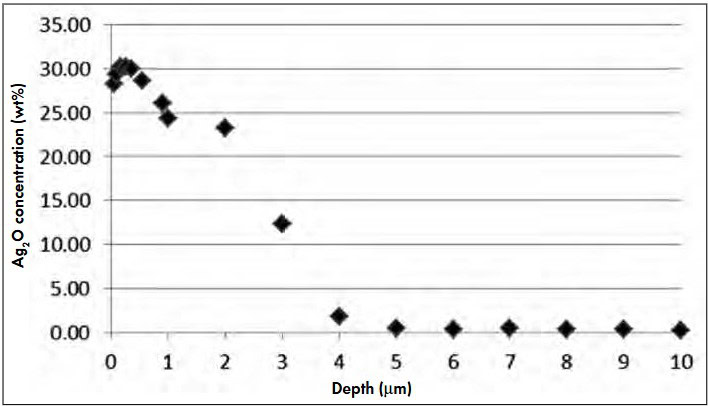
Figure 1. Electron microprobe profile after silver-ion exchange in a 50 wt% AgNO3·50 wt% KNO3 bath for 5 min at 350°C. (Credit: Corning Inc.)
However, the relationship of the steady-state concentration of Ag1+ in the molten bath [e.g., xAgNO3·(1 – x)MNO3, where M is an alkali] to that in the glass is not straightforward. It depends on glass composition and bath composition, that is, whether the IOX of silver is for lithium, sodium, or potassium. The statistical mechanical approach used by Araujo7 provides the basis for developing a model for IOX in this system. We used Araujo’s approach to calculate silver mole fraction in the glass as a function of the mole fraction of silver in the bath for a typical alkali aluminoborosilicate glass. It is important to recognize that this relationship is highly nonlinear and depends on bath constituents and glass composition.
Creating a ‘kill zone’—Role of the hydrated surface layer
To interpret antimicrobial behavior requires understanding the role of ambient environment. Any reaction of the microbe with Ag1+ occurs on the surface, and there must be a liquid vehicle to support both the Ag1+ and the microbe to create a reaction zone. This vehicle is the ubiquitous hydrated layer described in several references as the hydrogen-bonded (chemically adsorbed) and physisorbed water layers.11,12
Saliba et al.,13 measured water layer thickness (number of water layers) as a function of relative humidity using an infrared (IR) measurement of water on a glass surface under controlled relative humidity conditions.
Our understanding of the phenomenon is that moisture on the surface equilibrated from ambient air provides the mediating role. We further assume that Ag1+ near or at the glass surface comes into equilibrium with silver in the hydrated layer, where the interaction with bacteria occurs (Figure 2).
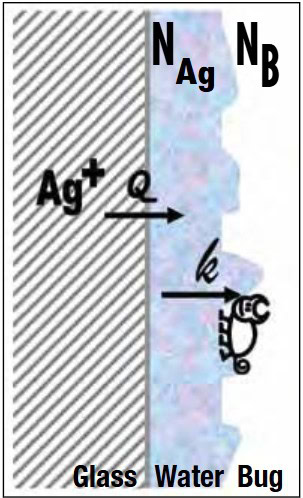
Figure 2. Schematic representation of the interaction of Ag1+ in the hydrated layer with a microbe. NAg represents the concentration of silver that exchanges into the hydrated layer, and Q is the partition function from Eq. (3). NB is the concentration of bacteria, and k is the bacterial growth or death rate constant and varies according to species. (Credit: Corning Inc.)
We estimated how much Ag1+ from glass equilibrates with that in the hydrated layer using a “leaching” approach, where we soaked silver-containing glass in deionized water and measured the amount of silver in the leach solution using ICP/MS detection.
We also had recourse to the Araujo chemical potential model7 to relate the amount of silver in the hydrated layer to that in glass. We now consider the “bath” as the silver-containing glass and the “glass” as the hydrated layer. The goal was to ascertain how glass composition influences phenomena relating to the hydrated layer.
Killing germs—A kinetic model of antimicrobial function
To be useful for touchscreen devices, the antimicrobial property must activate within a practical timeframe. A general kinetic model can help understand the antimicrobial results irrespective of the type of test used, in particular the role of ambient humidity. The proposed model assumes silver interacts with the microbe only in the hydrated layer, where both species are sufficiently mobile. We can ignore diffusion within the layer, although one could easily add the computational terms if required. The model is essentially a kinetic model and accounts for the amount of Ag1+ at the glass surface and in the hydrated layer, and how it interacts with bacteria. Figure 3 shows a typical output of numerical simulation using the mathematical model for factors described in the previous sections to predict the anticipated antimicrobial property of the glass surface. In other words, will silver introduced into the glass ultimately lead to antimicrobial activity? More importantly, what factors control antimicrobial efficacy?
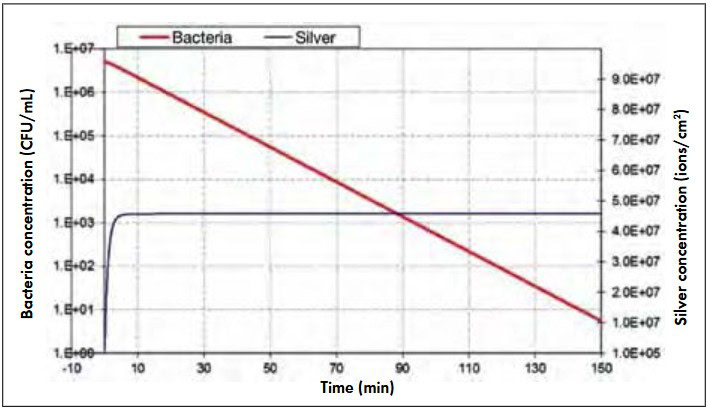
Figure 3. Solution for numerical simulation of the kinetic model for silver-ion concentrations and bacteria levels over a range of times. In this case, relative humidity was 80%. (Credit: Corning Inc.)
The kinetic model incorporates various factors (Ag1+ in glass and the hydrated layer, thickness of the layer, and interaction of the bacteria with Ag+1 in the layer) in a quantitative way to understand antimicrobial activity. To estimate the role of ambient humidity on the antimicrobial efficacy, we modeled a representative example of silver concentration in glass. We then use the hydrated layer thickness as determined by relative humidity.13 Using the model to predict antimicrobial efficacy as a function of relative humidity, Figure 4 shows that efficacy drops rapidly with decreasing relative humidity.
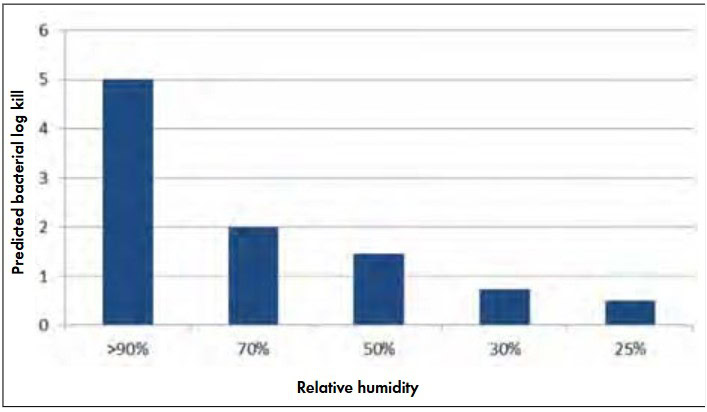
Figure 4. Kinetic model prediction for antimicrobial efficacy as a function of relative humidity. Each “log kill” represents a 90% kill rate, i.e, 10% survival rate. (Credit: Corning Inc.)
The span of time over which antimicrobial function needs to be effective varies widely depending on the application. For example, smartphones have an average lifespan of 21 months, whereas bank automated teller machines could be in service for up to 10 years. An advantage of the kinetic model is that it can be used to predict the lifetime efficacy of glass antimicrobial activity. Figure 5 shows antimicrobial efficacy of a silver-containing antimicrobial glass versus a standard cover glass without antimicrobial functionality. The number of Escherichia coli (E. coli) bacteria, made visible with a fluorescent dye, deposited on the glass surfaces clearly declined on silver-containing antimicrobial glass within two hours, while no perceptible change was observed on standard glass within the same timeframe.
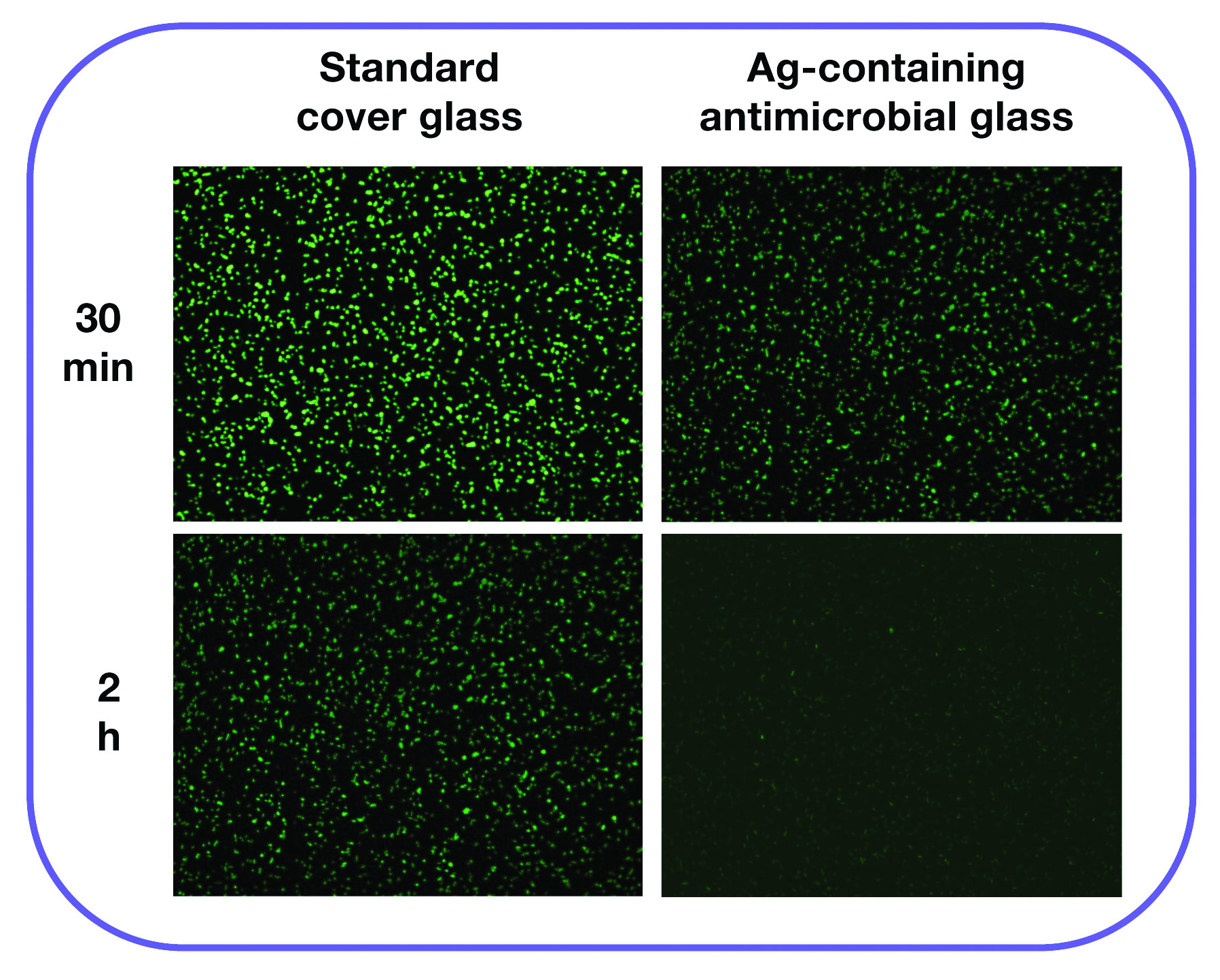
Figure 5. Viability of E. coli bacteria, labeled with a fluorescent dye, on standard and silver-containing antimicrobial cover glasses after 30 min and 2 h. After 4 h the number of bacteria colony-forming units observed fell by more than six orders of magnitude. (Credit: Corning Inc.)
Antimicrobial lifetime refers to the viability of Ag1+ over an extended period of use. Standardized test protocols evaluate antimicrobial surfaces in terms of “bio-burden.”14 There are several versions of bio-burden. What is common to all is the application of inoculum for a given extended period of time, followed by a series of rinses or wipes and then another inoculum exposure and antimicrobial test. We can use the kinetic model to estimate antimicrobial lifetime, including the mathematical term that regenerates Ag1+ from glass.
Summary
Glasses containing silver ions introduced by IOX can produce a viable antimicrobial surface if care is taken to understand the physical and chemical processes that contribute to overall antimicrobial efficacy. To find an optimum set of conditions to maximize antimicrobial efficacy, we must understand each process in some detail. To that end, we modeled the amount of silver in glass from an IOX bath and, ultimately, how much silver ends up on the glass surface in the hydrated layer. We determined that explicit understanding of the role of the hydrated layer and how it relates to the ambient environment is critical to evaluate the specific antimicrobial efficacy. Our model also allowed us to estimate the lifetime of antimicrobial activity as a function of Ag1+ in glass.
Acknowledgements
The authors thank Joseph Schroeder and Advanced Materials and Processing laboratory for sample preparation; Karl Koch for assistance with the kinetic model; Benjamin Hanson (EMP); Elzbieta Bakowska (ICP/MS) in Characterization and Materials Processing for various characterizations; and Gary Calabrese and Prantik Mazumder for helpful discussions and suggestions for the paper.

Related Articles

Market Insights
Next-gen superconducting ceramics could change how we travel and much more
Forty years ago, two physicists from IBM’s research laboratory in Zürich, Switzerland, reported a groundbreaking discovery: Superconductivity, or the quantum mechanical phenomenon in which certain materials exhibit zero electrical resistance when cooled, could be achieved at higher temperatures using ceramics. Superconductivity had been discovered decades before, but its applications had…

Market Insights
Why most AI manufacturing projects fail and how to fix it
Artificial intelligence is reshaping advanced manufacturing, especially processes involving ceramics, glasses, and other hard or brittle materials. But adopting AI is far more difficult than simply buying software and connecting machines. Manufacturers must understand the advantages and limitations of different models, so they can determine where AI fits best within…

Bulletin Features
Radiation effects on rare earth chemistry in molten salts for nuclear applications
Across the nuclear energy sector, molten salts are shaping the next generation of nuclear technologies, from advanced power reactors to used nuclear fuel recycling. In molten salt reactors (MSRs), molten salts uniquely serve as both the primary coolant and fuel medium, a dual role that sets MSRs apart from conventional…