
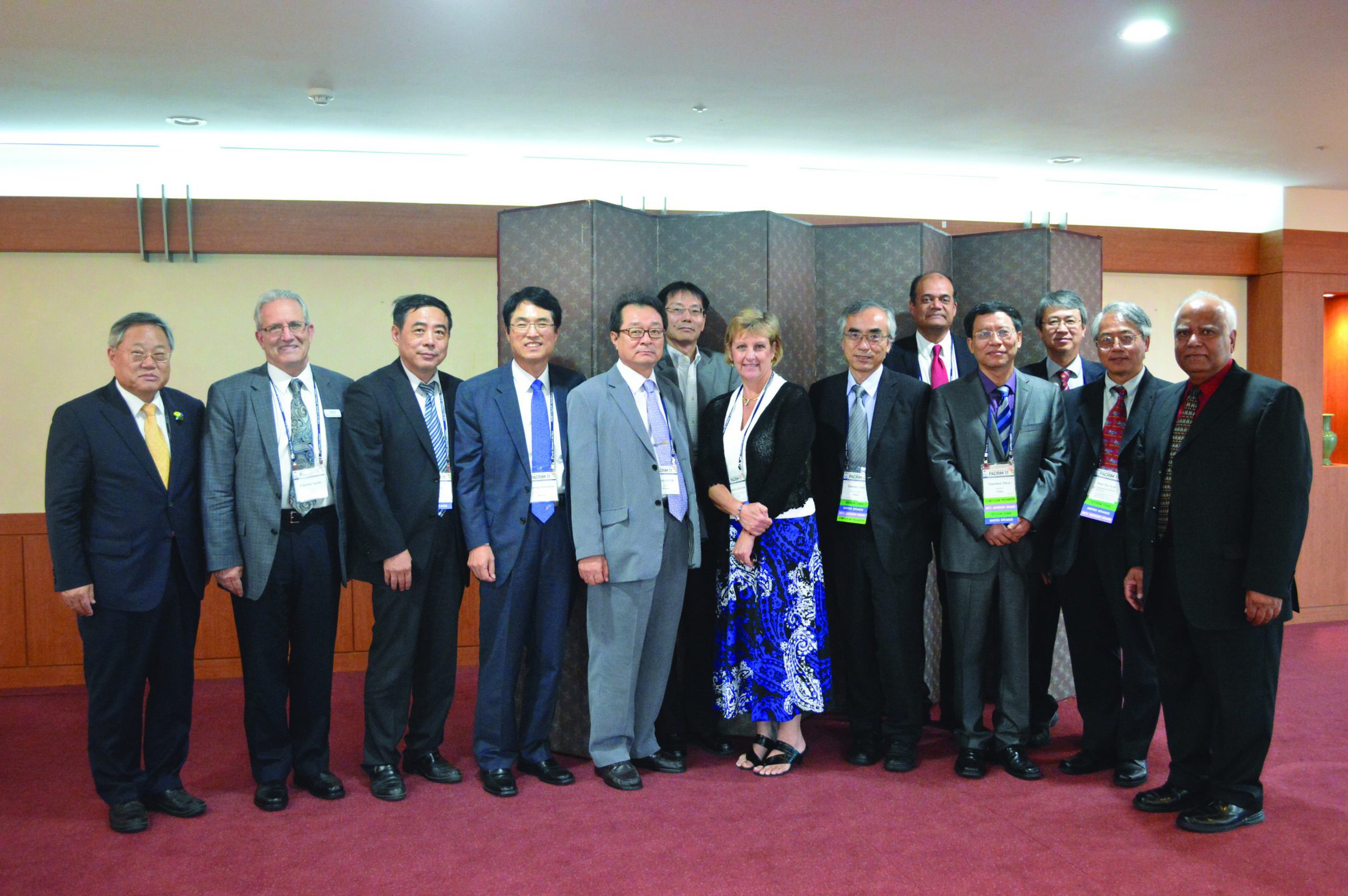
The 11th International Conference of Pacific Rim Ceramic Societies (PACRIM 11) was held on Korea’s Jeju Island Aug. 30–Sept. 4, 2015. Chaired by Hai-Doo Kim, president of the Korea Institute of Materials Science and a Fellow of ACerS, the conference and exhibition were organized by the Korean Ceramic Society with the support of the ceramic societies of Australia, China, Japan, and the U.S.
The umbrella theme of plenary presentations at the conference, “Megatrends: what will come next?,” included the following plenary speakers and their topics:
- Suk-Joong Kang, Korea Advanced Institute of Science and Technology – Grain growth: An enduring subject in materials science and engineering
- Yu Zhou, Harbin Institute of Technology, China – Fabrication, microstructural evolution, and mechanical properties of carbide, nitride, and boride ceramics
- Teruo Kishi, Innovative Structural Materials Association, Japan – Megatrend of materials research and introduction of projects of structural materials in Japan
- Oh-Hun Kwon, Saint-Gobain Northboro R&D Center, U.S. – Living comfortably with multifunctional ceramics: the opportunities and challenges ahead.
Abstracts of plenary presentations are available at pacrim11.org/Plenary_Speakers.php. In addition, dozens of speakers from Asia, Europe, and North America participated in the conference’s 38 symposia, which addressed topics related to multi-scale modeling and simulation; innovative processing and manufacturing; nanotechnology and structural ceramics; multifunctional materials and systems; ceramics for energy and the environment; and ceramics in biology, medicine, and human health.
The conference’s more than 1,000 attendees hailed from more than 30 countries and included some 300 students. ACerS was represented at PACRIM 11 by Kathleen Richardson, president; Mrityunjay Singh, president-elect; Richard Brow, past president; and Charlie Spahr, executive director. Members of ACerS Board of Directors H.T. Lin and Tatsuki Ohji were also at the conference, as well as past BOD members Michael Hoffman, Ivar Reimanis, and Raj Bordia. Mario Affatigato, co-editor of ACerS International Journal of Applied Glass Science, and Dileep Singh, PACRIM 12 chair, represented the ceramics and glass community at the event, among many other attendees from the field.
“The PACRIM collaboration is as strong as ever,” says Spahr. “The Korean Ceramic Society, with Hai-Doo Kim as chair and Young-Wook Kim as technical program chair of PACRIM 11, produced a truly international event in Jeju at a world-class venue. ACerS looks forward to building on the momentum generated here for the next event in 2017.”
The first PACRIM conference was held in Hawaii and hosted by the American Ceramic Society in 1993. Successive conferences have been held in countries throughout the Asia-Pacific region and North America. The conference series has established a strong reputation for state-of-the-art presentation and information exchange on the cutting edge ceramic technologies and have facilitated global dialogue and discussion with leading global experts.
The next conference in the series, PACRIM 12, will be held May 21–26, 2017, at the Hilton Waikoloa Village in Waikoloa, Hawaii. Dileep Singh, who leads the Thermal Management team at Argonne National Laboratory’s Center for Transportation Research, is organizing the conference. Go to ceramics.org/meetings/pacrim12 to sign up to receive PACRIM 12 updates by email.
Return to main article: “Korea’s core competencies“
Related Articles
Bulletin Features
Emerging Professionals: Science for Society & Future Focus
Science for Society articles: Rishabh Kundu and Ryan C. Eaton: “One small tweak to the lens of materials research, one giant leap for mankind” Grace Dunham: “Microwave firing: Inspiring young scientists through rapid ceramic demos” Hossein Libre: “Shaping materials science through policy engagement” Future Focus articles: Kartik Nemani: “Hope and…

Bulletin Features
Emerging Professionals: Research Articles
Experiential learning: Developing the next generation of engineers By Ryan Eaton When a measure becomes a target, it ceases to be a good measure. Goodhart’s law, coined in reference to monetary policy, is readily applicable to engineering education. When students begin optimizing their study habits to pass an exam rather…

Bulletin Features
Durable and programmable metasurfaces enabled by phase change materials
Controlling light with high spatial precision enables technologies ranging from imaging and sensing to communications. Traditionally, optical components such as lenses and filters rely on bulk materials and fixed geometries, which limit their ability to adapt dynamically. Metasurfaces offer a fundamentally different approach. These materials consist of planar arrays of…